Preparation and Properties of Compounds MCQ Questions & Answers in Inorganic Chemistry | Chemistry
Learn Preparation and Properties of Compounds MCQ questions & answers in Inorganic Chemistry are available for students perparing for IIT-JEE, NEET, Engineering and Medical Enternace exam.
11.
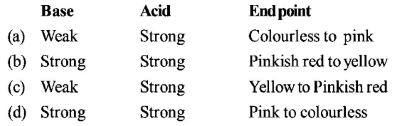
An alkali is titrated against an acid with methyl orange as indicator, which of the following in a correct combination?
A
(a)
B
(b)
C
(c)
D
(d)
Answer :
(c)
$$pH$$ range for methyl orange is
\[\xleftarrow[\text{Pinkish red}]{}3.9-4.5\xrightarrow[\text{Yellow }]{}\]
Generally, weak bases have $$pH$$ greater than 7. When methyl orange is added to a weak base solution, solution becomes yellow. This solution is then titrated by a strong acid and at the end point pH will be less than 3.1.
∴ Solution becomes pinkish red.
12.
In Lassaigne’s test, the organic compound is fused with a piece of sodium metal in order to
A
increase the ionisation of the compound.
B
decrease the melting point of the compound.
C
increase the reactivity of the compound.
D
convert the covalent compound into a mixture of ionic compounds.
Answer :
convert the covalent compound into a mixture of ionic compounds.
To convert covalent compounds into ionic compounds such as $$NaCN,N{a_2}S,NaX,$$ etc.
13.
Lassaigne’s test is used to detect
A
nitrogen
B
sulphur
C
chlorine
D
All of the above
Answer :
All of the above
The detection of chlorine, sulphur and nitrogen in organic compounds is done by Lassaigne’s test.
14.
An organic compound has $$C$$ and $$H$$ percentage in the ratio 6 : 1 and $$C$$ and $$O$$ percentage in the ratio 3 : 4 the compound is
15.
Lassaigne’s test for the detection of nitrogen fails in
A
$$N{H_2}CONHN{H_2} \cdot HCl$$
B
$$N{H_2}N{H_2} \cdot HCl$$
C
$$N{H_2}CON{H_2}$$
D
$${C_6}{H_5}NHN{H_2} \cdot HCl$$
Answer :
$$N{H_2}N{H_2} \cdot HCl$$
Lassaigne’s test is given by only those compounds which contain both carbon and nitrogen. When compounds containing $$C$$ and $$N$$ heated with sodium, then it form $$NaCN$$ which is easily detected by $$FeC{l_3}.$$
Or
Some compounds live hydrazine $$\left( {N{H_2} \cdot N{H_2}} \right)$$ although contain nitrogen but they do not respond Lassaigne’s test because they do not have any
carbon and hence, $$NaCN$$ is not formed.
16.
$$A$$ is a lighter phenol and $$B$$ is an aromatic carboxylic acid. Separation of a mixture of $$A$$ and $$B$$ can be carried out easily by using a solution of
A
sodium hydroxide
B
sodium sulphate
C
calcium chloride
D
sodium bicarbonate
Answer :
sodium bicarbonate
Carboxylic acids are soluble in sodium bicarbonate but phenol are not dissolve in it, so they are separated because carboxylic acid react with $$NaHC{O_3}$$ and form sodium carboxylate.
$$R - COOH + NaHC{O_3} \to $$ $$R - CO{O^ - }N{a^ + } + {H_2}C{O_3}$$
17.
The most suitable method of separation of 1 : 1 mixture of $$ortho$$ and $$para$$ - nitrophenols is
A
sublimation
B
chromatography
C
crystallisation
D
steam distillation
Answer :
steam distillation
Steam distillation is used to purify the substances which
(i) are volatile in steam but are immiscible with water.
(ii) possess sufficiently high vapour pressure at the boiling point of water.
(iii) contain non- volatile impurities.
The process of steam distillation can also be used to separate a mixture of two organic compounds one of which is steam volatile while the other is not.
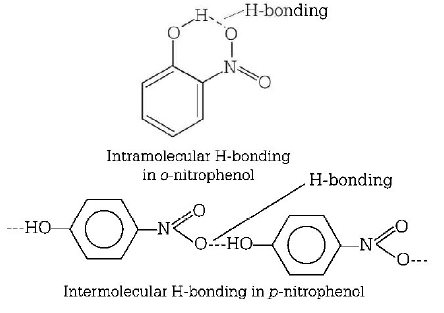
In $$ortho$$ and $$para$$ - nitrophenol, $$ortho$$ - nitrophenol has intramolecular $$H$$ - bonding. So, it has lower boiling point. Intermolecular $$H$$ - Bonding more strong then intramolecular $$H$$ - bonding. Whereas $$para$$ - nitrophenol has intermolecular $$H$$ - bonding. So, it has higher boiling point. Due to difference in boiling points $$ortho$$ and $$para$$ - nitrophenol can be separated from each other by distillation.
18.
$$A$$ is a lighter phenol and $$B$$ is an aromatic carboxylic acid. Separation of mixture of $$A$$ and $$B$$ can be carried out easily by using a solution of
A
sodium hydroxide
B
sodium sulphate
C
calcium chloride
D
sodium bicarbonate
Answer :
sodium bicarbonate
Carboxylic acids dissolve in sodium bicarbonate, while phenol does not.
19.
The Lassaigne’s extract is boiled with $$conc.\,HN{O_3}$$ while testing for halogens. By doing so it
A
helps in the precipitation of $$AgCl$$
B
increases the solubility product of $$AgCl$$
C
increases the concentration of $$NO_3^ - \,ions$$
D
decomposes $$N{a_2}S$$ and $$NaCN,$$ if formed
Answer :
decomposes $$N{a_2}S$$ and $$NaCN,$$ if formed
$$N{a_2}S$$ and $$NaCN,$$ if present in the extract, will be decomposed to $${H_2}S$$ and $$HCN$$ by $$HN{O_3}.$$
$$\eqalign{
& NaCN + HN{O_3} \to NaN{O_3} + HCN \cr
& N{a_2}S + 2HN{O_3} \to 2NaN{O_3} + {H_2}S \cr} $$
These will escape from the solution and will not interfere with the test for halogens.
20.
$$1.25\,g$$ of a sample of $$N{a_2}C{O_3}$$ and $$N{a_2}S{O_4}$$ is dissolved in $$250\,ml$$ solution. $$25\,ml$$ of this solution neutralises $$20\,ml$$ of $$0.1\,N\,{H_2}S{O_4}.$$ The $$\% $$ of $$N{a_2}C{O_3}$$ in this sample is
A
84.8%
B
8.48%
C
15.2%
D
42.4%
Answer :
84.8%
Let the amount of $$N{a_2}C{O_3}$$ present in the mixture be $$x\,g.$$ $$N{a_2}S{O_4}$$ will not react with $${H_2}S{O_4}.$$ Then
$$\eqalign{
& \frac{x}{{53}} = \frac{{20 \times 0.1 \times 10}}{{1000}} \cr
& \therefore \,x = 1.06g \cr
& \therefore \,{\text{Percentage of}}\,N{a_2}C{O_3} \cr
& = \frac{{1.06 \times 100}}{{1.25}} \cr
& = 84.8\% \cr} $$