211. Acetic anhydride reacts with diethyl ether in the presence of anhydrous \[AlC{{l}_{3}}\] to give
A
$$C{H_3}COOC{H_3}$$
B
$$C{H_3}C{H_2}COOC{H_3}$$
C
$$C{H_3}COOC{H_2}C{H_3}$$
D
$$C{H_3}C{H_2}OH$$
Answer :
$$C{H_3}COOC{H_2}C{H_3}$$
212. Phenol is less acidic than
A
ethanol
B
$$o$$ - nitrophenol
C
$$o$$ - methylphenol
D
$$o$$ - methoxyphenol
Answer :
$$o$$ - nitrophenol
213. Conversion of ethyl alcohol into acetaldehyde is an example of
A
hydrolysis
B
oxidation
C
reduction
D
molecular rearrangement
Answer :
oxidation
214.
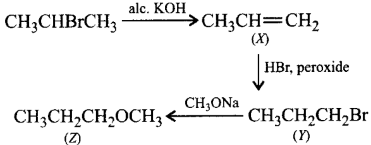
Identify $$X, Y$$ and $$Z$$ in the following sequence of reactions \[C{{H}_{3}}CHBrC{{H}_{3}}\xrightarrow{\text{alc}\text{.}\,KOH}X\] \[\xrightarrow[\text{Peroxide}]{HBr}Y\xrightarrow{C{{H}_{3}}ONa}Z\]
| $$X$$ | $$Y$$ | $$Z$$ | |
|---|---|---|---|
| (a) | $$C{H_3}CH = C{H_2}$$ | $$C{H_3}CH\left( {Br} \right)C{H_2}Br$$ | $$C{H_3}CH\left( {OH} \right)C{H_3}$$ |
| (b) | $$C{H_3}CH = C{H_2}$$ | $$C{H_3}C{H_2}C{H_2}Br$$ | $$C{H_3}C{H_2}OC{H_2}C{H_3}$$ |
| (c) | $$C{H_3}CH = C{H_2}$$ | $$C{H_3}CH\left( {Br} \right)C{H_3}$$ | $$C{H_3}C{H_2}OC{H_2}C{H_3}$$ |
| (d) | $$C{H_3}CH = C{H_2}$$ | $$C{H_3}C{H_2}C{H_2}Br$$ | $$C{H_3}C{H_2}C{H_2}OC{H_3}$$ |
A
(a)
B
(b)
C
(c)
D
(d)
Answer :
(d)
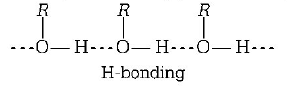
215. Ethanol and dimethyl ether form a pair of functional isomers. The boiling point of ethanol is higher than that of dimethyl ether due to the presence of
A
$$H$$ - bonding in ethanol
B
$$H$$ - bonding in dimethyl ether
C
$$ - C{H_3}$$ group in ethanol
D
$$ - C{H_3}$$ group in dimethyl ether
Answer :
$$H$$ - bonding in ethanol
216.
Which one of the following substituents at $$para$$ - position is most effective in stabilizing the phenoxide 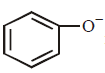 ion ?
ion ?
A
$$ - C{H_3}$$
B
$$ - OC{H_3}$$
C
$$ - COC{H_3}$$
D
$$ - C{H_2}OH$$
Answer :
$$ - COC{H_3}$$
217.
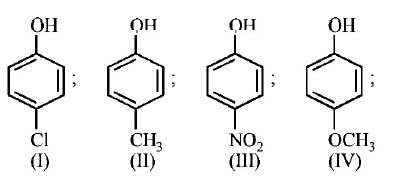
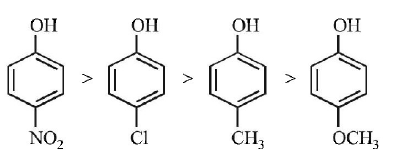
Arrange the following compounds in order of decreasing
acidity :
A
II > IV > I > III
B
I > II > III > IV
C
III > I > II > IV
D
IV > III > I > II
Answer :
III > I > II > IV
218.
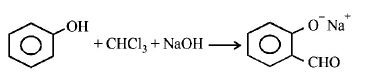
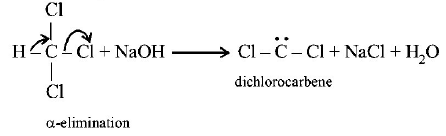
The electrophile involved in the above reaction is
A
trichloromethyl anion \[\left( \overset{\Theta }{\mathop{C}}\,C{{l}_{\text{3}}} \right)\]
B
formyl cation \[\left( \overset{\Theta }{\mathop{C}}\,HO \right)\]
C
dichloromethyl cation \[\left( \overset{\Theta }{\mathop{C}}\,HC{{l}_{2}} \right)\]
D
dichlorocarbene \[\left( CC{{l}_{2}} \right)\]
Answer :
dichlorocarbene \[\left( CC{{l}_{2}} \right)\]
219.
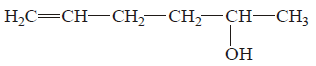
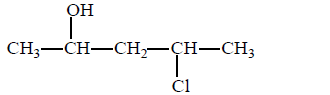
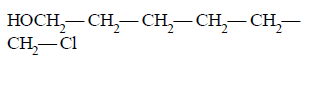
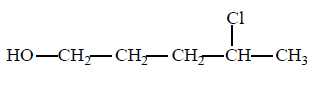
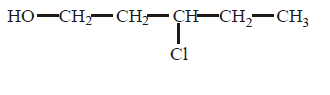
\[\xrightarrow[\text{Pyridine}]{SOC{{l}_{2}}}\left( A \right)\xrightarrow[\left( {{H}_{2}}O \right)]{{{O}_{3}}/Zn}\underset{{{C}_{5}}{{H}_{9}}ClO}{\mathop{\left( B \right)}}\,\xrightarrow{NaB{{H}_{4}}}\left( C \right)\] Compound $$(C)$$ is
A
B
C
D
Answer :
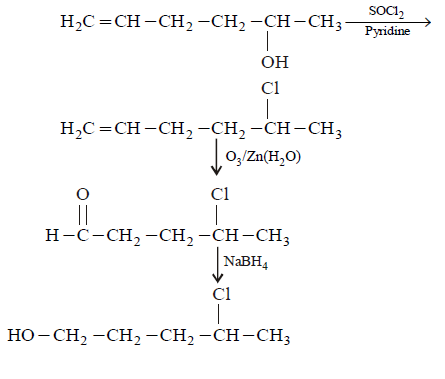
220. Chlorination of toluene in the presence of light and heat followed by treatment with aqueous $$NaOH$$ gives
A
o - Cresol
B
p - Cresol
C
2, 4 - Dihydroxytoluene
D
Benzoicacid
Answer :
Benzoicacid