61. The energy of electron in first energy level is $$ - 21.79 \times {10^{ - 12}}erg$$ per atom. The energy of electron in second energy level is :
A
\[-54.47\times {{10}^{-12}}\,erg\,\,ato{{m}^{-1}}\]
B
\[-5.447\times {{10}^{-12}}erg\,\,ato{{m}^{-1}}\]
C
\[-0.5447\times {{10}^{-12}}erg\,\,ato{{m}^{-1}}\]
D
\[-0.05447\times {{10}^{-12}}erg\,\,ato{{m}^{-1}}\]
Answer :
\[-5.447\times {{10}^{-12}}erg\,\,ato{{m}^{-1}}\]
62. Arrange the electromagnetic radiations $$a, b, c, d$$ and $$e$$ in increasing order of energy. Frequencies of $$a, b$$ and $$c$$ are $${10^{15}},{10^{14}}$$ and $${10^{17}}$$ respectively whereas wavelength of $$(d)$$ and $$(e)$$ are $$350\,nm$$ and $$100\,nm$$ respectively ?
A
$$a,b,c,d,e$$
B
$$a,b,d,e,c$$
C
$$a,d,b,e,c$$
D
$$b,a,d,e,c$$
Answer :
$$b,a,d,e,c$$
63. Among the following groupings which represents the collection of isoelectronic species?
A
$$N{O^ + },C_2^{2 - },O_2^ - ,CO$$
B
$${N_2},C_2^{2 - },CO,NO$$
C
$$CO,N{O^ + },C{N^ - },C_2^{2 - }$$
D
$$NO,C{N^ - },{N_2},O_2^ - $$
Answer :
$$CO,N{O^ + },C{N^ - },C_2^{2 - }$$
64. Which of the following observations was not correct during Rutherford's scattering experiment ?
A
Most of the $$\alpha $$ - particles passed through the gold foil undeflected.
B
A small fraction of the $$\alpha $$ - particles was deflected by small angles.
C
A large number of the $$\alpha $$ - particles were bounced back.
D
A very few $$\alpha $$ - particles $$\left( { \sim 1\,\,{\text{in}}\,\,20,000} \right)$$ were bounced back.
Answer :
A large number of the $$\alpha $$ - particles were bounced back.
65. How many electrons can fit in the orbital for which $$n = 3\,{\text{and}}\,I = 1\,?$$
A
2
B
6
C
10
D
14
Answer :
2
66. Which one is not in agreement with Bohr's model of the atom ?
A
Line spectra of hydrogen atom
B
Pauli's exclusion principle
C
Planck's theory
D
Heisenberg's uncertainty principle
Answer :
Heisenberg's uncertainty principle
67. Electromagnetic radiation with maximum wavelength is :
A
ultraviolet
B
radiowave
C
$$X-$$ray
D
infrared
Answer :
radiowave
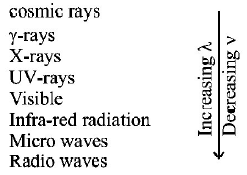
68.
Consider the following sets of quantum numbers.
| $$n$$ | $$l$$ | $$m$$ | $$s$$ | |
| (i) | 3 | 0 | 0 | $$ + \frac{1}{2}$$ |
| (ii) | 2 | 2 | 1 | $$ + \frac{1}{2}$$ |
| (iii) | 4 | 3 | −2 | $$ - \frac{1}{2}$$ |
| (iv) | 1 | 0 | −1 | $$ - \frac{1}{2}$$ |
| (v) | 3 | 2 | 3 | $$ + \frac{1}{2}$$ |
Which of the following sets of quantum number is not possible?
A
(ii), (iii) and (iv)
B
(i), (ii), (iii) and (iv)
C
(ii), (iv) and (v)
D
(i) and (iii)
Answer :
(i) and (iii)
69.
The uncertainty in momentum of an electron is $$1 \times {10^{ - 5}}kg/ms.$$ The uncertainty in its position will be
$$\left( {{\text{Given,}}\,h = 6.62 \times {{10}^{ - 34}}kg\,\,{m^2}/s} \right)$$
A
$$1.05 \times {10^{ - 28}}m$$
B
$$1.05 \times {10^{ - 26}}m$$
C
$$5.27 \times {10^{ - 30}}m$$
D
$$5.25 \times {10^{ - 28}}m$$
Answer :
$$5.27 \times {10^{ - 30}}m$$
70. Which of the following sets of quantum numbers is correct for an electron in $$4f$$ orbital ?
A
$$n = 4,\,l = 3,\,m = + 1,\,s = + \frac{1}{2}$$
B
$$n = 4,\,l = 4,\,m = - 4,\,s = - \frac{1}{2}$$
C
$$n = 4,\,l = 3,\,m = + 4,\,s = + \frac{1}{2}$$
D
$$n = 3,\,l = 2,\,m = - 2,\,s = + \frac{1}{2}$$
Answer :
$$n = 4,\,l = 3,\,m = + 1,\,s = + \frac{1}{2}$$