Solid State MCQ Questions & Answers in Physical Chemistry | Chemistry
Learn Solid State MCQ questions & answers in Physical Chemistry are available for students perparing for IIT-JEE, NEET, Engineering and Medical Enternace exam.
91.
Non-stoichiometric compound have the properties of :
A
Electrical conductance
B
Isolation
C
Insulation
D
None of these
Answer :
None of these
Non-stoichiometric compounds are chemical compounds with an elemental
composition that cannot be represented by a ratio of well-defined natural numbers, and are therefore in violation of the law of definite proportions. They are most often
solids that contain random defects, resulting in the deficiency of one element. So, none of given option is correct.
92.
In $$ABC\,ABC$$ packing, if the number of atoms in the unit cell is $$n$$ then the number of tetrahedral voids in the unit cell is equal to
A
$$n$$
B
$$\frac{n}{2}$$
C
$$\frac{n}{4}$$
D
$$2n$$
Answer :
$$2n$$
Number of tetrahedral voids per atom in a unit cell is 2. Hence, the total number of tetrahedral voids $$= 2n.$$
93.
The radii of $$N{a^ + }$$ and $$C{l^ - }\,ions$$ are $$95\,pm$$ and $$181\,pm$$ respectively. The edge length of $$NaCl$$ unit cell is
A
276$$\,pm$$
B
138$$\,pm$$
C
552$$\,pm$$
D
415$$\,pm$$
Answer :
552$$\,pm$$
In a $$fcc$$ lattice, the distance between the cation and anion is equal to the sum of their radii, which is equal to half of the edge length of unit cell,
$$\eqalign{
& {\text{i}}{\text{.e}}{\text{.}}\,\,{r^ + } + {r^ - } = \frac{a}{2}\,\,{\text{(where }}a = {\text{edge length)}} \cr
& {{\text{r}}^ + } = 95\,pm,\,{r^ - } = 181\,pm \cr
& {\text{Edge length}} \cr
& = 2{r^ + } + 2{r^ - } = \left( {2 \times 95 + 2 \times 181} \right)pm \cr
& = \left( {190 + 362} \right)pm \cr
& = 552\,pm. \cr} $$
94.
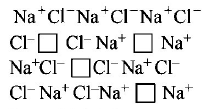
What type of crystal defect is indicated in the diagram below?
A
Interstitial defect
B
Schottky defect
C
Frenkel defect
D
Frenkel and Schottky defects .
Answer :
Schottky defect
When equal number of cations and anions are missing from their regular lattice positions, we have schottky defect. This type of defects are more common in ionic compounds with high co-ordination number and where the size of positive and negative ions are almost equal e.g. $$NaCl$$ $$KCl$$ ete.
95.
If we mix a pentavalent impurity in a crystal lattice of germanium, what type of semiconductor formation will occur?
A
$$p$$-type
B
$$n$$-type
C
Both (A) and (B)
D
Neither (A) nor (B)
Answer :
$$n$$-type
$$n$$ - type, since electron is set free.
96.
$$NaCl$$ type crystal ( with coordination no. 6 : 6 ) can be converted into $$CsCl$$ type crystal ( with coordination no. 8 : 8 ) by applying
A
high temperature
B
high pressure
C
high temperature and high pressure
D
low temperature and low pressure
Answer :
high pressure
Increase of pressure increases coordination number. Hence, by applying high pressure, $$NaCl$$ type crystal can be changed into $$CsCl$$ type crystal.
97.
Which of the following crystals does not exhibit Frenkel defect ?
A
$$AgBr$$
B
$$AgCl$$
C
$$KBr$$
D
$$ZnS$$
Answer :
$$KBr$$
$$KBr$$ ionic solid shows Schottky defect.
98.
Percentages of free space in cubic close packed structure and in body centered packed structure are respectively
A
30% and 26%
B
26% and 32%
C
32% and 48%
D
48% and 26%
Answer :
26% and 32%
Packing fraction is defined as the ratio of the volume of the unit cell that is occupied by the spheres to the volume of the unit cell.
$$P-F.$$ for $$cpp$$ and $$bcc$$ are 0.74 and 0.68 respectively.
So, the free space in $$ccp$$ and $$bcc$$ are 26% & 32% respectively.
99.
To get $$n$$ - type of semiconductor, germanium should be doped with
A
gallium
B
arsenic
C
aluminium
D
boron
Answer :
arsenic
Doping of germanium with arsenic ( or other group-15 element ) gives rise to $$n$$ - type semiconductor.
100.
Which of the following solids is not an electrical conductor ?
$$\eqalign{
& \left( {\text{i}} \right)M{g_{\left( s \right)}} \cr
& \left( {{\text{ii}}} \right)Ti{O_{\left( s \right)}} \cr
& \left( {{\text{iii}}} \right){I_{2\left( s \right)}} \cr
& \left( {{\text{iv}}} \right){H_2}{O_{\left( s \right)}} \cr} $$
A
(i) only
B
(ii) only
C
(iii) and (iv)
D
(ii), (iii) and (iV)
Answer :
(iii) and (iv)
$${I_{2\left( s \right)}}$$ is a non-polar molecular solid and is an insulator. $${H_2}{O_{\left( s \right)}}$$ is a hydrogen bonded molecular solid and is an insulator. $$Mg$$ is metallic solid and is a conductor in solid as well as in molten state. $$TiO$$ is an ionic solid and is an insulator in solid state but is a conductor in molten state and in aqueous solutions.