Solid State MCQ Questions & Answers in Physical Chemistry | Chemistry
Learn Solid State MCQ questions & answers in Physical Chemistry are available for students perparing for IIT-JEE, NEET, Engineering and Medical Enternace exam.
61.
An alloy of copper, silver and gold is found to have cubic lattice in which $$Cu$$ atoms constitute $$ccp.$$ If $$Ag$$ atoms are located at the edge centres and $$Au$$ atom is present at body centre, the alloy will have the formula
A
$$CuAgAu$$
B
$$C{u_4}A{g_4}Au$$
C
$$C{u_4}A{g_3}Au$$
D
$$C{u_4}A{g_6}Au$$
Answer :
$$C{u_4}A{g_3}Au$$
Number of $$Cu$$ -atoms per unit cell
$$ = \frac{1}{8} \times 8 + \frac{1}{2} \times 6 = 4.$$
Number of $$Ag$$ -atoms per unit cell
$$ = \frac{1}{4} \times 12 = 3$$
Number of $$Au$$ -atoms per unit cell $$= 1$$ ( at body centre )
Formula $$:C{u_4}A{g_3}Au$$
62.
Iodine molecules are held in the crystals lattice by ________.
A
London forces
B
dipole-dipole interactions
C
covalent bonds
D
coulombic forces
Answer :
London forces
Iodine $$\left( {{I_2}} \right)$$ is a molecular solid and non polar in nature. Their molecules are held by weak dispersion forces or London forces.
63.
If the radius of an octahedral void is $$r$$ and radius of atoms in close packing is $$R,$$ the relation between $$r$$ and $$R$$ is
A
$$r = 0.414\,R$$
B
$$R = 0.414r$$
C
$$r = 2R$$
D
$$r = \sqrt 2 R$$
Answer :
$$r = 0.414\,R$$
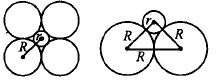
$$\eqalign{
& {\left( {2R} \right)^2} = {\left( {R + r} \right)^2} + {\left( {R + r} \right)^2} \cr
& \sqrt 2 R = R + r\,\,;\left( {\sqrt 2 - 1} \right)R = r \cr
& 0.414R = r \cr} $$
64.
Silver halides generally show
A
Schottky defect
B
Frenkel defect
C
both Frenkel and Schottky defects
D
cation excess defect
Answer :
both Frenkel and Schottky defects
$$AgBr$$ shows Frenkel and Schottky defects because radius ratio of $$AgBr$$ is intermediate. It has rock salt structure i.e., $$fcc$$ or $$ccp$$ lattice $$fo$$ $$Br$$ and $$Ag$$ occupies all the octahedral voids.
65.
What is the coordination number in a square close packed structure in two dimensions ?
A
2
B
3
C
4
D
6
Answer :
4
A sphere in square close packing is in contact with four spheres in two dimensions, so coordination number will be 4.
66.
Crystalline $$CsCl$$ has density $$3.988\,g\,c{m^{ - 3}}.$$ The volume occupied by single $$CsCl$$ $$ion$$ pair in the crystal will be
67.
Total volume of atoms present in a face-centred cubic unit cell of a metal is ( $$r$$ is atomic radius )
A
$$\frac{{12}}{3}\pi {r^3}$$
B
$$\frac{{16}}{3}\pi {r^3}$$
C
$$\frac{{20}}{3}\pi {r^3}$$
D
$$\frac{{24}}{3}\pi {r^3}$$
Answer :
$$\frac{{16}}{3}\pi {r^3}$$
The face centered cubic unit cell contains 4 atom
∴ Total volume of atoms $$ = 4 \times \frac{4}{3}\pi {r^3} = \frac{{16}}{3}\pi {r^3}$$
68.
The density of mercury is $$13.6\,g/mL.$$ The diameter of an atom of mercury assuming that each atom is occupying a cube of edge length equal to the diameter of the mercury atom is approximately
$$\eqalign{
& {N_A} = 6.023 \times {10^{23}} \cr
& {\text{Atomic mass of mercury}} = 200 \cr
& {\text{Number of atoms present in }}200g{\text{ of }}Hg \cr
& = 6.023 \times {10^{23}} \cr
& {\text{So, number of atoms present in }}1g{\text{ of }}Hg \cr
& = \frac{{6.023 \times {{10}^{23}}}}{{200}} \cr
& = 3.0115 \times {10^{21}} \cr
& {\text{Moss of 1 atom}} = \frac{1}{{3.011 \times {{10}^{21}}}}g \cr
& {\text{Density of}}\,\,Hg = 13.6\,g/mL \cr
& \because {\text{Density = }}\frac{{{\text{Mass}}}}{{{\text{Volume}}}} \cr
& \therefore {\text{Volume}} = \frac{{{\text{Mass}}}}{{{\text{density}}}} \cr
& {\text{Volume of 1 atom of mercury }}\left( {Hg} \right) \cr
& = \frac{1}{{3.0115 \times {{10}^{21}} \times 13.6}}mL \cr
& = 2.44 \times {10^{ - 23}}\,mL \cr} $$
As each mercury atom occupies a cube of edge length equal to its diameter, therefore
$$\eqalign{
& {\text{Diameter of 1 mercury atom}} \cr
& = {\left( {2.44 \times {{10}^{ - 23}}} \right)^{\frac{1}{3}}}\,\,cm \cr
& = 2.905 \times {10^{ - 8}}\,cm \cr
& = 2.91\mathop {\text{A}}\limits^{\text{o}} \cr} $$
69.
The radius of a calcium ion is $$94\,pm$$ and of the oxide ion is 146$$\,pm.$$ The possible crystal structure of calcium oxide will be
A
tetrahedral
B
trigonal
C
octahedral
D
pyramidal
Answer :
octahedral
$$\eqalign{
& {\text{As per formula,}} \cr
& {\text{radius ratio}} = \frac{{{\text{radius of cation}}}}{{{\text{radius of anion}}}} \cr
& \,\,\,\,\,\,\,\,\,\,\,\,\,\,\,\,\,\,\,\,\,\,\,\,\,\,\,\,\, = \frac{{94}}{{146}} = 0.643 \cr} $$
Since the value is between 0.414 - 0.732 hence the coordination no. will be 6 and geometry will be octahedral.
70.
Which of the following will have metal deficiency defect ?
A
$$NaCl$$
B
$$FeO$$
C
$$KCl$$
D
$$ZnO$$
Answer :
$$FeO$$
$$FeO$$ is mostly found with a composition of $$F{e_{0.95}}O.$$ In crystals of $$FeO,$$ some $$F{e^{2 + }}$$ cations are missing and the loss of positive charge is made up by the presence of the required number of $$F{e^{3 + }}\,ions.$$