51. Which one of the following salts will have the same value of van’t Hoff factor $$(i)$$ as that of $${K_4}\left[ {Fe{{\left( {CN} \right)}_6}} \right]?$$
A
$$A{l_2}{\left( {S{O_4}} \right)_3}$$
B
$$NaCl$$
C
$$Al{\left( {N{O_3}} \right)_3}$$
D
$$N{a_2}S{O_4}$$
Answer :
$$A{l_2}{\left( {S{O_4}} \right)_3}$$
52. Which of the following has the lowest freezing point?
A
$$0.1\,m\,\,{\text{sucrose}}$$
B
$$0.1\,m\,\,{\text{urea}}$$
C
$$0.1\,m\,\,{\text{ethanol}}$$
D
$$0.1\,m\,\,{\text{glucose}}$$
Answer :
$$0.1\,m\,\,{\text{ethanol}}$$
53. The system that forms maximum boiling azeotrope is
A
acetone - chloroform
B
ethanol - acetone
C
$$n$$-hexane - $$n$$-heptane
D
carbon disulphide - acetone.
Answer :
acetone - chloroform
54. The value of Henry's constant The value of Henry's constant is _____________.
A
greater for gases with higher solubility
B
greater for gases with lower solubility
C
constant for all gases
D
not related to the solubility of gases
Answer :
greater for gases with lower solubility
55.
Arrange the following solutions in increasing order of their osmotic pressures.
(i) 34.2 $$g$$ /litre sucrose
(ii) 60 $$g$$ /litre of urea
(iii) 90 $$g$$ /litre of glucose
(iv) 58.5 $$g$$ /litre of sodium chloride
A
(i) < (iii) < (ii) < (iv)
B
(iii) < (i) < (iv) < (ii)
C
(i) < (iii) < (iv) < (ii)
D
(ii) < (iv) < (i) < (iii)
Answer :
(i) < (iii) < (ii) < (iv)
56. The molecular weight of benzoic acid in benzene as determined by depression in freezing point method corresponds to :
A
ionization of benzoic acid.
B
dimerization of benzoic acid.
C
trimerization of benzoic acid.
D
solvation of benzoic acid.
Answer :
dimerization of benzoic acid.
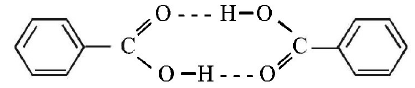
57. The van’t Hoff factor, $$i$$ for a compound which undergoes dissociation in one solvent and association in other solvent is respectively.
A
less than one and less than one
B
greater than one and less than one
C
greater than one and greater than one
D
less than one and greater than one
Answer :
greater than one and less than one
58. The freezing point depression constant for water is $$ - {1.86^ \circ }C\,{m^{ - 1}}.$$ If $$5.00\,g\,N{a_2}S{O_4}$$ is dissolved in $$45.0\,g\,{H_2}O,$$ the freezing point is changed by $$ - {3.82^ \circ }C.$$ Calculate the van't Hoff factor for $$N{a_2}S{O_4}.$$
A
2.63
B
3.11
C
0.381
D
2.05
Answer :
2.63
59. Freezing point of an aqueous solution is $$ - {0.186^ \circ }C.$$ If the values of $${K_b}$$ and $${K_f}$$ of water are respectively $$0.52\,K\,kg\,mo{l^{ - 1}}$$ and $$1.86\,K\,kg\,mo{l^{ - 1}},$$ then the elevation of boiling point of the solution in $$K$$ is
A
0.52
B
1.04
C
1.34
D
0.052
Answer :
0.052
60. If $$\alpha $$ is the degree of dissociation of $$N{a_2}S{O_4},$$ the vant Hoff’s factor $$(i)$$ used for calculating the molecular mass is
A
$$1 + \alpha $$
B
$$1 - \alpha $$
C
$$1 + 2\alpha $$
D
$$1 - 2\alpha $$
Answer :
$$1 + 2\alpha $$