Friction MCQ Questions & Answers in Basic Physics | Physics
Learn Friction MCQ questions & answers in Basic Physics are available for students perparing for IIT-JEE, NEET, Engineering and Medical Enternace exam.
31.
What will be the maximum speed of a car on a road turn of radius $$30\,m,$$ if the coefficient of friction between the tyres and the road is 0.4? (Take $$g = 9.8\,m/{s^2}$$ )
A
$$10.84\,m/s$$
B
$$9.84\,m/s$$
C
$$8.84\,m/s$$
D
$$6.84\,m/s$$
Answer :
$$10.84\,m/s$$
When a vehicle goes round a curved road, it requires some centripetal force. While rounding the curve, the wheels of the vehicle have a tendency to leave the curved path and regain the straight line path. Force of friction between the wheels and the road opposes this tendency of the wheels. This force (of friction) therefore, acts towards the centre of the circular track and provides the necessary centripetal force.
If $$v$$ is the velocity of the vehicle while rounding the curve, the centripetal force required $$ = \frac{{m{v^2}}}{r}$$
As, this force is provided only by the force of friction,
$$\eqalign{
& \frac{{m{v^2}}}{r} \leqslant \mu mg \cr
& \Rightarrow {v^2} \leqslant \mu rg \cr
& \Rightarrow v \leqslant \sqrt {\mu rg} \cr
& \therefore {v_{\max }} = \sqrt {\mu rg} \cr} $$
Here, radius of curved road $$r = 30 m,$$
coefficient of friction $$\mu = 0.04$$
$$\eqalign{
& \therefore {v_{\max }} = \sqrt {0.4 \times 30 \times 9.8} \cr
& = 10.84\,m/s \cr} $$
32.
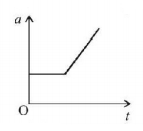
A block is placed on a rough horizontal plane.A time dependent horizontal force $$F = kt$$ acts on the block, where $$k$$ is a positive constant. The acceleration - time graph of the block is :
A
B
C
D
Answer :
Graph (B) correctly depicts the acceleration - time graph of the block.
33.
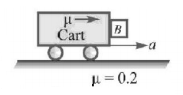
If $$\mu $$ be the coefficient of friction between the block and the cart, horizontal acceleration of the cart that is required to prevent block $$B$$ from falling is:
A
$$\frac{\mu }{g}$$
B
$$\frac{g}{\mu }$$
C
$$g$$
D
$$\left( {{\mu ^2} + 1} \right)g$$
Answer :
$$\frac{g}{\mu }$$
$$\eqalign{
& mg = \mu N = \mu \,ma \cr
& \therefore a = \frac{g}{\mu }. \cr} $$
34.
A block of base $$10cm \times 10cm$$ and height $$15cm$$ is kept on an inclined plane. The coefficient of friction between them is $$\sqrt 3 .$$ The inclination $$\theta $$ of this inclined plane from the horizontal plane is gradually increased from $${0^ \circ }.$$ Then
A
at $$\theta = 30°,$$ the block will start sliding down the plane
B
the block will remain at rest on the plane up to certain $$\theta $$ and then it will topple
C
at $$\theta = 60°,$$ the block will start sliding down the plane and continue to do so at higher angles
D
at $$\theta = 60°,$$ the block will start sliding down the plane and on further increasing $$\theta ,$$ it will topple at certain $$\theta .$$
Answer :
the block will remain at rest on the plane up to certain $$\theta $$ and then it will topple
For the block to slide, the angle of inclination should be equal to the angle of repose, i.e.,
$${\tan ^{ - 1}}\mu = {\tan ^{ - 1}}\sqrt 3 = {60^ \circ }$$
Therefore, option (a) is wrong.
For the block to topple, the condition of the block will be as shown in the figure.
In $$\Delta POM,\tan \theta = \frac{{PM}}{{OM}} = \frac{{5cm{\text{ }}}}{{7.5cm}} = \frac{2}{3}$$
For this, $$\theta < 60°.$$ From this we can conclude that the block will topple at lesser angle of inclination. Thus the block will remain at rest on the plane up to a certain anlgle $$\theta $$ and then it will topple.
35.
A plank with a box on it at one end is gradually raised about the other end. As the angle of inclination with the horizontal reaches $${30^ \circ },$$ the box starts to slip and slides $$4.0\,m$$ down the plank in $$4.0\,s.$$ The coefficients of static and kinetic friction between the box and the plank will be, respectively
A
0.6 and 0.6
B
0.6 and 0.5
C
0.5 and 0.6
D
0.4 and 0.3
Answer :
0.6 and 0.5
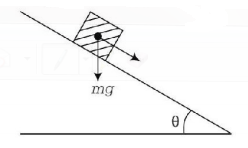
Given a plank with a box on its one end is gradually raised about the end having angle of inclination is $${30^ \circ },$$ the box starts to slip and slides down $$4m$$ the plank in $$4s$$ as shown in figure.
The coefficient of static friction,
$${\mu _s} = \tan {30^ \circ } = \frac{1}{{\sqrt 3 }} = 0.6$$
So, distance covered by a plank,
$$\eqalign{
& s = ut + \frac{1}{2}a{t^2} \cr
& {\text{Here,}}\,u = 0\,{\text{and}}\,a = g\left( {\sin \theta - \mu \cos \theta } \right) \cr
& \therefore \quad 4 = \frac{1}{2}g\left( {\sin {{30}^ \circ } - {\mu _k}\cos {{30}^ \circ }} \right){\left( 4 \right)^2} \cr
& \Rightarrow 0.5 = 10 \times \frac{1}{2} - {\mu _K} \times 10 \times \frac{{\sqrt 3 }}{2} \cr
& \Rightarrow 5\sqrt 3 {\mu _K} = 4.5 \Rightarrow {\mu _K} = 0.51 \cr} $$
Thus, coefficient of kinetic friction between the box and the plank is 0.51.
36.
A system consists of three masses $${m_1},{m_2}$$ and $${m_3}$$ connected by a string passing over a pulley $$P.$$ The mass $${m_1}$$ hangs freely and $${m_2}$$ and $${m_3}$$ are on a rough horizontal table (the coefficient of friction = $$\mu $$ ). The pulley is frictionless and of negligible mass. The downward acceleration of mass $${m_1}$$ is (Assume, $${m_1} = {m_2} = {m_3} = m$$ )
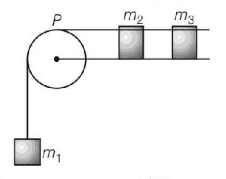
First of all consider the forces on the blocks
For the 1st block $$\left[ {\because {m_1} = {m_2} = {m_3}} \right]$$
$$mg - {T_1} = m \times a\,......\left( {\text{i}} \right)$$
Let us consider 2nd and 3rd block as a system.
$${\text{So,}}\,\,{T_1} - 2\mu mg = 2m \times a\,.......\left( {{\text{ii}}} \right)$$
Solving Eqs. (i) and (ii),
$$ \Rightarrow mg - {T_1} = m \times a \Rightarrow {T_1} - 2\mu mg = 2m \times a$$
Addiing Eqs. (i) and (ii)
$$mg\left( {1 - 2\mu } \right) = 3m \times a \Rightarrow a = \frac{g}{3}\left( {1 - 2\mu } \right)$$
37.
Two identical smooth surfaced solid cylinders of radius $$r$$ are placed touching along their lengths on a horizontal surface. A third cylinder of same material but twice the radius of that of the cylinders is placed lengthwise on them so that the system remains at rest. If all three cylinders have the same length, then minimum value of the coefficient of friction between smaller cylinders and the surface is:
A
$$\frac{1}{{\sqrt 2 }}$$
B
$$\frac{1}{3}$$
C
$$\frac{1}{{3\sqrt 2 }}$$
D
None of these
Answer :
$$\frac{1}{{3\sqrt 2 }}$$
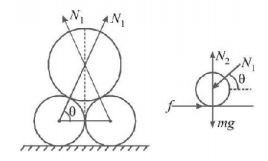
$$\sin \theta = \frac{r}{{3r}} = \frac{1}{3},\cos \theta = \sqrt {\frac{8}{9}} $$
If mass of smaller cylinder is $$m,$$ then mass of bigger one will be $$4m.$$ For the equilibrium of upper cylinder,
$$\eqalign{
& 2{N_1}\sin \theta = 4\,mg \cr
& \therefore {N_1} = \frac{{2mg}}{{\sin \theta }}\,......\left( {\text{i}} \right) \cr} $$
Now for the equilibrium of lower cylinder,
$$\eqalign{
& {N_2} = {N_1}\sin \theta + mg\,......\left( {{\text{ii}}} \right) \cr
& {\text{and}}\,\,f = {N_1}\cos \theta \cr
& {\text{or}}\,\,\mu {N_2} = {N_1}\cos \theta \,......\left( {{\text{iii}}} \right) \cr} $$
After solving above equations, we get
$$\mu = \frac{1}{{3\sqrt 2 }}.$$
38.
It is difficult to move a cycle with brakes on because
A
rolling friction opposes motion on road
B
sliding friction opposes motion on road
C
rolling friction is more than sliding friction
D
sliding friction is more than rolling friction
Answer :
sliding friction is more than rolling friction
When brakes are on, the wheels of the cycle will slide on the road instead of rolling there. It means the sliding friction will come into play instead of rolling friction. The value of sliding friction is more than that of rolling friction.
39.
A car is negotiating a curved road of radius $$R.$$ The road is banked at angle $$\theta .$$ The coefficient of friction between the tyres of the car and the road is $${\mu _s}.$$ The maximum safe velocity on this road is
According to question, a car is negotiating a curved road of radius $$R.$$ The road is banked at angle $$\theta $$ and the coefficient of friction between the tyres of car and the road is $${{\mu _s}}.$$ So, this given situation can be drawn as shown in figure below.
Considering the case of vertical equilibrium
$$\eqalign{
& N\cos \theta = mg + {f_l}\sin \theta \cr
& \Rightarrow mg = N\cos \theta - {f_l}\sin \theta \,......\left( {\text{i}} \right) \cr} $$
Considering the case of horizontal equilibrium,
$$N\sin \theta + {f_1}\cos \theta = \frac{{m{v^2}}}{R}\,......\left( {{\text{ii}}} \right)$$
Divide eqs. (i) and (ii), we get
$$\eqalign{
& \frac{{{v^2}}}{{Rg}} = \frac{{\sin \theta + {\mu _s}\cos \theta }}{{\cos \theta - {\mu _s}\sin \theta }}\,\,\left[ {{f_l} \propto {\mu _s}} \right] \cr
& \Rightarrow v = \sqrt {Rg\left( {\frac{{\sin \theta + {\mu _s}\cos \theta }}{{\cos \theta - {\mu _s}\sin \theta }}} \right)} \cr
& \Rightarrow v = \sqrt {Rg\left( {\frac{{\tan \theta + {\mu _s}}}{{1 - {\mu _s}\tan \theta }}} \right)} \cr} $$