Kinematics MCQ Questions & Answers in Basic Physics | Physics
Learn Kinematics MCQ questions & answers in Basic Physics are available for students perparing for IIT-JEE, NEET, Engineering and Medical Enternace exam.
121.
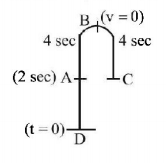
A particle when thrown, moves such that it passes from same height at 2 and 10 seconds, then this height $$h$$ is :
A
$$5\,g$$
B
$$g$$
C
$$8\,g$$
D
$$10\,g$$
Answer :
$$10\,g$$
As the time taken from $$D$$ to $$A = 2\,\sec .$$ and $$D \to A \to B \to C = 10\,\sec \,\left( {{\text{given}}} \right).$$
As ball goes from $$B \to C\left( {u = 0,t = 4\,\sec } \right)$$
$${v_c} = 0 + 4g.$$
As it moves from $$C$$ to $$D,$$ $$s = ut + \frac{1}{2}g{t^2}$$
$$s = 4g \times 2 + \frac{1}{2}g \times 4 = 10\,g.$$
122.
The maximum range of a gun of horizontal terrain is $$16\,km.$$ If $$g = 10\,m{s^{ - 2}},$$ then muzzle velocity of a shell must be
A
$$160\,m{s^{ - 1}}$$
B
$$200\sqrt 2 \,m{s^{ - 1}}$$
C
$$400\,m{s^{ - 1}}$$
D
$$800\,m{s^{ - 1}}$$
Answer :
$$400\,m{s^{ - 1}}$$
Range of projectile is given by
$$R = \frac{{{u^2}\sin 2\theta }}{g}$$
For range to be maximum, angle $$\theta $$ should be of $${45^ \circ }.$$
$$\eqalign{
& \therefore {R_{\max }} = \frac{{{u^2}\sin 2 \times {{45}^ \circ }}}{g} = \frac{{{u^2}\sin {{90}^ \circ }}}{g} \cr
& {\text{or}}\,{R_{\max }} = \frac{{{u^2}}}{g} \cr
& {\text{Here,}}\,{R_{\max }} = \frac{{{u^2}}}{g} = 16\,km = 16000\,m \cr
& {\text{or}}\,u = \sqrt {16000\,g} = \sqrt {16000 \times 10} = 400\,m{s^{ - 1}} \cr} $$
123.
A body covers 26, 28, 30, 32 meters in 10th,11th,12th and 13th seconds respectively. The body starts
A
from rest and moves with uniform velocity
B
from rest and moves with uniform acceleration
C
with an initial velocity and moves with uniform acceleration
D
with an initial velocity and moves with uniform velocity
Answer :
with an initial velocity and moves with uniform acceleration
The distance covered in $$n$$th second is
$${S_n} = u + \frac{1}{2}\left( {2n - 1} \right)a$$
where $$u$$ is Initial velocity $$\& \,a$$ is acceleration
$$\eqalign{
& {\text{then}}\,26 = u + \frac{{19a}}{2}\,......\left( {\text{i}} \right) \cr
& 28 = u + \frac{{21a}}{2}\,......\left( {{\text{ii}}} \right) \cr
& 30 = u + \frac{{23a}}{2}\,......\left( {{\text{iii}}} \right) \cr
& 32 = u + \frac{{25a}}{2}\,......\left( {{\text{iv}}} \right) \cr} $$
From eqs. (i) and (ii) we get
$$u = 7\,m/\sec ,a = 2\,m/{\sec ^2}$$
$$\therefore $$ The body starts with initial velocity $$u = 7\,m/\sec $$
and moves with uniform acceleration $$a = 2m/{\sec ^2}$$
124.
A car of mass $$1000\,kg$$ is moving at a speed of $$30\,m/s.$$ Brakes are applied to bring the car to rest. If the deceleration is $$5\,m/{s^2}$$ the car comes to stop after travelling $$dm$$ in $$ts.$$ Then
A
$$d = 150,t = 5$$
B
$$d = 120,t = 8$$
C
$$d = 180,t = 6$$
D
$$d = 90,t = 6$$
Answer :
$$d = 90,t = 6$$
Given: mass of car $$m = 1000\,kg,u = 30\,m/s;v = 0\,m/s$$
retardation, $$ - a = 5\,m/{s^2}$$
By equation, $${v^2} - {u^2} = 2as$$
$$\eqalign{
& 0 - {\left( {30} \right)^2} = - 2 \times 5 \times d \cr
& \therefore d = \frac{{900}}{{10}} = 90\,m \cr} $$
and $$a = \frac{{v - u}}{t}\therefore t = \frac{{v - u}}{a} = \frac{{0 - 30}}{{ - 5}} = 6s$$
125.
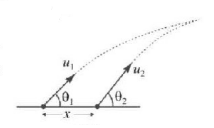
Two particles are projected simultaneously from the level ground as shown in figure. They may collide after a time:
$$\eqalign{
& x + {u_2}\cos {\theta _2}t = {u_1}\cos {\theta _1}t \cr
& \therefore t = \frac{x}{{{u_1}\cos {\theta _1} - {u_2}\cos {\theta _2}}}\,......\left( {\text{i}} \right) \cr} $$
Also $${u_1}\sin {\theta _1} = {u_2}\sin {\theta _2}\,......\left( {{\text{ii}}} \right)$$
After solving above equations, we get
$$t = \frac{{x\sin {\theta _2}}}{{{u_1}\sin \left( {{\theta _2} - {\theta _1}} \right)}}.$$
126.
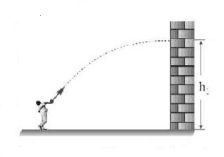
You throw a ball with a $$\vec v = \left( {3\hat i + 4\hat j} \right)m/s$$ towards a wall, where it hits at height $${h_1}.$$ Suppose that the launch velocity were, instead, $$\vec v = \left( {5\hat i + 4\hat j} \right)m/s$$ and $${h_2}$$ is height, then
128.
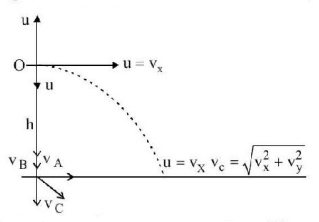
Three particles $$A,B$$ and $$C$$ are thrown from the top of a tower with the same speed. $$A$$ is thrown up, $$B$$ is thrown down and $$C$$ is horizontally. They hit the ground with speeds $${v_A},{v_B}$$ and $${v_C}$$ respectively then,
A
$${v_A} = {v_B} = {v_C}$$
B
$${v_A} = {v_B} > {v_C}$$
C
$${v_B} > {v_C} > {v_A}$$
D
$${v_A} > {v_B} = {v_C}$$
Answer :
$${v_A} = {v_B} = {v_C}$$
For A:
It goes up with velocity $$u$$ will it reaches its maximum height (i.e. velocity becomes zero) and comes back to $$O$$ and attains velocity $$u.$$
Using $${v^2} = {u^2} + 2as \Rightarrow {v_A} = \sqrt {{u^2} + 2gh} $$ For B : going down with velocity $$u$$
$$ \Rightarrow {v_B} = \sqrt {{u^2} + 2gh} $$ For C : horizontal velocity remains same, i.e. $$u.$$
Vertical velocity $$ = \sqrt {0 + 2gh} = \sqrt {2gh} $$
The resultant $${v_C} = \sqrt {v_x^2 + v_y^2} = \sqrt {{u^2} + 2gh} .$$
Hence $${v_A} = {v_B} = {v_C}$$
129.
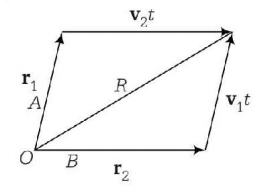
Two particles $$A$$ and $$B,$$ move with constant velocities $${v_1}$$ and $${v_2}.$$ At the initial moment, their position vectors are $${r_1}$$ and $${r_2}$$ respectively. The condition for particles $$A$$ and $$B$$ for their collision is
For two particles $$A$$ and $$B$$ move with constant velocities $${v_1}$$ and $${v_2}.$$ Such that two particles to collide, the direction of the relative velocity of one with respect to other should be directed towards the relative position of the other particle.
i.e. $$\frac{{{r_1} - {r_2}}}{{\left| {{r_1} - {r_2}} \right|}} \to $$ direction of relative position of 1 w.r.t. 2.
Similarly $$\frac{{{v_1} - {v_2}}}{{\left| {{v_1} - {v_2}} \right|}} \to $$ direction of velocity of 2 w.r.t. 1.
So, for collision of $$A$$ and $$B,$$ we get
$$\frac{{{r_1} - {r_2}}}{{\left| {{r_1} - {r_2}} \right|}} = \frac{{{v_2} - {v_1}}}{{\left| {{v_2} - {v_1}} \right|}}$$ Alternate Method
As resultant displacement of a particle,
$$R = {r_1} - {v_1}t = {r_2} - {v_2}t$$
$$\eqalign{
& {\text{i}}{\text{.e}}{\text{.}}\,\,{r_1} - {r_2} = \left( {{v_2} - {v_1}} \right)t \cr
& {\text{So,}}\,\,\frac{{{r_1} - {r_2}}}{{\left| {{r_1} - {r_2}} \right|}} = \frac{{\left( {{v_2} - {v_1}} \right)t}}{{\left| {{v_2} - {v_1}} \right|t}} \cr
& \frac{{{r_1} - {r_2}}}{{\left| {{r_1} - {r_2}} \right|}} = \frac{{\left( {{v_2} - {v_1}} \right)}}{{\left| {{v_2} - {v_1}} \right|}} \cr} $$
130.
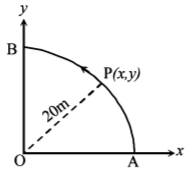
A point $$P$$ moves in counter-clockwise direction on a circular path as shown in the figure. The movement of $$'P\,'$$ is such that it sweeps out a length $$s = {t^3} + 5,$$ where $$s$$ is in metres and $$t$$ is in seconds. The radius of the path is $$20 \,m.$$ The acceleration of $$'P\,'$$ when $$t=2 \,s$$ is nearly.-