Kinematics MCQ Questions & Answers in Basic Physics | Physics
Learn Kinematics MCQ questions & answers in Basic Physics are available for students perparing for IIT-JEE, NEET, Engineering and Medical Enternace exam.
181.
A particle of unit mass undergoes one-dimensional motion such that its velocity varies according to $$v\left( x \right) = \beta {x^{ - 2n}}$$ where, $$\beta $$ and $$n$$ are constants and $$x$$ is the position of the particle. The acceleration of the particle as a function of $$x,$$ is given by
182.
A body is projected vertically upwards with a velocity $$u,$$ after time $$t$$ another body is projected vertically upwards from the same point with a velocity $$v,$$ where $$v < u.$$ If they meet as soon as possible, then choose the correct option
A
$$t = \frac{{u - v + \sqrt {{u^2} + {v^2}} }}{g}$$
B
$$t = \frac{{u - v + \sqrt {{u^2} - {v^2}} }}{g}$$
C
$$t = \frac{{u + v + \sqrt {{u^2} - {v^2}} }}{g}$$
D
$$t = \frac{{u - v + \sqrt {{u^2} - {v^2}} }}{{2g}}$$
Let the two bodies meet each other at a height $$h$$ after time $$T$$ of the projection of second body. Then before meeting, the first body was in motion for time $$\left( {t + T} \right)$$ whereas the second body was in motion for time $$T.$$
The distance moved by the first body in time $$\left( {t + T} \right)$$
$$ = u\left( {t + T} \right) - \frac{1}{2}g{\left( {t + T} \right)^2}.$$
And the distance moved by the second body in time
$$T = vT - \frac{1}{2}g{T^2} = h\,\,\left( {{\text{supposed above}}} \right).\,......\left( 1 \right)$$
$$\because $$ The two bodies meet each other,
$$\therefore $$ They are equidistant from the point of projection.
$$\eqalign{
& {\text{Hence,}}\,\,\,u\left( {t + T} \right) - \frac{1}{2}g{\left( {t + T} \right)^2} = vT - \frac{1}{2}g{T^2} \cr
& {\text{or}}\,\,g{t^2} + 2t\left( {gT - u} \right) + 2\left( {v - u} \right)T = 0\,......\left( 2 \right) \cr} $$
Also from (1) we get,
$$h = vT - \frac{1}{2}g{T^2}$$
$$\therefore \frac{{dh}}{{dT}} = v - gT$$
$$\therefore $$ $$h$$ increases as $$T$$ increases
$$\therefore $$ $$T$$ is minimum when $$h$$ is minimum i.e., when
$$\frac{{dh}}{{dT}} = 0,\,\,{\text{i}}{\text{.e}}{\text{.}}\,{\text{when}}\,\,v - gT = 0\,\,{\text{or}}\,\,T = \frac{v}{g}.$$
Substituting this value of $$T$$ in (2), we get
$$\eqalign{
& g{t^2} + 2t\left( {v - u} \right) + 2\left( {v - u} \right)\left( {\frac{v}{g}} \right) = 0 \cr
& {\text{or}}\,\,t = \frac{{2g\left( {u - v} \right) + \sqrt {4{g^2}{{\left( {u - v} \right)}^2} + 8v{g^2}\left( {u - v} \right)} }}{{2{g^2}}} \cr
& {\text{or}}\,\,t = \frac{{u - v + \sqrt {{u^2} - {v^2}} }}{g} \cr} $$
neglecting the negative sign which gives negative value of $$t.$$
183.
A particle moves a distance $$x$$ in time $$t$$ according to the equation $$x = {\left( {t + 5} \right)^{ - 1}}.$$ The acceleration of particle is proportional to
A
$${\left( {{\text{velocity}}} \right)^{\frac{3}{2}}}$$
B
$${\left( {{\text{distance}}} \right)^2}$$
C
$${\left( {{\text{distance}}} \right)^{ - 2}}$$
D
$${\left( {{\text{velocity}}} \right)^{\frac{2}{3}}}$$
Given, distance $$x = {\left( {t + 5} \right)^{ - 1}}......\left( {\text{i}} \right)$$
Differentiating Eq. (i) w.r.t. $$t,$$ we get
$$\frac{{dx}}{{dt}} = \left( v \right) = \frac{{ - 1}}{{{{\left( {t + 5} \right)}^2}}}\,......\left( {{\text{ii}}} \right)$$
Again, differentiating Eq. (ii) w.r.t. $$t,$$ we get
$$\frac{{{d^2}x}}{{d{t^2}}} = \left( a \right) = \frac{2}{{{{\left( {t + 5} \right)}^3}}}\,......\left( {{\text{iii}}} \right)$$
Comparing Eqs. (ii) and (iii), we get $$\left( a \right) \propto {\left( v \right)^{\frac{3}{2}}}$$
184.
Which of the following is not a vector quantity ?
A
Speed
B
Velocity
C
Torque
D
Displacement
Answer :
Speed
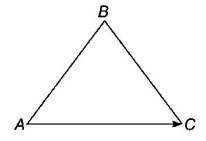
Speed is a scalar quantity. It gives no idea about the direction of motion of the object. Velocity is a vector quantity, as it has both magnitude and direction. Displacement is a vector as it possesses both magnitude and direction. When an object goes on the path $$ABC$$ (in figure), then the displacement of the object is $$AC.$$ The arrow head at $$C$$ shows that the object is displaced from $$A$$ to $$C.$$
Torque is turning effect of force which is a vector quantity.
185.
A cricket ball thrown across a field is at heights $${h_1}$$ and $${h_2}$$ from point of projection at times $${t_1}$$ and $${t_2}$$ respectively after the throw. The ball is caught by a fielder at the same height as that of projection. The time of flight of the ball in this journey is
A
$$\frac{{{h_1}t_2^2 - {h_1}t_1^2}}{{{h_1}{t_2} - {h_2}{t_1}}}$$
B
$$\frac{{{h_1}t_2^2 + {h_1}t_1^2}}{{{h_1}{t_2} + {h_2}{t_1}}}$$
C
$$\frac{{{h_1}{t_2}}}{{{h_2}{t_1} - {h_1}{t_2}}}$$
187.
What is the linear velocity, if angular velocity vector $$\omega = 3\hat i - 4\hat j + \hat k$$ and position vector $$r = 5\hat i - 6\hat j + 6\hat k?$$
188.
A metro train starts from rest and in $$5s$$ achieves $$108\,km/h.$$ After that it moves with constant velocity and comes to rest after travelling $$45\,m$$ with uniform retardation. If total distance travelled is $$395\,m,$$ find total time of travelling.
A
$$12.2\,s$$
B
$$15.3\,s$$
C
$$9\,s$$
D
$$17.2\,s$$
Answer :
$$17.2\,s$$
Given : $$u = 0,t = 5\,\sec ,v = 108\,km/hr = 30\,m/s$$
By equation of motion $$v = u + at$$
$$\eqalign{
& {\text{or}}\,\,a = \frac{v}{t} = \frac{{30}}{5} = 6\,m/{s^2}\left[ {\because u = 0} \right] \cr
& {S_1} = \frac{1}{2}a{t^2} = \frac{1}{2} \times 6 \times {5^2} = 75\,m \cr} $$
Distance travelled in first $$5\,\sec $$ is $$75\,m.$$
Distance travelled with uniform speed of $$30\,m/s$$ is $${S_2}$$
$$\eqalign{
& 395 = {S_1} + {S_2} + {S_3} \Rightarrow 395 = 75 + {S_2} + 45 \cr
& \Rightarrow {S_2} = 275\,m \cr} $$
Time taken to travel $$275\,m = \frac{{275}}{{30}} = 9.2\,\sec $$
For retarding motion, we have
$$\eqalign{
& {0^2} - {32^2} = 2\left( { - a} \right) \times 45,\,{\text{we}}\,{\text{get}}\,a = 10\,m/{s^2} \cr
& S = ut + \frac{1}{2}a{t^2} \Rightarrow 45 = 30t + \frac{1}{2}\left( { - 10} \right){t^2} \cr
& \Rightarrow 45 = 30t - 5{t^2} \cr} $$
On solving we get, $$t = 3\,\sec $$
Total time taken $$ = 5 + 9.2 + 3 = 17.2\,\sec .$$
189.
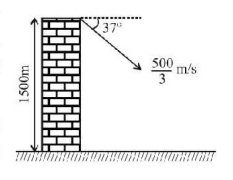
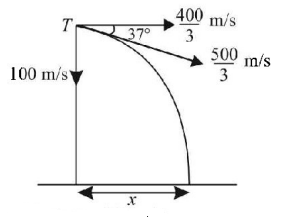
A particle is projected from a tower as shown in figure, then the distance from the foot of the tower where it will strike the ground will be
190.
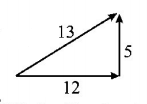
If the magnitudes of vectors $$\overrightarrow A ,\overrightarrow B $$ and $$\overrightarrow C $$ are 12, 5 and 13 units respectively and $$\overrightarrow A + \overrightarrow B = \overrightarrow C ,$$ the angle between vectors $$A$$ and $$B$$ is: