211. If $$\vec A = \vec B - \vec C,$$ then, the angle between $${\vec A}$$ and $${\vec B}$$ is
A
$${\tan ^{ - 1}}\frac{{{B^2} + {A^2} - {C^2}}}{{2AB}}$$
B
$${\sin ^{ - 1}}\frac{{{B^2} + {A^2} - {C^2}}}{{2AB}}$$
C
$${\cos ^{ - 1}}\frac{{{A^2} + {B^2} - {C^2}}}{{2AB}}$$
D
$${\sec ^{ - 1}}\frac{{{A^2} + {B^2} - {C^2}}}{{2AB}}$$
Answer :
$${\cos ^{ - 1}}\frac{{{A^2} + {B^2} - {C^2}}}{{2AB}}$$
212. It is given that $$t = p{x^2} + qx,$$ where $$x$$ is displacement and $$t$$ is time. The acceleration of particle at origin is
A
$$ - \frac{{2p}}{{{q^3}}}$$
B
$$ - \frac{{2q}}{{{p^3}}}$$
C
$$\frac{{2p}}{{{q^3}}}$$
D
$$\frac{{2q}}{{{p^3}}}$$
Answer :
$$ - \frac{{2p}}{{{q^3}}}$$
213.
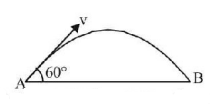
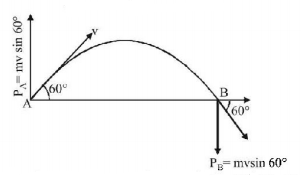
A projectile of mass $$m$$ is thrown with a velocity $$v$$ making an angle $${60^ \circ }$$ with the horizontal. Neglecting air resistance, the change in velocity from the departure $$A$$ to its arrival at $$B,$$ along the vertical direction is
A
$$2v$$
B
$$\sqrt 3 v$$
C
$$v$$
D
$$\frac{v}{{\sqrt 3 }}$$
Answer :
$$\sqrt 3 v$$
214.
A particle is moving such that its position co-ordinates $$\left( {x,y} \right)$$ are $$\left( {2m,3m} \right)$$ at time $$t = 0,\,\left( {6m,7m} \right)$$ at time $$t = 2\,s$$ and $$\left( {13m,14m} \right)$$ at time $$t = 5\,s.$$
Average velocity vector $$\left( {{v_{av}}} \right)$$ from $$t = 0$$ to $$t = 5\,s$$ is
A
$$\frac{1}{5}\left( {13\hat i + 14\hat j} \right)$$
B
$$\frac{7}{3}\left( {\hat i + \hat j} \right)$$
C
$$2\left( {\hat i + \hat j} \right)$$
D
$$\frac{{11}}{5}\left( {\hat i + \hat j} \right)$$
Answer :
$$\frac{{11}}{5}\left( {\hat i + \hat j} \right)$$
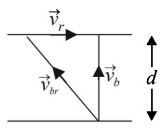
215. A boat which has a speed of $$5 km/hr$$ in still water crosses a river of width $$1 \,km$$ along the shortest possible path in $$15 \,minutes.$$ The velocity of the river water in $$km/hr$$ is-
A
1
B
3
C
4
D
$$\sqrt {41} $$
Answer :
3
216. A body starts from rest, what is the ratio of the distance travelled by the body during the 4th and 3rd $$s$$ ?
A
$$\frac{7}{5}$$
B
$$\frac{5}{7}$$
C
$$\frac{7}{3}$$
D
$$\frac{3}{7}$$
Answer :
$$\frac{7}{5}$$
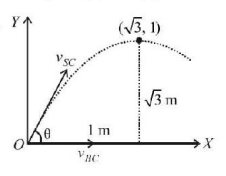
217. A boy is standing on a cart moving along $$x$$-axis with the speed of $$10\,m/s.$$ When the cart reaches the origin he throws a stone in the horizontal $$x-y$$ plane with the speed of $$5\,m/s$$ with respect to himself at an angle $$\theta $$ with the $$x$$-axis. It is found that the stone hits a ball lying at rest at a point whose co-ordinates are $$\left( {\sqrt 3 m,1m} \right).$$ The value of $$\theta $$ is (gravitational effect is to be ignored)
A
$${30^ \circ }$$
B
$${60^ \circ }$$
C
$${90^ \circ }$$
D
$${120^ \circ }$$
Answer :
$${30^ \circ }$$
218.
Consider a rubber ball freely falling from a height $$h = 4.9\,m$$ onto a horizontal elastic plate. Assume that the duration of collision is negligible and the collision with the plate is totally elastic.
Then the velocity as a function of time and the height as a function of time will be:
A
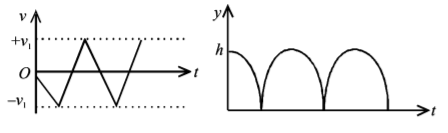
B
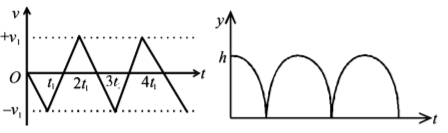
C
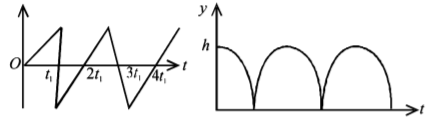
D
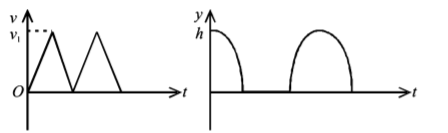
Answer :
219.
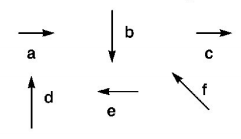
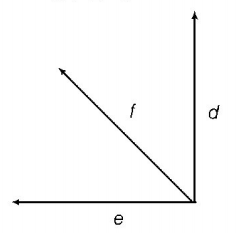
Six vectors $$a$$ to $$f$$ have the magnitudes and directions indicated in the figure. Which of the following statements is true?
A
$$b + c = f$$
B
$$d + c = f$$
C
$$d + e = f$$
D
$$b + e = f$$
Answer :
$$d + e = f$$
220. A body is thrown upwards and reaches half of its maximum height. At that position
A
its acceleration is minimum
B
its velocity is maximum
C
its velocity is zero
D
its acceleration is constant
Answer :
its acceleration is constant