Kinematics MCQ Questions & Answers in Basic Physics | Physics
Learn Kinematics MCQ questions & answers in Basic Physics are available for students perparing for IIT-JEE, NEET, Engineering and Medical Enternace exam.
321.
A projectile can have the same range $$'R\,'$$ for two angles of projection. If $$'{T_1}'$$ and $$'{T_2}'$$ to be time of flights in the two cases, then the product of the two time of flights is directly proportional to.
A
$$R$$
B
$$\frac{1}{R}$$
C
$$\frac{1}{{{R^2}}}$$
D
$${R^2}$$
Answer :
$$R$$
The angle for which the ranges are same is complementary.
Let one angle be $$\theta ,$$ then other is $${90^ \circ } - \theta $$
$$\eqalign{
& {T_1} = \frac{{2u\,\sin \theta }}{g},\,\,\,{T_2} = \frac{{2u\,\cos \theta }}{g} \cr
& {T_1}{T_2} = \frac{{4{u^2}\,\sin \theta \cos \theta }}{g} = 2R\,\,\,\left( {\because R = \frac{{{u^2}{{\sin }^2}\theta }}{g}} \right) \cr} $$
Hence it is proportional to $$R.$$
322.
Find the torque of a force $$F = - 3\hat i + \hat j + 5\hat k$$ acting at the point $$r = 7\hat i + 3\hat j + \hat k.$$
A
$$ - 21\hat i + 3\hat j + 5\hat k$$
B
$$ - 14\hat i + 3\hat j - 16\hat k$$
C
$$4\hat i + 4\hat j + 6\hat k$$
D
$$14\hat i - 38\hat j + 16\hat k$$
Answer :
$$14\hat i - 38\hat j + 16\hat k$$
Given, $$r = 7\hat i + 3\hat j + \hat k,F = - 3\hat i + \hat j + 5\hat k$$
$$\therefore \tau = r \times F = \left| r \right|\left| F \right|\sin \theta $$
where, $$\theta $$ is the angle between $$r$$ and $$F$$
$$ = \left( {7\hat i + 3\hat j + \hat k} \right) \times \left( { - 3\hat i + \hat j + 5\hat k} \right)$$
\[ = \left| {\begin{array}{*{20}{c}}
{\hat i}&{\hat j}&{\hat k}\\
7&3&1\\
{ - 3}&1&5
\end{array}} \right| = \hat i\left( {15 - 1} \right) - \hat j\left( {35 + 3} \right) + \hat k\left( {7 + 9} \right)\]
$$ = 14\hat i - 38\hat j + 16\hat k$$ Alternative
$$\eqalign{
& \therefore \tau = r \times F \cr
& = \left( {7\hat i + 3\hat j + \hat k} \right) \times \left( { - 3\hat i + \hat j + 5\hat k} \right) \cr
& = - 21\left( {\hat i \times \hat i} \right) + 7\left( {\hat i \times \hat j} \right) + 35\left( {\hat i \times \hat k} \right) - 9\left( {\hat j \times \hat i} \right) + 3\left( {\hat j \times \hat j} \right) + 15\left( {\hat j \times \hat k} \right) - 3\left( {\hat k \times \hat i} \right) + \left( {\hat k \times \hat j} \right) + 5\left( {\hat k \times \hat k} \right) \cr
& = 0 + 7\hat k - 35\hat j + 9\hat k + 0 + 15\hat i - 3\hat j - 1 + 0 \cr
& = 14\hat i - 38\hat j + 16\hat k \cr} $$
323.
A bullet is fired with a speed of $$1500\,m/s$$ in order to hit a target $$100\,m$$ away. If $$g = 10\,m/{s^2}.$$ The gun should be aimed
A
$$15\,cm$$ above the target
B
$$10\,cm$$ above the target
C
$$2.2\,cm$$ above the target
D
directly towards the target
Answer :
$$2.2\,cm$$ above the target
The bullet performs a horizontal journey of $$100\,cm$$ with constant velocity of $$1500\,m/s.$$ The bullet also performs a vertical journey of $$h$$ with zero initial velocity and downward acceleration $$g.$$
$$\therefore $$ For horizontal journey, time $$\left( t \right) = \frac{{{\text{Distance}}}}{{{\text{Velocity}}}}$$
$$\therefore t = \frac{{100}}{{1500}} = \frac{1}{{15}}\sec \,......\left( 1 \right)$$
The bullet performs vertical journey for this time.
For vertical journey, $$h = ut + \frac{1}{2}g{t^2}$$
$$\eqalign{
& h = 0 + \frac{1}{2} \times 10 \times {\left( {\frac{1}{{15}}} \right)^2} \cr
& {\text{or,}}\,\,h = \frac{{20}}{9}cm = 2.2\,cm \cr} $$
324.
A body is thrown upwords. If air resistance causing deceleration of $$5\,m/{s^2},$$ then ratio of time of ascent to time of descent is [take $$g = 10\,m/{s^2}$$ ]
326.
A stone is thrown vertically upwards. When stone is at a height half of its maximum height, its speed is $$10\,m/s,$$ then the maximum height attained by the stone is $$\left( {g = 10\,m/{s^2}} \right)$$
A
$$8\,m$$
B
$$10\,m$$
C
$$15\,m$$
D
$$20\,m$$
Answer :
$$10\,m$$
Let $$u$$ be the initial velocity and $$H$$ be the maximum height attained.
$$\eqalign{
& {\text{At height }}h = \frac{H}{2},\,{\text{we have }}v = {v_1}\, = 10\,m/s \cr
& {\text{From third equation of motion, }}v_1^2 = {u^2} - 2gh\left( {{\text{Negative sign indicates that velocity and acceleration are in opposite direction}}} \right) \cr
& {\text{or}}\,{\left( {10} \right)^2} = {u^2} - 2g\frac{H}{2}\,......\left( {\text{i}} \right) \cr
& {\text{At}}\,{\text{height}}\,H,\,{v_2} = 0 \cr
& v_2^2 = {u^2} - 2gH\,\,{\text{or}}\,\,0 = {u^2} - 2gH\,......\left( {{\text{ii}}} \right) \cr
& {\text{Subtract Eq}}{\text{. }}\left( {{\text{ii}}} \right){\text{ from Eq}}{\text{. }}\left( {\text{i}} \right),{\text{ we get}} \cr
& {\left( {10} \right)^2} = 2g\frac{H}{2}\,\,{\text{or}}\,\,H = \frac{{{{\left( {10} \right)}^2}}}{g} \cr
& {\text{or}}\,H = \frac{{{{\left( {10} \right)}^2}}}{{10}} = 10\,m \cr} $$ Alternative
Maximum height attained by the stone
$$\eqalign{
& H = \frac{{{u^2}}}{{2g}} \cr
& {\text{When,}}\,H = \frac{H}{2},u = 10\,m/s \cr
& \frac{H}{2} = \frac{{{{\left( {10} \right)}^2}}}{{2g}}\,\,{\text{or}}\,\,H = \frac{{100}}{{10}} = 10\,m \cr} $$
327.
A ball is dropped from a high rise platform at $$t = 0$$ starting from rest. After $$6$$ seconds another ball is thrown downwards from the same platform with a speed $$v.$$ The two balls meet at $$t = 18\,s.$$ What is the value of $$v$$? (take $$g = 10\,m/{s^2}$$ )
A
$$75\,m/s$$
B
$$55\,m/s$$
C
$$40\,m/s$$
D
$$60\,m/s$$
Answer :
$$75\,m/s$$
Clearly distance moved by 1st ball in $$18\,s$$ = distance moved by 2nd ball in $$12\,s.$$
Now, distance moved in $$18\,s$$ by 1st ball $$ = \frac{1}{2} \times 10 \times {18^2} = 90 \times 18 = 1620\,\,m$$
Distance moved in $$12\,s$$ by 2nd ball $$ = ut + \frac{1}{2}g{t^2}$$
$$\eqalign{
& \therefore 1620 = 12v + 5 \times 144 \cr
& \Rightarrow v = 135 - 60 = 75\,m{s^{ - 1}} \cr} $$
328.
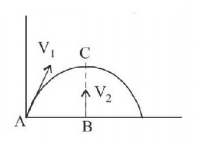
If $${V_1}$$ is velocity of a body projected from the point $$A$$ and $${V_2}$$ is the velocity of a body projected from point $$B$$ which is vertically below the highest point $$C.$$ if both the bodies collide, then
A
$${V_1} = \frac{1}{2}{V_2}$$
B
$${V_2} = \frac{1}{2}{V_1}$$
C
$${V_1} = {V_2}$$
D
Two bodies can't collide.
Answer :
$${V_2} = \frac{1}{2}{V_1}$$
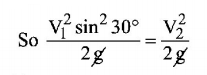
Two bodies will collide at the highest point if both cover the same vertical height in the same time.
$$\eqalign{
& \Rightarrow \frac{{{V_2}}}{{{V_1}}} = \sin {30^ \circ } = \frac{1}{2} \cr
& \therefore {V_2} = \frac{1}{2}{V_1} \cr} $$