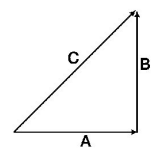
51. The magnitudes of vectors $$A,$$ $$B$$ and $$C$$ are 3, 4 and 5 units respectively. If $$A + B = C,$$ the angle between $$A$$ and $$B$$ is
A
$$\frac{\pi }{2}$$
B
$${\cos ^{ - 1}}\left( {0.6} \right)$$
C
$${\tan ^{ - 1}}\left( {\frac{7}{5}} \right)$$
D
$$\frac{\pi }{4}$$
Answer :
$$\frac{\pi }{2}$$
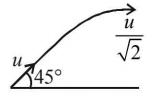
52. A ball whose kinetic energy is $$E$$, is projected at an angle of $${45^ \circ }$$ to the horizontal. The kinetic energy of the ball at the highest point of its flight will be-
A
$$E$$
B
$$\frac{E}{{\sqrt 2 }}$$
C
$$\frac{E}{2}$$
D
Zero
Answer :
$$\frac{E}{2}$$
53. The distance travelled by a particle starting from rest and moving with an acceleration $$\frac{4}{3}m{s^{ - 2}},$$ in the third-second is
A
$$6\,m$$
B
$$4\,m$$
C
$$\frac{{10}}{3}m$$
D
$$\frac{{19}}{3}m$$
Answer :
$$\frac{{10}}{3}m$$
54. When milk is churned, cream gets separated due to
A
centripetal force
B
centrifugal force
C
frictional force
D
gravitational force
Answer :
centrifugal force
55. A man leaves his house for a cycle ride. He comes back to his house after half-an-hour after covering a distance of one $$km.$$ What is his average velocity for the ride ?
A
zero
B
$$2\,km\,{h^{ - 1}}$$
C
$$10\,km\,{s^{ - 1}}$$
D
$$\frac{1}{2}\,km\,{s^{ - 1}}$$
Answer :
zero
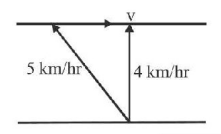
56. A boat which has a speed of $$5\,km/hr$$ in still water crosses a river of width $$1\,km$$ along the shortest possible path in 15 minutes. The velocity of the river water in $$km/hr$$ is
A
$$3$$
B
$$4$$
C
$$\sqrt {21} $$
D
$$1$$
Answer :
$$3$$
57. Two particles $$A$$ and $$B$$ separated by a distance $$2R$$ are moving counter clockwise along the same circular path of radius $$R$$ each with uniform speed $$v.$$ At time $$t = 0,$$ $$A$$ is given a tangential acceleration of magnitude $$a = \frac{{72{v^2}}}{{25\pi R}}$$ then
A
the time lapse for the two bodies to collide is $$\frac{{6\pi R}}{{5v}}$$
B
the angle covered by $$A$$ is $$\frac{{11\pi }}{6}$$
C
angular velocity of $$A$$ is $$\frac{{11v}}{{5R}}$$
D
radial acceleration of $$A$$ is $$\frac{{289{v^2}}}{{5R}}$$
Answer :
the angle covered by $$A$$ is $$\frac{{11\pi }}{6}$$
58. An athlete completes one round of a circular track of radius $$R$$ in $$40\,\sec .$$ What will be his displacement at the end of $$3\,\min. \,20\sec .$$ ?
A
Zero
B
$$2R$$
C
$$2\,\pi R$$
D
$$7\,\pi R$$
Answer :
Zero
59. Two cars of mass $${m_1}$$ and $${m_2}$$ are moving in circles of radii $${r_1}$$ and $${r_2}$$ respectively. Their speeds are such that they make complete circles in the same time $$t.$$ The ratio of their centripetal acceleration is:
A
$${m_1}{r_1}:{m_2}{r_2}$$
B
$${m_1}:{m_2}$$
C
$${r_1}:{r_2}$$
D
$$1:1$$
Answer :
$${r_1}:{r_2}$$
60. A particle of mass $$m$$ is projected with a velocity $$\upsilon $$ making an angle of $${30^ \circ }$$ with the horizontal. The magnitude of $$\left( {{V_h} \times h} \right)$$ of the projectile when the particle is at its maximum height $$h$$
A
$$\frac{{\sqrt 3 }}{2}\frac{{{\upsilon ^2}}}{g}$$
B
zero
C
$$\frac{{{\upsilon ^3}}}{{\sqrt 2 g}}$$
D
$$\frac{{\sqrt 3 }}{{16}}\frac{{{\upsilon ^3}}}{g}$$
Answer :
$$\frac{{\sqrt 3 }}{{16}}\frac{{{\upsilon ^3}}}{g}$$