21.
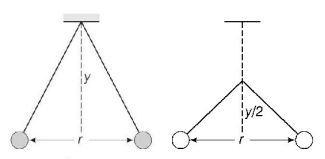
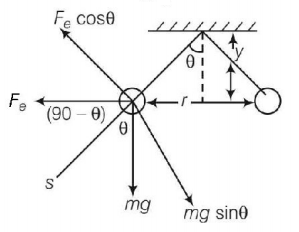
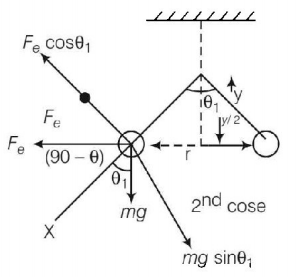
Two pith balls carrying equal charges are suspended from a common point by strings of equal length, the equilibrium separation between them is $$r.$$ Now, the strings are rigidly clamped at half the height. The equilibrium separation between the balls now becomes
A
$${\left( {\frac{1}{{\sqrt 2 }}} \right)^2}$$
B
$$\left( {\frac{r}{{\sqrt 2 }}} \right)$$
C
$$\left( {\frac{{2r}}{{\sqrt 3 }}} \right)$$
D
$$\left( {\frac{{2r}}{3}} \right)$$
Answer :
$$\left( {\frac{r}{{\sqrt 2 }}} \right)$$
22. Two insulated charged metalic sphere $$P$$ and $$Q$$ have their centres separated by a distance of $$60\,cm.$$ The radii of $$P$$ and $$Q$$ are negligible compared to the distance of separation. The mutual force of electrostatic repulsion if the charge on each is $$3.2 \times {10^{ - 7}}C$$ is
A
$$5.2 \times {10^{ - 4}}N$$
B
$$2.5 \times {10^{ - 3}}N$$
C
$$1.5 \times {10^{ - 3}}N$$
D
$$3.5 \times {10^{ - 4}}N$$
Answer :
$$2.5 \times {10^{ - 3}}N$$
23. The force of repulsion between two electrons at a certain distance is $$F.$$ The force between two protons separated by the same distance is $$\left( {{m_p} = 1836\,{m_e}} \right)$$
A
$$2F$$
B
$$F$$
C
$$1836\,F$$
D
$$\frac{F}{{1836}}$$
Answer :
$$F$$
24. A uniformly charged solid sphere of radius $$R$$ has potential $${V_0}$$ (measured with respect to $$\infty $$) on its surface. For this sphere the equipotential surfaces with potentials $$\frac{{3{V_0}}}{2},\frac{{5{V_0}}}{4},\frac{{3{V_0}}}{4}$$ and $$\frac{{{V_0}}}{4}$$ have radius $${R_1},{R_2},{R_3}$$ and $${R_4}$$ respectively. Then
A
$${R_1} = 0\,{\text{and}}\,{R_2} < \left( {{R_4} - {R_3}} \right)$$
B
$$2R < {R_4}$$
C
$${R_1} = 0\,{\text{and}}\,{R_2} > \left( {{R_4} - {R_3}} \right)$$
D
$${R_1} \ne 0\,{\text{and}}\,\left( {{R_2} - {R_1}} \right) > \left( {{R_4} - {R_3}} \right)$$
Answer :
$${R_1} = 0\,{\text{and}}\,{R_2} < \left( {{R_4} - {R_3}} \right)$$
25.
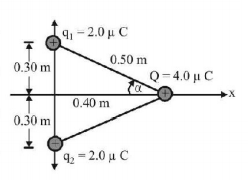
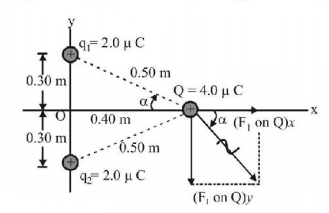
In fig., two equal positive point charges $${q_1} = {q_2} = 2.0\,\mu C$$ interact with a third point charge $$Q = 4.0\,\mu C.$$ The magnitude, as well as direction, of the net force on $$Q$$ is
A
$$0.23\,N$$ in the $$+x$$ -direction
B
$$0.46\,N$$ in the $$+x$$ -direction
C
$$0.23\,N$$ in the $$-x$$ -direction
D
$$0.46\,N$$ in the $$-x$$ -direction
Answer :
$$0.46\,N$$ in the $$+x$$ -direction
26.
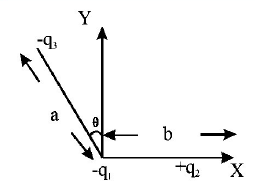
Three charges $$ - {q_1}, + {q_2}$$ and $$ - {q_3}$$ are place as shown in the figure. The $$x$$-component of the force on $$ - {q_1}$$ is proportional to
A
$$\frac{{{q_2}}}{{{b^2}}} - \frac{{{q_3}}}{{{a^2}}}\cos \theta $$
B
$$\frac{{{q_2}}}{{{b^2}}} + \frac{{{q_3}}}{{{a^2}}}\sin \theta $$
C
$$\frac{{{q_2}}}{{{b^2}}} + \frac{{{q_3}}}{{{a^2}}}\cos \theta $$
D
$$\frac{{{q_2}}}{{{b^2}}} - \frac{{{q_3}}}{{{a^2}}}\sin \theta $$
Answer :
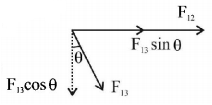
$$\frac{{{q_2}}}{{{b^2}}} + \frac{{{q_3}}}{{{a^2}}}\sin \theta $$
27. A charge particle $$'q'$$ is shot towards another charged particle $$'Q'$$ which is fixed, with a speed $$'v'.$$ It approaches $$'Q'$$ upto a closest distance $$r$$ and then returns. If $$q$$ were given a speed of $$'2v'$$ the closest distances of approach would be
A
$$\frac{r}{2}$$
B
$$2r$$
C
$$r$$
D
$$\frac{r}{4}$$
Answer :
$$\frac{r}{4}$$
28. $$1\,C$$ charge is equivalent to charge on how much number of protons?
A
$$6 \times {10^{18}}$$
B
$$7 \times {10^{19}}$$
C
$$8 \times {10^{20}}$$
D
$$9 \times {10^{21}}$$
Answer :
$$6 \times {10^{18}}$$
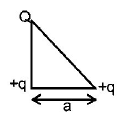
29.
Three charges $$Q, + q$$ and $$ + q$$ are placed at the vertices of a right-angled isosceles triangle as shown. The net electrostatic energy of the configuration is zero if $$Q$$ is equal to
A
$$\frac{{ - q}}{{1 + \sqrt 2 }}$$
B
$$\frac{{ - 2q}}{{2 + \sqrt 2 }}$$
C
$$ - 2q$$
D
$$ + q$$
Answer :
$$\frac{{ - 2q}}{{2 + \sqrt 2 }}$$
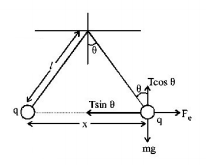
30. Two balls of same mass and carrying equal charge are hung from a fixed support of length $$l.$$ At electrostatic equilibrium, assuming that angles made by each thread is small, the separation, $$x$$ between the balls is proportional to :
A
$$l$$
B
$${l^2}$$
C
$${l^{\frac{2}{3}}}$$
D
$${l^{\frac{1}{3}}}$$
Answer :
$${l^{\frac{1}{3}}}$$