31. Two positive ions, each carrying a charge $$q,$$ are separated by a distance $$d.$$ If $$F$$ is the force of repulsion between the ions, the number of electrons missing from each ion will be ($$e$$ being the charge on an electron)
A
$$\frac{{4\pi {\varepsilon _0}F{d^2}}}{{{e^2}}}$$
B
$$\sqrt {\frac{{4\pi {\varepsilon _0}F{e^2}}}{{{d^2}}}} $$
C
$$\sqrt {\frac{{4\pi {\varepsilon _0}F{d^2}}}{{{e^2}}}} $$
D
$$\frac{{4\pi {\varepsilon _0}F{d^2}}}{{{q^2}}}$$
Answer :
$$\sqrt {\frac{{4\pi {\varepsilon _0}F{d^2}}}{{{e^2}}}} $$
32. The force between two small charged spheres having charges of $$1 \times {10^{ - 7}}C$$ and $$2 \times {10^{ - 7}}C$$ placed $$20\,cm$$ apart in air is
A
$$4.5 \times {10^{ - 2}}C$$
B
$$4.5 \times {10^{ - 3}}C$$
C
$$5.4 \times {10^{ - 2}}C$$
D
$$5.4 \times {10^{ - 3}}C$$
Answer :
$$4.5 \times {10^{ - 3}}C$$
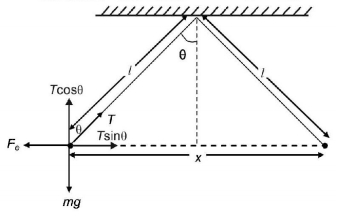
33. Two identical charged spheres suspended from a common point by two massless strings of length $$l$$ are initially a distance $$d\left( {d < < l} \right)$$ apart because of their mutual repulsion. The charge begins to leak from both the spheres at a constant rate. As a result charges approach each other with a velocity $$v.$$ Then as a function of distance $$x$$ between them,
A
$$v\, \propto \,{x^{ - 1}}$$
B
$$v\, \propto \,{x^{\frac{1}{2}}}$$
C
$$v\, \propto \,x$$
D
$$v\, \propto \,{x^{ - \frac{1}{2}}}$$
Answer :
$$v\, \propto \,{x^{ - \frac{1}{2}}}$$
34.
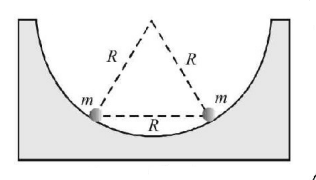
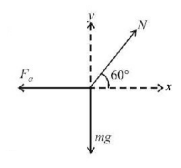
Two identical beads each have a mass $$m$$ and charge $$q.$$ When placed in a hemispherical bowl of radius $$R$$ with frictionless, nonconductive walls, the beads move, and at equilibrium the distance between them is $$R$$ (Fig. ). Determine the charge on each bead.
A
$$R{\left( {\frac{{mg}}{{{k_e}\sqrt 3 }}} \right)^{\frac{1}{2}}}$$
B
$$R{\left( {\frac{{mg}}{{{k_e}\sqrt 2 }}} \right)^{\frac{1}{2}}}$$
C
$$R{\left( {\frac{{mg}}{{{k_e}2\sqrt 3 }}} \right)^{\frac{1}{2}}}$$
D
$$R{\left( {\frac{{2mg}}{{{k_e}\sqrt 3 }}} \right)^{\frac{1}{2}}}$$
Answer :
$$R{\left( {\frac{{mg}}{{{k_e}\sqrt 3 }}} \right)^{\frac{1}{2}}}$$
35.
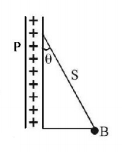
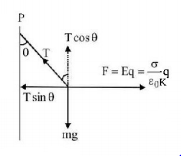
A charged ball $$B$$ hangs from a silk thread $$S,$$ which makes an angle $$\theta $$ with a large charged conducting sheet $$P,$$ as shown in the figure. The surface charge density $$\sigma $$ of the sheet is proportional to
A
$$\cot \theta $$
B
$$\cos \theta $$
C
$$\tan \theta $$
D
$$\sin \theta $$
Answer :
$$\tan \theta $$
36. Two points $$P$$ and $$Q$$ are maintained at the potentials of $$10V$$ and $$-4 V,$$ respectively. The work done in moving 100 electrons from $$P$$ to $$Q$$ is :
A
$$9.60 \times {10^{ - 17}}J$$
B
$$ - 2.24 \times {10^{ - 16}}J$$
C
$$2.24 \times {10^{ - 16}}J$$
D
$$ - 9.60 \times {10^{ - 17}}J$$
Answer :
$$2.24 \times {10^{ - 16}}J$$
37. Two spherical conductors $$B$$ and $$C$$ having equal radii and carrying equal charges on them repel each other with a force $$F$$ when kept apart at some distance. A third spherical conductor having same radius as that $$B$$ but uncharged is brought in contact with $$B,$$ then brought in contact with $$C$$ and finally removed away from both. The new force of repulsion between $$B$$ and $$C$$ is
A
$$\frac{F}{8}$$
B
$$\frac{3F}{4}$$
C
$$\frac{F}{4}$$
D
$$\frac{3F}{8}$$
Answer :
$$\frac{3F}{8}$$
38.
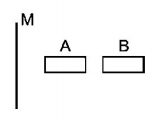
A large nonconducting sheet $$M$$ is given a uniform charge density. Two uncharged small metal rods $$A$$ and $$B$$ are placed near the sheet as shown in figure. Then
A
$$M$$ attracts $$A$$
B
$$M$$ attracts $$B$$
C
$$A$$ attracts $$B$$
D
All of these
Answer :
All of these
39. Two positive ions, each carrying a charge $$q,$$ are separated by a distance $$d.$$ If $$F$$ is the force of repulsion between the ions, the number of electrons missing from each ion will be ($$e$$ being the charge of an electron)
A
$$\frac{{4\pi {\varepsilon _0}F{d^2}}}{{{e^2}}}$$
B
$$\sqrt {\frac{{4\pi {\varepsilon _0}F{e^2}}}{{{d^2}}}} $$
C
$$\sqrt {\frac{{4\pi {\varepsilon _0}F{d^2}}}{{{e^2}}}} $$
D
$$\frac{{4\pi {\varepsilon _0}F{d^2}}}{{{q^2}}}$$
Answer :
$$\sqrt {\frac{{4\pi {\varepsilon _0}F{d^2}}}{{{e^2}}}} $$
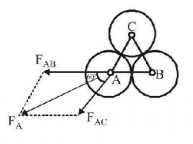
40. Three identical spheres, each having a charge $$q$$ and radius $$R,$$ are kept in such a way that each touches the other two. The magnitude of the electric force on any sphere due to the other two is
A
$$\frac{1}{{4\pi {\varepsilon _0}}}{\left( {\frac{q}{R}} \right)^2}$$
B
$$\frac{{\sqrt 3 }}{{4\pi {\varepsilon _0}}}{\left( {\frac{q}{R}} \right)^2}$$
C
$$\frac{{\sqrt 3 }}{{16\pi {\varepsilon _0}}}{\left( {\frac{q}{R}} \right)^2}$$
D
$$\frac{{\sqrt 5 }}{{16\pi {\varepsilon _0}}}{\left( {\frac{q}{R}} \right)^2}$$
Answer :
$$\frac{{\sqrt 3 }}{{16\pi {\varepsilon _0}}}{\left( {\frac{q}{R}} \right)^2}$$