51. Suppose the charge of a proton and an electron differ slightly. One of them is $$ - e$$ and the other is $$\left( {e + \Delta e} \right).$$ If the net of electrostatic force and gravitational force between two hydrogen atoms placed at a distance $$d$$ (much greater than atomic size) apart is zero, then $${\Delta e}$$ is of the order [Given mass of hydrogen, $${m_h} = 1.67 \times {10^{ - 27}}kg$$ ]
A
$${10^{ - 20}}C$$
B
$${10^{ - 23}}C$$
C
$${10^{ - 37}}C$$
D
$${10^{ - 47}}C$$
Answer :
$${10^{ - 37}}C$$
52. Point charges $$+ 4q, - q$$ and $$+ 4q$$ are kept on the $$x$$-axis at points $$x = 0,\,x = a$$ and $$x = 2a,$$ respectively. Then,
A
only $$-q$$ is in stable equilibrium
B
None of the charges is in equilibrium
C
all the charges are in unstable equilibrium
D
all the charges are in stable equilibrium
Answer :
all the charges are in unstable equilibrium

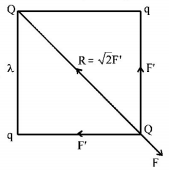
53. A charge $$Q$$ is placed at each of the opposite corners of a square. A charge $$q$$ is placed at each of the other two corners. If the net electrical force on $$Q$$ is zero, then $$\frac{Q}{q}$$ equals:
A
$$-1$$
B
$$1$$
C
$$ - \frac{1}{{\sqrt 2 }}$$
D
$$ - 2\sqrt 2 $$
Answer :
$$ - 2\sqrt 2 $$
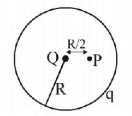
54. A thin spherical conducting shell of radius $$R$$ has a charge $$q.$$ Another charge $$Q$$ is placed at the centre of the shell. The electrostatic potential at a point $$P$$ a distance $$\frac{R}{2}$$ from the centre of the shell is
A
$$\frac{{2Q}}{{4\pi {\varepsilon _0}R}}$$
B
$$\frac{{2Q}}{{4\pi {\varepsilon _0}R}} - \frac{{2q}}{{4\pi {\varepsilon _0}R}}$$
C
$$\frac{{2Q}}{{4\pi {\varepsilon _0}R}} + \frac{q}{{4\pi {\varepsilon _0}R}}$$
D
$$\frac{{\left( {q + Q} \right)2}}{{4\pi {\varepsilon _0}R}}$$
Answer :
$$\frac{{2Q}}{{4\pi {\varepsilon _0}R}} + \frac{q}{{4\pi {\varepsilon _0}R}}$$
55.
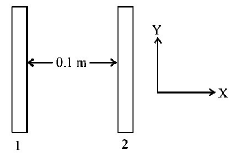
Two insulating plates are both uniformly charged in such a way that the potential difference between them is $${V_2} - {V_1} = 20V.$$ (i.e., plate 2 is at a higher potential). The plates are separated by $$d = 0.1 m$$ and can be treated as infinitely large. An electron is released from rest on the inner surface of plate 1. What is its speed when it hits plate 2?
$$\left( {e = 1.6 \times {{10}^{ - 19}}C,{m_e} = 9.11 \times {{10}^{ - 31}}kg} \right)$$
A
$$2.65 \times {10^6}m/s$$
B
$$7.02 \times {10^{12}}m/s$$
C
$$1.87 \times {10^6}m/s$$
D
$$32 \times {10^{ - 19}}m/s$$
Answer :
$$2.65 \times {10^6}m/s$$
56.
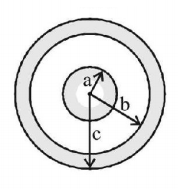
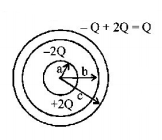
A solid conducting sphere of radius $$a$$ has a net positive charge $$2Q.$$ A conducting spherical shell of inner radius $$b$$ and outer radius $$c$$ is concentric with the solid sphere and has a net charge $$- Q.$$ The surface charge density on the inner and outer surfaces of the spherical shell will be
A
$$ - \frac{{2Q}}{{4\pi {b^2}}},\frac{Q}{{4\pi {c^2}}}$$
B
$$ - \frac{Q}{{4\pi {b^2}}},\frac{Q}{{4\pi {c^2}}}$$
C
$$0,\frac{Q}{{4\pi {c^2}}}$$
D
None of the above
Answer :
$$ - \frac{{2Q}}{{4\pi {b^2}}},\frac{Q}{{4\pi {c^2}}}$$
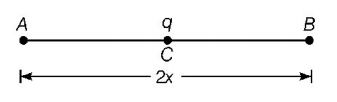
57. A charge $$q$$ is placed at the centre of the line joining two exactly equal positive charges $$Q.$$ The system of three charges will be in equilibrium, if $$q$$ is equal to
A
$$ - \frac{Q}{4}$$
B
$$ + Q$$
C
$$ - Q$$
D
$$\frac{Q}{2}$$
Answer :
$$ - \frac{Q}{4}$$