Electric Current MCQ Questions & Answers in Electrostatics and Magnetism | Physics
Learn Electric Current MCQ questions & answers in Electrostatics and Magnetism are available for students perparing for IIT-JEE, NEET, Engineering and Medical Enternace exam.
91.
Five cells each of emf $$E$$ and internal resistance $$r$$ send the same amount of current through an external resistance $$R$$ whether the cells are connected in parallel or in series. Then the ratio $$\left( {\frac{R}{r}} \right)$$ is
A
2
B
$$\frac{1}{2}$$
C
$$\frac{1}{5}$$
D
1
Answer :
1
Given : Number of cells, $$n = 5,$$ emf of each cell $$= E$$
Internal resistance of each cell $$ = r$$
In series, current through resistance $$R$$
$$I = \frac{{nE}}{{nr + R}} = \frac{{5E}}{{5r + R}}$$
In parallel, current through resistance $$R$$
$$I' = \frac{E}{{\frac{r}{n} + R}} = \frac{{nE}}{{r + nR}} = \frac{{5E}}{{r + 5R}}$$
According to question, $$I = I'$$
$$\eqalign{
& \therefore \frac{{5E}}{{5r + 5R}} = \frac{{5E}}{{r + 5R}} \Rightarrow 5r + R = r + 5R \cr
& {\text{or}}\,R = r \cr
& \therefore \frac{R}{r} = 1 \cr} $$
92.
The masses of the three wires of copper are in the ratio of $$1:3:5$$ and their lengths are in the ratio of $$5 : 3: 1.$$ The ratio of their electrical resistance is
93.
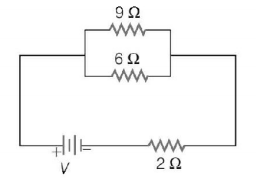
If power dissipated in the $$9\,\Omega $$ resistor in the circuit shown is $$36\,W,$$ the potential difference across the $$2\,\Omega $$ resistor is
94.
Direct current is passed through a copper sulphate solution using platinum electrodes. The elements liberated at the electrodes are
A
copper at anode and sulphur at cathode
B
sulphur at anode and copper at cathode
C
oxygen at anode and copper at cathode
D
copper at anode and oxygen at cathode
Answer :
oxygen at anode and copper at cathode
Copper sulphate in water dissociates as follows
$$CuS{O_4} \to C{u^{ + + }} + SO_4^{ - - }$$
At cathode,
$$2\,C{u^{ + + }} + 4{e^ - } \to 2Cu$$
At anode,
$$2{H_2}O \to 4{H^ + } + {O_2} + 4{e^ - }$$
Hence, copper is liberated at cathode and oxygen is liberated at anode.
95.
$$n$$ resistances each of $$r$$ ohm, when connected in parallel give an equivalent resistance of $$R$$ ohm. If these resistances were connected in series, the combination would have a resistance in ohms, equal to
A
$${n^2}R$$
B
$$\frac{R}{{{n^2}}}$$
C
$$\frac{R}{n}$$
D
$$nR$$
Answer :
$${n^2}R$$
Equivalent resistance of $$n$$ resistances each of $$r$$ ohm in parallel is given by
$$\frac{1}{R} = \frac{1}{r} + \frac{1}{r} + ... + n\,{\text{times}} = \frac{n}{r}$$
So, $$r = nR$$
When these resistances are connected in series, effective resistance is
$$\eqalign{
& R' = r + r + ... + n\,{\text{times}} = nr \cr
& \therefore R' = n\left( {nR} \right) = {n^2}R \cr} $$
96.
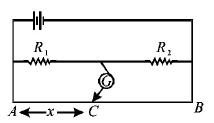
In the shown arrangement of the experiment of the meter bridge if $$AC$$ corresponding to null deflection of galvanometer is $$x,$$ what would be its value if the radius of the wire $$AB$$ is doubled?
A
$$x$$
B
$$4x$$
C
$$\frac{x}{4}$$
D
$$2x$$
Answer :
$$x$$
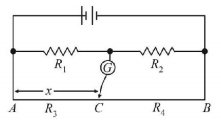
At null point
$$\frac{{{R_1}}}{{{R_2}}} = \frac{{{R_3}}}{{{R_4}}} = \frac{x}{{100 - x}}$$
If radius of the wire is doubled, then the resistance of $$AC$$ will change and also the resistance of $$CB$$ will change. But since $$\frac{{{R_1}}}{{{R_2}}}$$ does not change so, $$\frac{{{R_3}}}{{{R_4}}}$$ should also not change at null point. Therefore the point $$C$$ does not change.
97.
It takes $$12$$ minutes to boil $$1$$ litre of water in an electric kettle. Due to some defect it becomes necessary to remove $$20\% $$ turns of heating coil of the kettle. After repair, how much time will it take to boil $$1$$ litre of water ?
A
9.6 minute
B
14.4 minute
C
16.8 minute
D
18.2 minute
Answer :
9.6 minute
As voltage of appliance remains constant, the amount of heat produced is given by,
$$H = \frac{{{V^2}}}{R}t\,.......\left( {\text{i}} \right)$$
when resistance is reduced by $$20\% ,$$ new resistance is $$R' = R - 0.2\,R = 0.8\,R$$
$$H' = \frac{{{V^2}}}{{0.8R}}t'\,.......\left( {{\text{ii}}} \right)$$
Equating Eqs. (i) and (ii), we get
$$\eqalign{
& \frac{{{V^2}}}{R}t = \frac{{{V^2}}}{{0.8R}}t' \cr
& \Rightarrow t' = 0.8t = 0.8 \times 12 = 9.6\,\min \cr} $$
98.
The charge flowing through a resistance $$R$$ varies with time $$t$$ as $$Q = at - b{t^2}.$$ The total heat produced in $$R$$ by the time current ceases is
A
$$\frac{{{a^3}R}}{{6b}}$$
B
$$\frac{{{a^3}R}}{{3b}}$$
C
$$\frac{{{a^3}R}}{{2b}}$$
D
$$\frac{{{a^3}R}}{{b}}$$
Answer :
$$\frac{{{a^3}R}}{{6b}}$$
$$\eqalign{
& Q = at - b{t^2} \cr
& i = \frac{{dQ}}{{dt}} = a - 2bt \cr
& i = 0\,{\text{for}}\,t = {t_0} = \frac{a}{{2b}}, \cr} $$
i.e., current flow from $$t = 0\,{\text{to}}\,t = {t_0}.$$
The heat produced $$ = \int\limits_0^{{t_0}} {{i^2}R\,dt} .$$ Putting the value of $$i$$ we get heat produced $$ = \frac{{{a^3}R}}{{6b}}.$$
99.
The thermo e.m.f. of a thermo -couple is $$25\mu \,V{/^ \circ }C$$ at room temperature. A galvanometer of $$40 \,ohm$$ resistance, capable of detecting current as low as $${10^{ - 5}}A,$$ is connected with the thermo couple. The smallest temperature difference that can be detected by this system is
A
$${16^ \circ }C$$
B
$${12^ \circ }C$$
C
$${8^ \circ }C$$
D
$${20^ \circ }C$$
Answer :
$${16^ \circ }C$$
Let $$\theta $$ be the smallest temperature difference that can be detected by the thermocouple, then
$$I \times R = \left( {25 \times {{10}^{ - 6}}} \right)\theta $$
where $$I$$ is the smallest current which can be detected by the galvanometer of resistance $$R.$$
$$\eqalign{
& \therefore {10^{ - 5}} \times 40 = 25 \times {10^{ - 6}} \times \theta \cr
& \therefore \theta = {16^ \circ }C. \cr} $$
100.
Faraday’s laws are consequence of conservation of
A
energy
B
energy and magnetic field
C
charge
D
magnetic field
Answer :
energy
Faraday's laws are based on the conversion of electrical energy into mechanical energy, which is in accordance with the law of conservation of energy.