Electric Current MCQ Questions & Answers in Electrostatics and Magnetism | Physics
Learn Electric Current MCQ questions & answers in Electrostatics and Magnetism are available for students perparing for IIT-JEE, NEET, Engineering and Medical Enternace exam.
61.
Two batteries with e.m.f. $$12\,V$$ and $$13\,V$$ are connected in parallel across a load resistor of $$10\,\Omega $$. The internal resistances of the two batteries are $$1\,\Omega $$ and $$2\,\Omega $$ respectively. The voltage across the load lies between :
A
$$11.6\,V$$ and $$11.7\,V$$
B
$$11.5\,V$$ and $$11.6\,V$$
C
$$11.4\,V$$ and $$11.5\,V$$
D
$$11.7\,V$$ and $$11.8\,V$$
Answer :
$$11.5\,V$$ and $$11.6\,V$$
Using Kirchhoff’s law at $$P$$ we get
$$\frac{{V - 12}}{1} + \frac{{V - 13}}{2} + \frac{{V - 0}}{{10}} = 0$$
[Let potential at $$P,\,Q,\,U = 0$$ and at $$R = V$$ ]
$$\eqalign{
& \Rightarrow \frac{V}{1} + \frac{V}{2} + \frac{V}{{10}} = \frac{{12}}{1} + \frac{{13}}{2} + \frac{0}{{10}} \cr
& \Rightarrow \frac{{10 + 5 + 1}}{{10}}V = \frac{{24 + 13}}{2} \cr
& \Rightarrow V\left( {\frac{{16}}{{10}}} \right) = \frac{{37}}{2} \cr
& \Rightarrow V = \frac{{37 \times 10}}{{16 \times 2}} = \frac{{370}}{{32}} = 11.56\,volt \cr} $$
62.
A $$4\mu F$$ conductor is charged to $$400\,V$$ and then its plates are joined through a resistance of $$1\,k\Omega .$$ The heat produced in the resistance is
A
$$0.16\,J$$
B
$$1.28\,J$$
C
$$0.64\,J$$
D
$$0.32\,J$$
Answer :
$$0.32\,J$$
The energy stored in the capacitor $$ = \frac{1}{2}C{V^2}.$$
This energy will be converted into heat in the resistor.
$$\therefore H = \frac{1}{2}C{V^2}$$
where, $$C =$$ capacitance of capacitor
$$V =$$ voltage across the plate of capacitor
$$ \Rightarrow H = \frac{1}{2} \times 4 \times {10^{ - 6}} \times {\left( {400} \right)^2} = 0.32\,J$$
63.
In the given circuit, it is observed that the current $$I$$ is independent of the value of the resistance $${R_6}.$$ Then the resistance values must satisfy
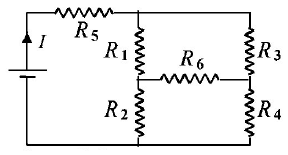
Since current $$I$$ is independent of $${R_6},$$ it follows that the resistance $${R_1},{R_2},{R_3}$$ and $${R_4}$$ must form the balanced
Wheatstone bridge. ∴ $${R_1}{R_4} = {R_2}{R_3}$$
64.
If an ammeter is to be used in place of a voltmeter, then we must connect with the ammeter a
A
low resistance in parallel
B
high resistance in parallel
C
high resistance in series
D
low resistance in series.
Answer :
high resistance in series
KEY CONCEPT : To convert a galvanometer into a voltmeter we connect a high resistance in series with the galvanometer.
The same procedure needs to be done if ammeter is to be used as a voltmeter.
65.
A potentiometer is an accurate and versatile device to make electrical measurement of EMF because the method involves
A
cells
B
potential gradients
C
a condition of no current flow through the galvanometer
D
a combination of cells, galvanometer and resistances
Answer :
a condition of no current flow through the galvanometer
When a cell is balanced against potential drop across a certain length of potentiometer wire, no current flows through the cell
∴ emf of cell = potential drop across balance length of potentiometer wire.
So, potentiometer is a more accurate device for measuring emf of a cell or no current flows through the cell during measurement of emf.
66.
For a cell, the terminal potential difference is $$2.2\,V$$ when circuit is open and reduces to $$1.8\,V$$ when cell is connected to a resistance $$R = 5\,\Omega ,$$ the internal resistance $$\left( r \right)$$ of cell is
A
$$\frac{{10}}{9}\Omega $$
B
$$\frac{9}{{10}}\Omega $$
C
$$\frac{{11}}{9}\Omega $$
D
$$\frac{5}{9}\Omega $$
Answer :
$$\frac{{10}}{9}\Omega $$
In an open circuit, emf of cell
$$E = 2.2\,V$$
In a closed circuit, terminal potential difference
$$V = 1.8\,V$$
External resistance, $$R = 5\,\Omega $$
Thus, internal resistance of cell is
$$\eqalign{
& r = \left( {\frac{E}{V} - 1} \right)R = \left( {\frac{{2.2}}{{1.8}} - 1} \right)5 \cr
& = \left( {\frac{{11}}{9} - 1} \right)5 = \frac{2}{9} \times 5 = \frac{{10}}{9}\,\Omega \cr} $$
67.
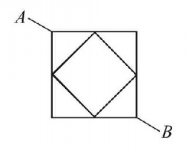
A wire has linear resistance $$\rho $$ (in $$Ohm/m$$ ). Find the resistance $$R$$ between points $$A$$ and $$B$$ if the side of the larger square is $$'d'.$$
A
$$\frac{{\rho d}}{{\sqrt 2 }}$$
B
$$\sqrt 2 \rho d$$
C
$$2rd$$
D
None of these
Answer :
$$\frac{{\rho d}}{{\sqrt 2 }}$$
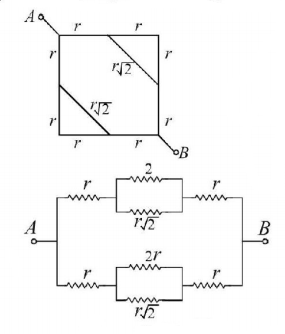
Let each half side has resistance $$r\left( { = \frac{{\rho d}}{2}} \right)$$
$$\eqalign{
& \therefore R = \frac{1}{2}\left[ {2r + \frac{{\left( {2r} \right)\left( {r\sqrt 2 } \right)}}{{\left( {2 + \sqrt 2 } \right)r}}} \right] = r\sqrt 2 \,\,\left( {{\text{on}}\,{\text{solving}}} \right) \cr
& \therefore R = \frac{{\rho d}}{{\sqrt 2 }} \cr} $$
68.
The current $$i$$ in the circuit (see Fig) is
A
$$\frac{1}{{45}}A$$
B
$$\frac{1}{{15}}A$$
C
$$\frac{1}{{10}}A$$
D
$$\frac{1}{5}A$$
Answer :
$$\frac{1}{{10}}A$$
$$BC$$ and $$AC$$ are in series
$$\therefore {R_{BCA}} = 30 + 30 = 60\Omega $$
Now $$BA$$ and $$DC$$ are in parallel.
$$\eqalign{
& \frac{1}{{{R_{eq}}}} = \frac{1}{{30}} + \frac{1}{{60}} = \frac{{90}}{{30 \times 60}} \cr
& {R_{eq}} = 20\Omega ;\,\,\,\,\,\,\, \cr
& V = IR \cr
& \Rightarrow I = \frac{2}{{20}} = 0.1\,Amp \cr} $$
69.
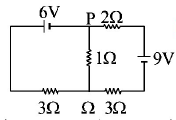
In the circuit shown, the current in the $$1\Omega $$ resistor is :
A
$$0.13\,A,$$ from $$Q$$ to $$P$$
B
$$0.13\,A,$$ from $$P$$ to $$Q$$
C
$$1.3\,A$$ from $$P$$ to $$Q$$
D
$$0\,A$$
Answer :
$$0.13\,A,$$ from $$Q$$ to $$P$$
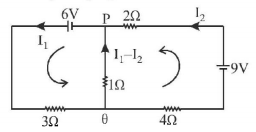
From $$KVL$$
$$ - 6 + {3I_1} + 1\left( {{I_i} - {I_2}} \right) = 0$$
$$\eqalign{
& 6 = 3{I_1} + {I_1} - {I_2} \cr
& 4{I_1} - {I_2} = 6\,......\left( 1 \right) \cr
& - 9 + 2{I_2} - \left( {{I_1} - {I_2}} \right) + 3{I_2} = 0 \cr
& - {I_1} + 6{I_2} = 9\,......\left( 2 \right) \cr} $$
On solving (1) and (2)
$$I_1 = 0.13A$$
Direction $$Q$$ to $$P,$$ since $${I_1} > {I_2}.$$ Alternatively
$$\eqalign{
& Eq = \frac{{\frac{{{E_1}}}{{{r_1}}} + \frac{{{E_2}}}{{{r_2}}}}}{{\frac{1}{{{r_1}}} + \frac{1}{{{r_2}}}}} = \frac{{\frac{6}{3} - \frac{9}{5}}}{{\frac{1}{3} + \frac{1}{5}}} = \frac{3}{{8V}} \cr
& \therefore I = \frac{{\frac{3}{8}}}{{\frac{{15}}{8} + 1}} = \frac{3}{{23}} = 0.13A \cr} $$
Considering potential at $$P$$ as $$0V$$ and at $$Q$$ as $$x$$ volt, then
$$\eqalign{
& \frac{{x - 6}}{3} + \frac{{x - 0}}{1} + \frac{{x + 9}}{5} = 0 \cr
& \therefore x = \frac{2}{{23}} \cr
& \therefore i = \frac{{x - 0}}{1} = \frac{2}{{23}} = 0.13A \cr} $$
From $$Q$$ to $$P$$
70.
The mean free path of electrons in a metal is $$4 \times {10^{ - 8}}m.$$ The electric field which can give on an average $$2\,eV$$ energy to an electron in the metal will be in unit of $$V{m^{ - 1}}$$