Electric Current MCQ Questions & Answers in Electrostatics and Magnetism | Physics
Learn Electric Current MCQ questions & answers in Electrostatics and Magnetism are available for students perparing for IIT-JEE, NEET, Engineering and Medical Enternace exam.
71.
A potentiometer wire has length $$4\,m$$ and resistance $$8\,\Omega .$$ The resistance that must be connected in series with the wire and an accumulator of emf $$2V,$$ so as to get a potential gradient $$1\,mV$$ per $$cm$$ on the wire is
A
$$32\,\Omega $$
B
$$40\,\Omega $$
C
$$44\,\Omega $$
D
$$48\,\Omega $$
Answer :
$$32\,\Omega $$
Given, $$l = 4m,$$
$$R =$$ potentiometer wire resistance $$ = 8\,\Omega $$
Potential gradient $$ = \frac{{dV}}{{dr}} = 1\,mV/cm$$
So, for $$400\,cm,\,\Delta V = 400 \times 1 \times {10^{ - 3}} = 0.4\,V$$
Let $$a$$ resistor $${R_s}$$ connected in series, so as
$$\eqalign{
& \Delta V = \frac{V}{{R + {R_s}}} \times R \Rightarrow 0.4 = \frac{2}{{8 + R}} \times 8 \cr
& \Rightarrow 8 + R = \frac{{16}}{{0.4}} = 40 \Rightarrow R = 32\,\Omega \cr} $$
72.
A student measures the terminal potential difference $$\left( V \right)$$ of a cell (of emf $$\varepsilon $$ and internal resistance $$r$$) as a function of the current $$\left( I \right)$$ flowing through it. The slope and intercept of the graph between $$V$$ and $$I,$$ respectively, equal to
A
$$\varepsilon \,{\text{and}}\, - r$$
B
$$ - r\,{\text{and}}\,\varepsilon $$
C
$$r\,{\text{and}}\, - \varepsilon $$
D
$$ - \varepsilon \,{\text{and}}\,r$$
Answer :
$$ - r\,{\text{and}}\,\varepsilon $$
According to Ohm's law
$$\frac{{dV}}{{dI}} = - r\,\,{\text{and}}\,V = \varepsilon \,\,{\text{if}}\,\,I = 0\,\,\left[ {{\text{As}}\,\,V + Ir = \varepsilon } \right]$$
So, slope of the graph $$ = -r$$ and intercept $$ = \varepsilon $$
73.
The resistance of a wire is $$5\,ohm$$ at $${50^ \circ }C$$ and $$6\,ohm$$ at $${100^ \circ }C.$$ The resistance of the wire at $${0^ \circ }C$$ will be
A
$$3\,ohm$$
B
$$2\,ohm$$
C
$$1\,ohm$$
D
$$4\,ohm$$
Answer :
$$4\,ohm$$
KEY CONCEPT : We know that
$${R_t} = {R_0}\left( {1 + \alpha t} \right),$$
where $${R_t}$$ is the resistance of the wire at $${t^ \circ }C,$$
$${R_0}$$ is the resistance of the wire at $${0^ \circ }C$$
and $$\alpha $$ is the temperature coefficient of resistance.
$$\eqalign{
& \Rightarrow {R_{50}} = {R_0}\left( {1 + 50\alpha } \right)......\left( {\text{i}} \right) \cr
& {R_{100}} = {R_0}\left( {1 + 100\alpha } \right)......\left( {{\text{ii}}} \right) \cr} $$
From (i), $${R_{50}} - {R_0} = 50\alpha {R_0}......\left( {{\text{iii}}} \right)$$
From (ii), $${R_{100}} - {R_0} = 100\alpha {R_0}......\left( {{\text{iv}}} \right)$$
Dividing (iii) by (iv), we get
$$\eqalign{
& \frac{{{R_{50}} - {R_0}}}{{{R_{100}} - {R_0}}} = \frac{1}{2} \cr
& {\text{Here,}}\,{R_{50}} = 5\Omega {\text{ and }}{R_{100}} = 6\Omega \cr
& \therefore \frac{{5 - {R_0}}}{{6 - {R_0}}} = \frac{1}{2} \cr
& {\text{or,}}\,6 - {R_0} = 10 - 2{R_0}{\text{ or,}}\,{R_0} = 4\Omega . \cr} $$
74.
A wire of a certain material is stretched slowly by 10 percent. Its new resistance and specific resistance become respectively
A
1.2 times, 1.1 times
B
1.21 times, same
C
Both remain the same
D
1.1 times, 1.1 times
Answer :
1.21 times, same
After stretching, specific resistance $$\left( \rho \right)$$ will remain same.
Original resistance of wire, $$R = \frac{{\rho l}}{A}$$
Ratio of resistance before and after streching,
$$\eqalign{
& \frac{{{R_2}}}{{{R_1}}} = \frac{{{l_2}}}{{{l_1}}} \times \frac{{{A_1}}}{{{A_2}}} = {\left[ {\frac{{{l_2}}}{{{l_1}}}} \right]^2} \cr
& \frac{{{R_2}}}{{{R_1}}} = \frac{{{{\left( {l + 10\% l} \right)}^2}}}{{{l^2}}} \cr
& \frac{{{R_2}}}{{{R_1}}} = \frac{{{{\left( {\frac{{11}}{{10}}l} \right)}^2}}}{{{l^2}}} \cr
& {R_2} = 1.21\,{R_1} \cr} $$
75.
Drift speed of electrons, when $$1.5\,A$$ of current flows in a copper wire of cross section $$5m{m^2},$$ is $$v.$$ If the electron density in copper is $$9 \times {10^{28}}/{m^3}$$ the value of $$v$$ in mm/s close to (Take charge of electron to be = $$1.6 \times {10^{ - 19}}C$$ )
76.
In meter bridge, the balancing length from left is found to be $$20\,cm$$ when standard resistance of $$1\,\Omega $$ is in right gap. The value of unknown resistance is
A
$$0.25\,\Omega $$
B
$$0.4\,\Omega $$
C
$$0.5\,\Omega $$
D
$$4\,\Omega $$
Answer :
$$0.25\,\Omega $$
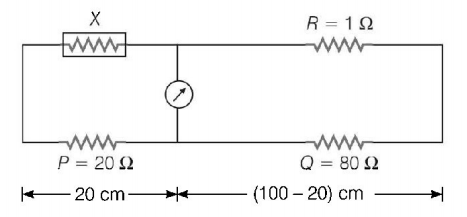
Let unknown resistance be $$X.$$
Then condition of Wheatstone bridge gives,
$$\frac{X}{R} = \frac{{20}}{{80}}$$
where, $$X =$$ unknown resistance
$$R =$$ known resistance
Hence, unknown resistance is
$$\eqalign{
& X = \frac{{20}}{{80}} \times R = \frac{1}{4} \times 1\,\,\left( {\because R = 1\,\Omega } \right) \cr
& = 0.25\,\Omega \cr} $$
77.
A current of $$3\,A$$ flows through the $$2\,\Omega $$ resistor shown in the circuit. The power dissipated in the $$5\,\Omega $$ resistor is
A
$$4\,W$$
B
$$2\,W$$
C
$$1\,W$$
D
$$5\,W$$
Answer :
$$5\,W$$
Voltage across $$2\,\Omega ,$$
$$ = 3 \times 2 = 6\,V$$
Voltage across $$4\,\Omega $$ and $$\left( {5\,\Omega + 1\,\Omega } \right)$$ resistor is same.
So, current across $$5\,\Omega = \frac{6}{{1 + 5}} = 1\,A\,\,\left[ {i = \frac{V}{R}} \right]$$
Power across $$5\,\Omega = P = {i^2}R$$
$$\eqalign{
& = {\left( 1 \right)^2} \times 5 \cr
& = 5\,W \cr} $$
78.
If $${\theta _i},$$ is the inversion temperature, $${\theta _n}$$ is the neutral temperature, $${\theta _c}$$ , is the temperature of the cold junction, then
A
$${\theta _i} + {\theta _c} = {\theta _n}$$
B
$${\theta _i} - {\theta _c} = 2{\theta _n}$$
C
$$\frac{{{\theta _i} + {\theta _C}}}{2} = {\theta _n}$$
79.
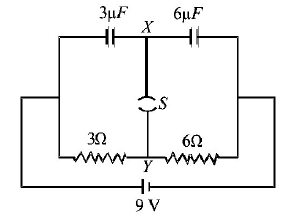
A circuit is connected as shown in the figure with the switch $$S$$ open. When the switch is closed, the total amount of charge that flows from $$Y$$ to $$X$$ is
A
0
B
$$54\mu C$$
C
$$27\mu C$$
D
$$81\mu C$$
Answer :
$$27\mu C$$
The total charge enclosed in the dotted portion when the switch $$S$$ is open is zero. When the switch is closed and steady state is reached, the current $$I$$ coming from the battery is
$$9 = I\left( {3 + 6} \right) \Rightarrow I = 1A$$
∴ Potential difference across $$3\Omega $$ resistance = $$3V$$ and potential difference across $$6\Omega $$ resistance = $$6V$$
∴ p.d. across $$3\,\mu F$$ capacitor = $$3V$$
and p.d. across $$6\,\mu F$$ capacitor = $$6V$$
∴ Charge on $$3\,\mu F$$ capacitor $${Q_1} = 3 \times 3 = 9\mu C$$
Charge on $$6\,\mu F$$ capacitor $${Q_2} = 6 \times 6 = 36\mu C$$
∴ Charge passing the switch $$ = 36 - 9 = 27\,\mu C$$
80.
40 electric bulbs are connected in series across a $$220\,V$$ supply. After one bulb is fused the remaining 39 are connected again in series across the same supply. The illumination will be
A
more with 40 bulbs than with 39
B
more with 39 bulbs than with 40
C
equal in both the cases
D
in the ratio $${40^2}:{39^2}$$
Answer :
more with 39 bulbs than with 40
As the voltage is same for both forty and thirty nine bulbs combination, therefore heat produced is given by $$H = \frac{{{V^2}t}}{R}$$ and $$H \propto \frac{1}{R}.$$ As equivalent resistance decreases, the combination of 39 bulbs will glow more.