111. A sphere of radius $$R$$ carries charge density $$\rho $$ proportional to the square of the distance from the centre such that $$\rho = C{R^2},$$ where $$C$$ is a positive constant. At a distance $$\frac{R}{2}$$ from the centre, the magnitude of the electric field is
A
$$\frac{{C{R^3}}}{{20{ \in _0}}}$$
B
$$\frac{{C{R^3}}}{{10{ \in _0}}}$$
C
$$\frac{{C{R^3}}}{{5{ \in _0}}}$$
D
$$\frac{{C{R^3}}}{{40{ \in _0}}}$$
Answer :
$$\frac{{C{R^3}}}{{40{ \in _0}}}$$
112.
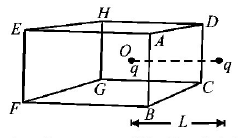
A charged particle $$q$$ is placed at the centre $$O$$ of cube of length $$L\left( {ABCDEFGH} \right).$$ Another same charge $$q$$ is placed at a distance $$L$$ from $$O.$$ Then the electric flux through $$ABCD$$ is
A
$$\frac{q}{4}\pi { \in _0}L$$
B
zero
C
$$\frac{q}{2}\pi { \in _0}L$$
D
$$\frac{q}{3}\pi { \in _0}L$$
Answer :
zero
113.
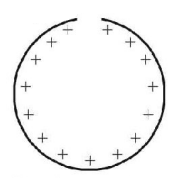
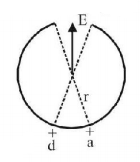
A ring of charge with radius $$0.5\,m$$ has $$0.002\,\pi m$$ gap. If the ring carries a charge of $$+1\,C,$$ the electric field at the centre is
A
$$7.5 \times {10^7}N{C^{ - 1}}$$
B
$$7.2 \times {10^7}N{C^{ - 1}}$$
C
$$6.2 \times {10^7}N{C^{ - 1}}$$
D
$$6.5 \times {10^7}N{C^{ - 1}}$$
Answer :
$$7.2 \times {10^7}N{C^{ - 1}}$$
114.
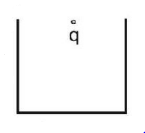
A charge $$q$$ is placed at the centre of the open end of a cylindrical vessel. The flux of the electric field through the surface of the vessel is
A
zero
B
$$\frac{q}{{{\varepsilon _0}}}$$
C
$$\frac{q}{{2{\varepsilon _0}}}$$
D
$$\frac{{2q}}{{{\varepsilon _0}}}$$
Answer :
zero
115. If the dipole of moment $$2.57 \times {10^{ - 17}}cm$$ is placed into an electric field of magnitude $$3.0 \times {10^4}\,N/C$$ such that the fields lines are aligned at $${30^ \circ }$$ with the line joining $$P$$ to the dipole, what torque acts on the dipole?
A
$$7.7 \times {10^{ - 13}}\,Nm$$
B
$$3.855 \times {10^{ - 13}}\,Nm$$
C
$$3.855 \times {10^{ - 15}}\,Nm$$
D
$$7.7 \times {10^{ - 15}}\,Nm$$
Answer :
$$3.855 \times {10^{ - 13}}\,Nm$$
116. Two point charges $$ + 8q$$ and $$ - 2q$$ are located at $$x = 0$$ and $$x = L$$ respectively. The location of a point on the $$x$$ axis at which the net electric field due to these two point charges is zero is
A
$$\frac{L}{4}$$
B
$$2L$$
C
$$4L$$
D
$$8L$$
Answer :
$$2L$$
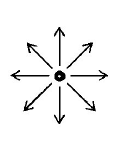
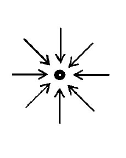
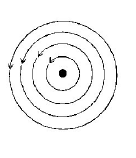
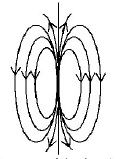
117. Which of the field patterns given below is valid for electric field as well as for magnetic field?
A
B
C
D
Answer :