31. During the propagation of electromagnetic waves in a medium
A
electric energy density is double of the magnetic energy density.
B
electric energy density is half of the magnetic energy density.
C
electric energy density is equal to the magnetic energy density.
D
both electric and magnetic energy densities are zero.
Answer :
electric energy density is equal to the magnetic energy density.
32. A point source of electromagnetic radiation has an average power output of $$800\,W.$$ The maximum value of electric field at a distance $$4.0\,m$$ from the source is
A
$$64.7\,V/m$$
B
$$57.8\,V/m$$
C
$$56.72\,V/m$$
D
$$54.77\,V/m$$
Answer :
$$54.77\,V/m$$
33. The oscillating electric and magnetic field vectors of electromagnetic wave are oriented along
A
the same direction and in phase
B
the same direction but have a phase difference of $${90^ \circ }$$
C
mutually perpendicular directions and are in phase
D
mutually perpendicular directions but has a phase difference of $${90^ \circ }$$
Answer :
mutually perpendicular directions and are in phase

34. Electromagnetic radiation of highest frequency is
A
infrared radiations
B
visible radiation
C
radio waves
D
$$\gamma $$-rays
Answer :
$$\gamma $$-rays
35.
Arrange the following electromagnetic radiations per quantum in the order of increasing energy :
i : Blue light
ii : Yellow light
iii : X-ray
iv : Radiowave.
A
iii, i, ii, iv
B
ii, i, iv, iii
C
iv, ii, i, iii
D
i, ii, iv, iii
Answer :
iv, ii, i, iii

36. If microwaves, X rays, infrared, gamma rays, ultraviolet, radio waves and visible parts of the electromagnetic spectrum are denoted by $$M, X, I, G, U, R$$ and $$V$$ then which of the following is the arrangement in ascending order of wavelength ?
A
$$R,M,I,V,U, X$$ and $$G$$
B
$$M,R,V,X,U,G$$ and $$I$$
C
$$G,X,U,V,I,M$$ and $$R$$
D
$$I,M,R,U, V, X$$ and $$G$$
Answer :
$$G,X,U,V,I,M$$ and $$R$$
37. In order to establish an instantaneous displacement current of $$1\,mA$$ in the space between the plates of $$2\mu F$$ parallel plate capacitor, the potential difference need to apply is
A
$$100\,V{s^{ - 1}}$$
B
$$200\,V{s^{ - 1}}$$
C
$$300\,V{s^{ - 1}}$$
D
$$500\,V{s^{ - 1}}$$
Answer :
$$500\,V{s^{ - 1}}$$
38. In which one of the following regions of the electromagnetic spectrum will the vibrational motion of molecules give rise to absorption?
A
Ultraviolet
B
Microwaves
C
Infrared
D
Radio waves
Answer :
Microwaves
39. Which of the following is the longest wave ?
A
X-rays
B
$$\gamma $$-rays
C
Microwaves
D
Radiowaves
Answer :
Radiowaves
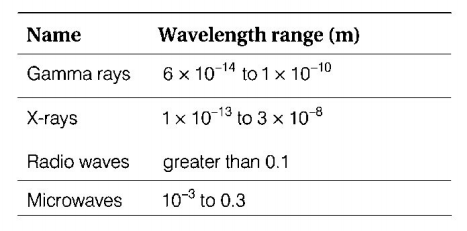
40. The energy of the $$EM$$ waves is of the order of $$15\,keV.$$ To which part of the spectrum does it belong?
A
X-rays
B
Infrared rays
C
Ultraviolet rays
D
$$\gamma $$-rays
Answer :
X-rays