11. In a mass spectrometer used for measuring the masses of ions, the ions are initially accelerated by an electric potential $$V$$ and then made to describe semicircular path of radius $$R$$ using a magnetic field $$B.$$ If $$V$$ and $$B$$ are kept constant, the ratio $$\left( {\frac{{{\text{charge}}\,{\text{on}}\,{\text{the}}\,{\text{ion}}}}{{{\text{mass of the ion}}}}} \right)$$ will be proportional to
A
$$\frac{1}{{{R^2}}}$$
B
$${{R^2}}$$
C
$$R$$
D
$$\frac{1}{R}$$
Answer :
$$\frac{1}{{{R^2}}}$$
12.
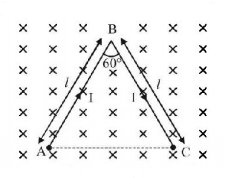
The magnetic force acting on the rod $$ABC$$ in the presence of external magnetic field as shown in the figure is
A
$$BI\ell $$
B
$$2BI\ell $$
C
$$BI\ell \sqrt 3 $$
D
Zero
Answer :
$$BI\ell $$
13. A thin is bent in the shape of a small circle of radius $$r.$$ If the charge per unit length of the rod is $$\sigma ,$$ and if the circle is rotated about its axis at a rate of $$n$$ rotations per second, the magnetic induction at a point on the axis at a large distance $$y$$ from the centre
A
$${\mu _0}\pi {r^3}n\frac{\sigma }{{{y^3}}}$$
B
$$2{\mu _0}\pi {r^3}n\frac{\sigma }{{{y^3}}}$$
C
$$\left( {\frac{{{\mu _0}}}{{4\pi }}} \right){r^3}n\frac{\sigma }{{{y^3}}}$$
D
$$\left( {\frac{{{\mu _0}}}{{2\pi }}} \right){r^3}n\frac{\sigma }{{{y^3}}}$$
Answer :
$${\mu _0}\pi {r^3}n\frac{\sigma }{{{y^3}}}$$
14. A magnetic needle lying parallel to a magnetic field requires $$W$$ units of work to turn it through $${60^ \circ }.$$ The torque needed to maintain the needle in this position will be
A
$$\sqrt 3 W$$
B
$$W$$
C
$$\frac{{\sqrt 3 }}{2}W$$
D
$$2W$$
Answer :
$$\sqrt 3 W$$
15.
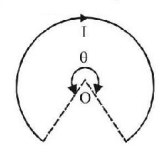
A current of $$I$$ ampere flows in a wire forming a circular arc of radius $$r$$ metres subtending an angle $$\theta $$ at the centre as shown. The magnetic field at the centre $$O$$ in tesla is
A
$$\frac{{{\mu _0}I\theta }}{{4\pi r}}$$
B
$$\frac{{{\mu _0}I\theta }}{{2\pi r}}$$
C
$$\frac{{{\mu _0}I\theta }}{{2r}}$$
D
$$\frac{{{\mu _0}I\theta }}{{4r}}$$
Answer :
$$\frac{{{\mu _0}I\theta }}{{4\pi r}}$$
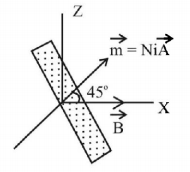
16. A rectangular coil (Dimension $$5\,cm \times 2.5\,cm$$ ) with 100 tums, carrying a current of $$3 A$$ in the clock-wise direction, is kept centered at the origin and in the $$X-Z$$ plane. A magnetic field of $$1 T$$ is applied along $$X$$-axis. If the coil is tilted through $${45^ \circ }$$ about $$Z$$-axis, then the torque on the coil is :
A
$$0.38\,Nm$$
B
$$0.55\,Nm$$
C
$$0.42\,Nm$$
D
$$0.27\,Nm$$
Answer :
$$0.27\,Nm$$
17. Two particles $$X$$ and $$Y$$ having equal charges, after being accelerated through the same potential difference, enter a region of uniform magnetic field and describe circular paths of radii $${R_1}$$ and $${R_2}$$ respectively. The ratio of the mass of $$X$$ to that of $$Y$$ is
A
$${\left( {\frac{{{R_1}}}{{{R_2}}}} \right)^{\frac{1}{2}}}$$
B
$$\frac{{{R_2}}}{{{R_1}}}$$
C
$${\left( {\frac{{{R_1}}}{{{R_2}}}} \right)^2}$$
D
$$\frac{{{R_1}}}{{{R_2}}}$$
Answer :
$${\left( {\frac{{{R_1}}}{{{R_2}}}} \right)^2}$$
18. An $$8\,cm$$ long wire carrying a current of $$10\,A$$ is placed inside a solenoid perpendicular to its axis. If the magnetic field inside the solenoid is $$0.3\,T,$$ then magnetic force on the wire is
A
$$0.14\,N$$
B
$$0.24\,N$$
C
$$0.34\,N$$
D
$$0.44\,N$$
Answer :
$$0.24\,N$$
19.
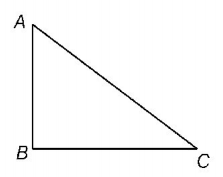
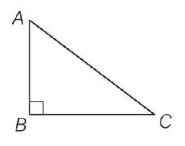
A current carrying closed loop in the form of a right angled isosceles $$\Delta ABC$$ is placed in a uniform magnetic field acting along $$AB.$$ If the magnetic force on the arm $$BC$$ is $$F,$$ the force on the arm $$AC$$ is
A
$$ - F$$
B
$$F$$
C
$$\sqrt 2 F$$
D
$$ - \sqrt 2 F$$
Answer :
$$ - F$$
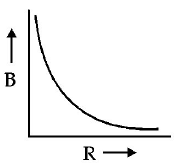
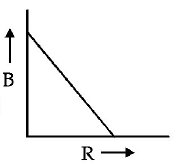
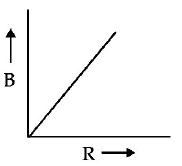
20. A charge $$Q$$ is uniformly distributed over the surface of non-conducting disc of radius $$R.$$ The disc rotates about an axis perpendicular to its plane and passing through its centre with an angular velocity $$\omega .$$ As a result of this rotation a magnetic field of induction $$B$$ is obtained at the centre of the disc. If we keep both the amount of charge placed on the disc and its angular velocity to be constant and vary the radius of the disc then the variation of the magnetic induction at the centre of the disc will be represented by the figure :
A
B
C
D
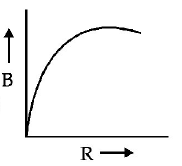
Answer :