Magnetic Effect of Current MCQ Questions & Answers in Electrostatics and Magnetism | Physics
Learn Magnetic Effect of Current MCQ questions & answers in Electrostatics and Magnetism are available for students perparing for IIT-JEE, NEET, Engineering and Medical Enternace exam.
81.
Two circular coils 1 and 2 are made from the same wire but the radius of the 1st coil is twice that of the 2nd coil. What is the ratio of potential difference applied across them so that the magnetic field at their centres is the same?
A
3
B
4
C
6
D
2
Answer :
4
Magnetic field at the centre of a circular coil is $$B = \frac{{{\mu _0}}}{{2\pi }} \times \frac{i}{r}$$
where, $$i$$ is current flowing in the coil and $$r$$ is radius of coil.
At the centre of coil-1,
$${B_1} = \frac{{{\mu _0}}}{{2\pi }} \times \frac{{{i_1}}}{{{r_1}}}\,......\left( {\text{i}} \right)$$
At the centre of coil-2
$${B_2} = \frac{{{\mu _0}}}{{2\pi }} \times \frac{{{i_2}}}{{{r_2}}}\,......\left( {{\text{ii}}} \right)$$
$$\eqalign{
& {\text{but}}\,\,{B_1} = {B_2} \cr
& \therefore \frac{{{\mu _0}}}{{2\pi }}\frac{{{i_1}}}{{{r_1}}} = \frac{{{\mu _0}}}{{2\pi }}\frac{{{i_2}}}{{{r_2}}} \cr
& {\text{or}}\,\,\frac{{{i_1}}}{{{r_1}}} = \frac{{{i_2}}}{{{r_2}}} \cr
& {\text{As}}\,{\text{given}}\,\,{r_1} = 2{r_2} \cr
& \therefore \quad \frac{{{i_1}}}{{2{r_2}}} = \frac{{{i_2}}}{{{r_2}}}\,\,{\text{or}}\,\,{i_1} = 2{i_2}\,......\left( {{\text{iii}}} \right) \cr} $$
Now, ratio of potential differences
$$\eqalign{
& \frac{{{V_2}}}{{{V_1}}} = \frac{{{i_2} \times {R_2}}}{{{i_1} \times {R_1}}} = \frac{{{i_2} \times {R_2}}}{{2{i_2} \times 2{R_2}}} = \frac{1}{4}\,\,\left[ {R \propto r} \right] \cr
& \therefore \frac{{{V_1}}}{{{V_2}}} = \frac{4}{1} \cr} $$ NOTE
If wires are made of same material, then resistance of coil is proportional to the radius of coil.
i.e., $$R \propto I\,\,{\text{so,}}\,\,R \propto 2\pi r$$
82.
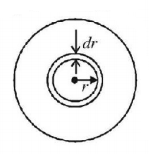
The current density $${\vec J}$$ inside a long, solid, cylindrical wire of radius $$a = 12\,mm$$ is in the direction of the central axis, and its magnitude varies linearly with radial distance $$r$$ from the axis according to $$J = \frac{{{J_0}r}}{a},$$ where $${J_0} = \frac{{{{10}^5}}}{{4\pi }}\,A/{m^2}.$$ Find the magnitude of the magnetic field at $$r = \frac{a}{2}$$ in $$\mu T.$$
A
$$10\mu T$$
B
$$4\mu T$$
C
$$5\mu T$$
D
$$3\mu T$$
Answer :
$$10\mu T$$
Current in the element $$ = J\left( {2\pi r.dr} \right)$$
Current enclosed by ampere loop of radius $$\frac{a}{2}$$
$$\eqalign{
& I = \int\limits_0^{\frac{a}{2}} {\frac{{{J_0}r}}{a}.} 2\pi r.dr \cr
& = \frac{{2\pi {J_0}}}{{3a}}{\left( {\frac{a}{2}} \right)^3} = \frac{{\pi {J_0}{a^3}}}{{12}} \cr} $$
Applying ampere’s law
$$\eqalign{
& B.2\pi .\frac{a}{2} = {\mu _0}.\frac{{\pi {J_0}{a^2}}}{{12}} \cr
& \Rightarrow B = \frac{{{\mu _0}{J_0}a}}{{12}} \cr} $$
On putting values, $$B = 10\mu T$$
83.
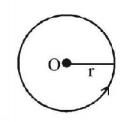
An electron moving in a circular orbit of radius $$r$$ makes $$n$$ rotations per second. The magnetic field produced at the centre has magnitude:
A
Zero
B
$$\frac{{{\mu _0}{n^2}e}}{r}$$
C
$$\frac{{{\mu _0}ne}}{{2r}}$$
D
$$\frac{{{\mu _0}ne}}{{2\pi r}}$$
Answer :
$$\frac{{{\mu _0}ne}}{{2r}}$$
Radius of circular orbit $$= r$$
No. of rotations per second $$= n$$
i.e., $$T = \frac{1}{n}$$
Magnetic field at its centre, $${B_c} = ?$$
As we know, current
$$i = \frac{e}{T} = \frac{e}{{\left( {\frac{1}{n}} \right)}} = en = {\text{equivalent current}}$$
Magnetic field at the centre of circular orbit,
$${B_c} = \frac{{{\mu _0}i}}{{2r}} = \frac{{{\mu _0}ne}}{{2r}}.$$
84.
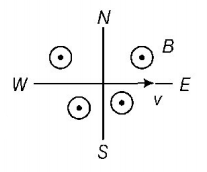
A positively charged particle moving due east enters a region of uniform magnetic field directed vertically upwards. The particle will
A
continue to move due East
B
move in a circular orbit with its speed unchanged
C
move in a circular orbit with its speed increased
D
gets deflected vertically upwards
Answer :
move in a circular orbit with its speed unchanged
According to the question, the magnetic field is perpendicular to the direction of motion of charged particle.
Force on the charged particle is given by
$$F = qvB\sin \theta = q\left( {v \times B} \right)$$
where, $$q =$$ charge on charged particle
$$v =$$ velocity of charged particle
$$B =$$ magnetic field
$$\theta =$$ angle between $$v$$ and $$B = {90^ \circ }$$
According to Fleming’s left hand rule, the force acts perpendicular to the velocity of the particle. This force in magnitude remains same but the direction of charged particle goes on changing and always perpendicular to the velocity of the particle, so the particle will move in a circular orbit. The magnetic force does not make any change in its kinetic energy which implies that speed is constant or unchanged.
85.
When a charged particle moving with velocity $$v$$ is subjected to a magnetic field of induction $$B,$$ the force on it is non-zero. This implies that
A
angle between $$v$$ and $$B$$ is necessarily $${90^ \circ }$$
B
angle between $$v$$ and $$B$$ can have any value other than $${90^ \circ }$$
C
angle between $$v$$ and $$B$$ can have any value other than zero and $${180^ \circ }$$
D
angle between $$v$$ and $$B$$ is either zero or $${180^ \circ }$$
Answer :
angle between $$v$$ and $$B$$ can have any value other than zero and $${180^ \circ }$$
When a charged particle $$q$$ is moving in a uniform magnetic field $$B$$ with velocity $$v$$ such that angle between $$v$$ and $$B$$ is $$\theta ,$$ then the charge $$q$$ experiences a force which is given by
$$F = q\left( {v \times B} \right) = qvB\sin \theta $$
If $$\theta = {0^ \circ }$$ or $${180^ \circ },$$ then $$\sin \theta = 0$$
$$\therefore F = qvB\sin \theta = 0$$
Since, force on charged particle is non-zero, so angle between $$v$$ and $$B$$ can have any value other than $${0^ \circ }$$ and $${180^ \circ }.$$ NOTE
Force experienced by the charged particle is the Lorentz force.
86.
A current $$I$$ flows along the length of an infinitely long, straight, thin walled pipe. Then
A
the magnetic field at all points inside the pipe is the same, but not zero
B
the magnetic field is zero only on the axis of the pipe
C
the magnetic field is different at different points inside the pipe
D
the magnetic field at any point inside the pipe is zero
Answer :
the magnetic field at any point inside the pipe is zero
There is no current inside the pipe. Therefore
$$\eqalign{
& \oint {\overrightarrow B .\overrightarrow {d\ell } = {\mu _0}I} \cr
& I = 0 \cr
& \therefore B = 0 \cr} $$
87.
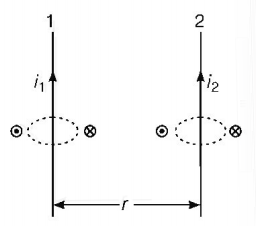
Two wires are held perpendicular to the plane of paper and are $$5\,m$$ apart. They carry currents of $$2.5\,A$$ and $$5\,A$$ in same direction. Then, the magnetic field strength $$\left( B \right)$$ at a point midway between the wires will be
A
$$\frac{{{\mu _0}}}{{4\pi }}T$$
B
$$\frac{{{\mu _0}}}{{2\pi }}T$$
C
$$\frac{{3{\mu _0}}}{{2\pi }}T$$
D
$$\frac{{3{\mu _0}}}{{4\pi }}T$$
Answer :
$$\frac{{{\mu _0}}}{{2\pi }}T$$
According to Maxwell's right handed screw rule, the magnetic field at right hand of wire 1 is perpendicular to the current carrying wire in plane of paper going inwards shown by $$ \otimes .$$ Similarly, the magnetic field at left hand of wire 2 is perpendicular to current carrying wire in plane of paper opposite to first wire shown by $$ \odot .$$ Thus, the two fields are opposite to each other.
Therefore, net magnetic field
$$B = {B_1} - {B_2} = \frac{{{\mu _0}{i_1}}}{{2\pi {r_1}}} - \frac{{{\mu _0}{i_2}}}{{2\pi {r_2}}}$$
At mid-point, $${r_1} = {r_2} = \frac{r}{2} = \frac{5}{2} = 2.5\,cm$$
Hence, $$B = \frac{{{\mu _0}}}{{2\pi }}\left( {\frac{{{i_1}}}{{\frac{r}{2}}} - \frac{{{i_2}}}{{\frac{r}{2}}}} \right)$$
$$\eqalign{
& = \frac{{{\mu _0}}}{{2\pi }}\left( {\frac{5}{{2.5}} - \frac{{2.5}}{{2.5}}} \right) \cr
& = \frac{{{\mu _0}}}{{2\pi }}\left( {2 - 1} \right) \cr
& = \frac{{{\mu _0}}}{{2\pi }}T \cr} $$
88.
The magnetic force acting on a charged particle of charge $$ - 2\mu C$$ in a magnetic field of $$2T$$ acting in $$y$$-direction, when the particle velocity is $$\left( {2\hat i + 3\hat j} \right) \times {10^6}\,m{s^{ - 1}}$$ is
89.
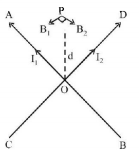
Two identical conducting wires $$AOB$$ and $$COD$$ are placed at right angles to each other. The wire $$AOB$$ carries an electric current $${I_1}$$ and $$COD$$ carries a current $${I_2}.$$ The magnetic field on a point lying at a distance $$d$$ from $$O,$$ in a direction perpendicular to the plane of the wires $$AOB$$ and $$COD,$$ will be given by
A
$$\frac{{{\mu _0}}}{{2\pi d}}\left( {I_1^2 + I_2^2} \right)$$
B
$$\frac{{{\mu _0}}}{{2\pi }}{\left( {\frac{{{I_1} + {I_2}}}{d}} \right)^{\frac{1}{2}}}$$
C
$$\frac{{{\mu _0}}}{{2\pi d}}{\left( {I_1^2 + I_2^2} \right)^{\frac{1}{2}}}$$
D
$$\frac{{{\mu _0}}}{{2\pi d}}\left( {{I_1} + {I_2}} \right)$$
Clearly, the magnetic fields at a point $$P,$$ equidistant from $$AOB$$ and $$COD$$ will have directions perpendicular to each other, as they are placed normal to each other.
$$\therefore $$ Resultant field, $$B = \sqrt {B_1^2 + B_2^2} $$
$$\eqalign{
& {\text{But}}\,{B_1} = \frac{{{\mu _0}{I_1}}}{{2\pi d}}\,{\text{and}}\,{B_2} = \frac{{{\mu _0}{I_2}}}{{2\pi d}} \cr
& \therefore B = \sqrt {{{\left( {\frac{{{\mu _0}}}{{2\pi d}}} \right)}^2}\left( {I_1^2 + I_2^2} \right)} \cr
& {\text{or,}}\,B = \frac{{{\mu _0}}}{{2\pi d}}{\left( {I_1^2 + I_2^2} \right)^{\frac{1}{2}}} \cr} $$
90.
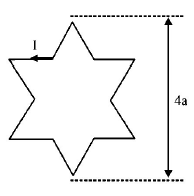
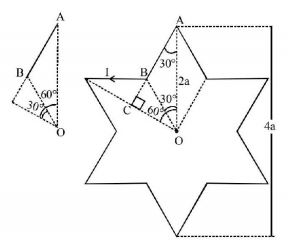
A symmetric star shaped conducting wire loop is carrying a steady state current $$I$$ as shown in the figure. The distance between the diametrically opposite vertices of the star is $$4a.$$ The magnitude of the magnetic field at the center of the loop is
A
$$\frac{{{\mu _0}I}}{{4\pi a}}6\left[ {\sqrt 3 - 1} \right]$$
B
$$\frac{{{\mu _0}I}}{{4\pi a}}6\left[ {\sqrt 3 + 1} \right]$$
C
$$\frac{{{\mu _0}I}}{{4\pi a}}3\left[ {\sqrt 3 - 1} \right]$$
D
$$\frac{{{\mu _0}I}}{{4\pi a}}3\left[ {2 - \sqrt 3 } \right]$$