91. Force between two identical bar magnets whose centres are r metre apart is $$4.8\,N,$$ when their axes are in the same line. If separation is increased to $$2r,$$ the force between them is
A
$$2.4\,N$$
B
$$1.2\,N$$
C
$$0.6\,N$$
D
$$0.3\,N$$
Answer :
$$0.3\,N$$
92. The time period of oscillation of a bar magnet suspended horizontally along the magnetic meridian is $${T_0}.$$ If this magnet is replaced by another magnet of the same size and pole strength but with double the mass, the new time period will be
A
$$\frac{{{T_0}}}{2}$$
B
$$\frac{{{T_0}}}{{\sqrt 2 }}$$
C
$$\sqrt 2 {T_0}$$
D
$$2{T_0}$$
Answer :
$$\sqrt 2 {T_0}$$
93. A compass which is allowed to move in a horizontal plane is taken to a geomagnetic pole. It
A
will stay in north-south direction only
B
will stay in east-west direction only
C
will stay in any position
D
None of these
Answer :
will stay in any position
94. A bar magnet having centre $$O$$ has a length of $$4\,cm.$$ Point $${P_1}$$ is in the broad side-on and $${P_2}$$ is in the end side-on position with $$O{P_1} = O{P_2} = 10\,{\text{metres}}{\text{.}}$$ The ratio of magnetic intensities $$H$$ at $${P_1}$$ and $${P_2}$$ is
A
$${H_1}:{H_2} = 16:100$$
B
$${H_1}:{H_2} = 1:2$$
C
$${H_1}:{H_2} = 2:1$$
D
$${H_1}:{H_2} = 100:16$$
Answer :
$${H_1}:{H_2} = 1:2$$
95. A bar magnet of magnetic moment $$M$$ is placed in a magnetic field of induction $$B.$$ The torque exerted on it is
A
$$M \cdot B$$
B
$$ - M \cdot B$$
C
$$M \times B$$
D
$$ - M \times B$$
Answer :
$$M \times B$$
96. A bar magnet is hung by a thin cotton thread in a uniform horizontal magnetic field and is in equilibrium state. The energy required to rotate it by $${60^ \circ }$$ is $$W.$$ Now the torque required to keep the magnet in this new position is
A
$$\frac{W}{{\sqrt 3 }}$$
B
$$\sqrt 3 W$$
C
$$\frac{{\sqrt 3 W}}{2}$$
D
$$\frac{{2W}}{{\sqrt 3 }}$$
Answer :
$$\sqrt 3 W$$
97.
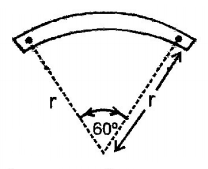
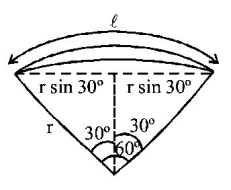
A bar magnet of length $$'\ell '$$ and magnetic dipole moment $$'M'$$ is bent in the form of an arc as shown in figure. The new magnetic dipole moment will be
A
$$\frac{3}{\pi }M$$
B
$$\frac{2}{\pi }M$$
C
$$\frac{M}{2}$$
D
$$M$$
Answer :
$$\frac{3}{\pi }M$$
98. If a diamagnetic substance is brought near the North or the South pole of a bar magnet, it is
A
repelled by both the poles
B
repelled by the North pole and attracted by the South pole
C
attracted by the North pole and repelled by the South pole
D
attracted by both the poles
Answer :
repelled by both the poles
99. Which of the following is responsible for the earth’s magnetic field?
A
Convective currents in earth’s core.
B
Diversive current in earth’s core.
C
Rotational motion of earth.
D
Translational motion of earth.
Answer :
Convective currents in earth’s core.
100. A bar magnet having a magnetic moment of $$2 \times {10^4}J{T^{ - 1}}$$ is free to rotate in a horizontal plane. A horizontal magnetic field $$B = 6 \times {10^{ - 4}}T$$ exists in the space. The work done in taking the magnet slowly from a direction parallel to the field to a direction $${60^ \circ }$$ from the field is
A
$$12\,J$$
B
$$6\,J$$
C
$$2\,J$$
D
$$0.6\,J$$
Answer :
$$6\,J$$