11. Above Curie temperature
A
a ferromagnetic substance becomes paramagnetic
B
a paramagnetic substance becomes diamagnetic
C
a diamagnetic substance becomes paramagnetic
D
a paramagnetic substance becomes ferromagnetic
Answer :
a ferromagnetic substance becomes paramagnetic
12. A compass needle which is allowed to move in a horizontal plane is taken to a geomagnetic pole. It
A
will become rigid showing no movement
B
will stay in any position
C
will stay in North-South direction only
D
will stay in East-West direction only
Answer :
will stay in North-South direction only
13. A magnetic needle is kept in a non-uniform magnetic field. It experiences
A
neither a force nor a torque
B
a torque but not a force
C
a force but not a torque
D
a force and a torque
Answer :
a force and a torque
14. A uniform magnetic field parallel to the plane of the paper exists in space initially directed from left to right. When a bar of soft iron is placed in the field parallel to it, the lines of force passing through it will be represented by
A
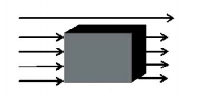
B
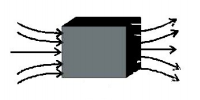
C
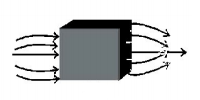
D
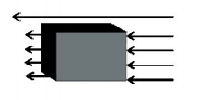
Answer :
15.
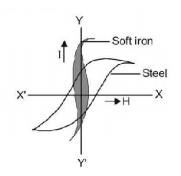
The mass of a speciment of a ferromagnetic material is $$0.6\,kg.$$ and its density is $$7.8 \times {10^3}kg/{m^3}.$$ If the area of hysteresis loop of alternating magnetising field of frequency $$50Hz$$ is $$0.722\,MKS$$ units then the hysteresis loss per second will be
A
$$277.7 \times {10^{ - 5}}joule$$
B
$$277.7 \times {10^{ - 6}}joule$$
C
$$277.7 \times {10^{ - 4}}joule$$
D
$$27.77 \times {10^{ - 4}}joule$$
Answer :
$$277.7 \times {10^{ - 5}}joule$$
16. For protecting a sensitive equipment from the external magnetic field, it should be
A
placed inside an aluminium can
B
placed inside an iron can
C
wrapped with insulation around it when passing current through it
D
surrounded with fine copper sheet
Answer :
placed inside an iron can
17. Relative permittivity and permeability of a material $${\varepsilon _r}$$ and $${\mu _r},$$ respectively. Which of the following values of these quantities are allowed for a diamagnetic material?
A
$${\varepsilon _r} = 0.5,{\mu _r} = 1.5$$
B
$${\varepsilon _r} = 1.5,{\mu _r} = 0.5$$
C
$${\varepsilon _r} = 0.5,{\mu _r} = 0.5$$
D
$${\varepsilon _r} = 1.5,{\mu _r} = 1.5$$
Answer :
$${\varepsilon _r} = 1.5,{\mu _r} = 0.5$$
18.
There are four light weight rod samples $$A,B,C$$ and $$D$$ separately suspended by thread. A bar magnet is slowly brought near each sample and the following observations are noted
(i) $$A$$ is feebly repelled
(ii) $$B$$ is feebly attracted
(iii) $$C$$ is strongly attracted
(iv) $$D$$ remains unaffected
Which one of the following is true?
A
$$C$$ is of a diamagnetic material
B
$$D$$ is of a ferromagnetic material
C
$$A$$ is of a non-magnetic material
D
$$B$$ is of a paramagnetic material
Answer :
$$B$$ is of a paramagnetic material
19. Two isolated point poles of strength $$30\,A-m$$ and $$60\,A-m$$ are placed at a distance of $$0.3\,m.$$ The force of repulsion is
A
$$2 \times {10^{ - 3}}N$$
B
$$2 \times {10^{ - 4}}N$$
C
$$2 \times {10^{ 5}}N$$
D
$$2 \times {10^{ - 5}}N$$
Answer :
$$2 \times {10^{ - 3}}N$$
20. The length of a magnet is large compared to its width and breadth. The time period of its oscillation in a vibration magnetometer is $$2\,s.$$ The magnet is cut along its length into three equal parts and three parts are then placed on each other with their like poles together. The time period of this combination will be
A
$$2\,s$$
B
$$\frac{2}{3}s$$
C
$$2\sqrt 3 \,s$$
D
$$\frac{2}{{\sqrt 3 }}s$$
Answer :
$$\frac{2}{3}s$$