41. If the period of oscillation of freely suspended bar magnet in earth’s horizontal field $$H$$ is $$4\,\sec.$$ When another magnet is brought near it, the period of oscillation is reduced to $$2s.$$ The magnetic field of second bar magnet is
A
$$4H$$
B
$$3H$$
C
$$2H$$
D
$$\sqrt 3 H$$
Answer :
$$4H$$
42. A short bar magnet is placed in the magnetic meridian of the earth with north pole pointing north. Neutral points are found at a distance of $$30\,cm$$ from the magnet on the East-West line, drawn through the middle point of the magnet. The magnetic moment of the magnet in $$A{m^2}$$ is close to: (Given $$\frac{{{\mu _0}}}{{4\pi }} = {10^{ - 7}}$$ in $$SI$$ units and $${B_H} = $$ Horizontal component of earth’s magnetic field $$ = 3.6 \times {10^{ - 5}}tesla$$ )
A
14.6
B
19.4
C
9.7
D
4.9
Answer :
9.7
43. A coil in the shape of an equilateral triangle of side $$l$$ is suspended between the pole pieces of a permanent magnet such that $$\overrightarrow B $$ is in plane of the coil. If due to a current $$i$$ in the triangle a torque $$\tau $$ acts on it, the side $$l$$ of the triangle is
A
$$\frac{2}{{\sqrt 3 }}{\left( {\frac{\tau }{{B.i}}} \right)^{\frac{1}{2}}}$$
B
$$2{\left( {\frac{\tau }{{\sqrt 3 B.i}}} \right)^{\frac{1}{2}}}$$
C
$$\frac{2}{{\sqrt 3 }}\left( {\frac{\tau }{{B.i}}} \right)$$
D
$$\frac{1}{{\sqrt 3 }}\frac{\tau }{{B.i}}$$
Answer :
$$2{\left( {\frac{\tau }{{\sqrt 3 B.i}}} \right)^{\frac{1}{2}}}$$
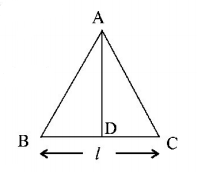
44. A bar magnet has a length $$8\,cm.$$ The magnetic field at a point at a distance $$3\,cm$$ from the centre in the broad side-on position is found to be $$4 \times {10^{ - 6}}T.$$ The pole strength of the magnet is.
A
$$6 \times {10^{ - 5}}Am$$
B
$$5 \times {10^{ - 5}}Am$$
C
$$2 \times {10^{ - 4}}Am$$
D
$$3 \times {10^{ - 4}}Am$$
Answer :
$$6 \times {10^{ - 5}}Am$$
45. A $$30\,cm$$ long bar magnet is placed in the magnetic meridian with its north pole pointing south. The neutral point is obtained at a distance of $$40\,cm$$ from the center of the magnet. Find the pole strength of the magnet. The horizontal component of earth's magnetic field is $$0.34\,gauss.$$
A
$$25.7\,Am$$
B
$$23.7\,Am$$
C
$$28.7\,Am$$
D
$$26.7\,Am$$
Answer :
$$26.7\,Am$$
46. The materials suitable for making electromagnets should have
A
high retentivity and low coercivity
B
low retentivity and low coercivity
C
high retentivity and high coercivity
D
low retentivity and high coercivity
Answer :
low retentivity and low coercivity
47. According to Curie’s law, the magnetic susceptibility of a paramagnetic substance at an absolute temperature $$T$$ is proportional to
A
$$\frac{1}{{{T^2}}}$$
B
$${T^2}$$
C
$$\frac{1}{T}$$
D
$$T$$
Answer :
$$\frac{1}{T}$$
48. Let $$V$$ and $$H$$ be the vertical and horizontal components of earth's magnetic field at any point on earth. Near the north pole
A
$$V > > H$$
B
$$V < < H$$
C
$$V = H$$
D
$$V = H = 0$$
Answer :
$$V > > H$$
49. A bar magnet is oscillating in the earth’s magnetic field with a period $$T.$$ What happens to its period of motion, if its mass is quadrupled?
A
Motion remains simple harmonic with new period $$ = \frac{T}{2}$$
B
Motion remains simple harmonic with new period $$= 2 T$$
C
Motion remains simple harmonic with new period $$= 4 T$$
D
Motion remains simple harmonic and the period stays nearly constant
Answer :
Motion remains simple harmonic with new period $$= 2 T$$
50. If the susceptibility of dia, para and ferromagnetic materials are $${\chi _d},{\chi _p},{\chi _f}$$ respectively, then
A
$${\chi _d} < {\chi _p} < {\chi _f}$$
B
$${\chi _d} < {\chi _f} < {\chi _p}$$
C
$${\chi _f} < {\chi _d} < {\chi _p}$$
D
$${\chi _f} < {\chi _p} < {\chi _d}$$
Answer :
$${\chi _d} < {\chi _p} < {\chi _f}$$