Atoms And Nuclei MCQ Questions & Answers in Modern Physics | Physics
Learn Atoms And Nuclei MCQ questions & answers in Modern Physics are available for students perparing for IIT-JEE, NEET, Engineering and Medical Enternace exam.
101.
If the angular momentum of an electron in an orbit is $$J$$ then the $$K.E.$$ of the electron in that orbit is
A
$$\frac{{{J^2}}}{{2m{r^2}}}$$
B
$$\frac{{Jv}}{r}$$
C
$$\frac{{{J^2}}}{{2m}}$$
D
$$\frac{{{J^2}}}{{2\pi }}$$
Answer :
$$\frac{{{J^2}}}{{2m{r^2}}}$$
Angular momentum $$ = mrv = J$$
$$\therefore v = \frac{J}{{mr}}$$
$$K.E.$$ of electron $$ = \frac{1}{2}m{v^2} = \frac{1}{2}m{\left( {\frac{J}{{mr}}} \right)^2} = \frac{{{J^2}}}{{2m{r^2}}}$$
102.
Consider 3rd orbit of $$H{e^ + }$$ (Helium), using non-relativistic approach, the speed of electron in this orbit will be [given $$K = 9 \times {10^9}$$ constant, $$Z=2$$ and $$h$$ (Plank's Constant) =$$ = 6.6 \times {10^{ - 34}}Js$$ ]
A
$$1.46 \times {10^6}\,m/s$$
B
$$0.73 \times {10^6}\,m/s$$
C
$$3.0 \times {10^8}\,m/s$$
D
$$2.92 \times {10^6}\,m/s$$
Answer :
$$1.46 \times {10^6}\,m/s$$
Speed of electron in nth orbit
$$\eqalign{
& {V_n} = \frac{{2\pi \,KZ{e^2}}}{{nh}} \cr
& V = \left( {2.19 \times {{10}^6}m/s} \right)\frac{Z}{n} \cr
& V = \left( {2.19 \times {{10}^6}} \right)\frac{2}{3}\left( {Z = 2\,\& \,n = 3} \right) \cr
& V = 1.46 \times {10^6}m/s \cr} $$
103.
If elements with principal quantum number $$n > 4$$ were not allowed in nature, the number of possible elements would be
A
60
B
32
C
4
D
64
Answer :
60
The maximum number of electrons in an orbit is $$2{n^2}.n > 4$$ is not allowed.
Therefore the number of maximum electron that can be in first four orbits are
$$\eqalign{
& 2{\left( 1 \right)^2} + 2{\left( 2 \right)^2} + 2{\left( 3 \right)^2} + 2{\left( 4 \right)^2} \cr
& = 2 + 8 + 18 + 32 = 60 \cr} $$
Therefore, possible element are 60.
104.
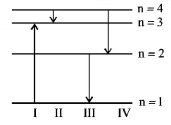
The diagram shows the energy levels for an electron in a certain atom. Which transition shown represents the emission of a photon with the most energy?
A
IV
B
III
C
II
D
I
Answer :
III
KEY CONCEPT : $$E = Rhc\left[ {\frac{1}{{n_1^2}} - \frac{1}{{n_2^2}}} \right]$$
$$E$$ will be maximum for the transition for which $$\left[ {\frac{1}{{n_1^2}} - \frac{1}{{n_2^2}}} \right]$$ is maximum. Here $${n_2}$$ is the higher energy level.
Clearly, $$\left[ {\frac{1}{{n_1^2}} - \frac{1}{{n_2^2}}} \right]$$ is maximum for the third transition, i.e. $$2 \to 1.$$ I transition represents the absorption of energy.
105.
Electron in hydrogen atom first jumps from third excited state to second excited state and then from second excited to the first excited state. The ratio of the wavelengths $${\lambda _1}:{\lambda _2}$$ emitted in the two cases is
A
$$\frac{7}{5}$$
B
$$\frac{{27}}{{20}}$$
C
$$\frac{{27}}{5}$$
D
$$\frac{{20}}{7}$$
Answer :
$$\frac{{20}}{7}$$
According to question, for wavelength $${\lambda _1},$$
$${n_1} = 4\,\,{\text{and}}\,\,{n_2} = 3$$
and for $${\lambda _2},{n_1} = 3\,\,{\text{and}}\,\,{n_2} = 2$$
and we know that, $$\frac{{hc}}{\lambda } = - 13.6\left[ {\frac{1}{{n_1^2}} - \frac{1}{{n_2^2}}} \right]$$
$$\eqalign{
& {\text{So,}}\,\,{\text{for}}\,\,{\lambda _1} \cr
& \Rightarrow \frac{{hc}}{{{\lambda _1}}} = - 13.6\left[ {\frac{1}{{{{\left( 4 \right)}^2}}} - \frac{1}{{{{\left( 3 \right)}^2}}}} \right] \cr
& \frac{{hc}}{{{\lambda _1}}} = 13.6\left[ {\frac{7}{{144}}} \right]\,.......\left( {\text{i}} \right) \cr} $$
Similarly, for $${{\lambda _2}}$$
$$\eqalign{
& \Rightarrow \frac{{hc}}{{{\lambda _2}}} = - 13.6\left[ {\frac{1}{{{{\left( 3 \right)}^2}}} - \frac{1}{{{{\left( 2 \right)}^2}}}} \right] \cr
& \frac{{hc}}{{{\lambda _2}}} = 13.6\left[ {\frac{5}{{36}}} \right]\,.......\left( {{\text{ii}}} \right) \cr} $$
Hence, from Eqs. (i) and (ii), we get
$$\frac{{{\lambda _1}}}{{{\lambda _2}}} = \frac{{20}}{7}$$
106.
Hydrogen atom is excited from ground state to another state with principal quantum number equal to 4. Then the number of spectral lines in the emission spectra will be :
A
2
B
3
C
5
D
6
Answer :
6
The possible number of the spectral lines is given
$$ = \frac{{n\left( {n - 1} \right)}}{2} = \frac{{4\left( {4 - 1} \right)}}{2} = 6$$
107.
In the Bohr’s model of hydrogen-like atom the force between the nucleus and the electron is modified as $$F = \frac{{{e^2}}}{{4\pi {\varepsilon _0}}}\left( {\frac{1}{{{r^2}}} + \frac{\beta }{{{r^3}}}} \right),$$ where $$\beta $$ is a constant. For this atom, the radius of the $$n$$th orbit in terms of the Bohr radius $$\left( {{a_0} = \frac{{{\varepsilon _0}{h^2}}}{{m\pi {e^2}}}} \right)$$ is :
108.
Energy required for the electron excitation in $$L{i^{ + + }}$$ from the first to the third Bohr orbit is :
A
$$36.3\,eV$$
B
$$108.8\,eV$$
C
$$122.4\,eV$$
D
$$12.1\,eV$$
Answer :
$$108.8\,eV$$
Energy of excitation,
$$\eqalign{
& \Delta E = 13.6\,{\pi ^2}\left( {\frac{1}{{{\eta _1}}} - \frac{1}{{{\eta _2}}}} \right)eV \cr
& \Rightarrow \Delta E = 13.6{\left( 3 \right)^2}\left( {\frac{1}{{{1^2}}} - \frac{1}{{{3^2}}}} \right) = 108.8\,eV \cr} $$
109.
The spectrum obtained from a sodium vapour lamp is an example of
A
band spectrum
B
continuous spectrum
C
emission spectrum
D
absorption spectrum
Answer :
emission spectrum
When continuous light from a source is examined directly in a spectroscope, we observe the emission spectrum of the source. The sodium vapour spectrum, consists of a few isolated bright lines. Each bright line corresponds to a particular wavelength. It is emitted by the atoms in the gaseous state.
When continuous light from a source is made to pass through an absorbing substance and then examined in a spectroscope, we observe absorption spectrum of the substance.
A band spectrum is emitted by chemical compounds in the vapour state. It is therefore a molecule spectrum.
A continuous emission spectrum consists of a wide range of unseparated wavelengths.
110.
In a Rutherford experiment, the number of particles scattered at $${90^ \circ }$$ angle are $$28$$ per minute then number of scattered particles at an angle $${60^ \circ }$$ and $${120^ \circ }$$ will be