121. Consider an electron in the $$n$$th orbit of a hydrogen atom in the Bohr model. The circumference of the orbit can be expressed in terms of de-Broglie wavelength $$\lambda $$ of that electron as
A
$$\left( {0.529} \right)n\lambda $$
B
$$\sqrt {n\lambda } $$
C
$$\left( {13.6} \right)\lambda $$
D
$$n\lambda $$
Answer :
$$n\lambda $$
122. A diatomic molecule is made of two masses $${m_1}$$ and $${m_2}$$ which are separated by a distance $$r.$$ If we calculate its rotational energy by applying Bohr's rule of angular momentum quantization, its energy will be given by: ($$n$$ is an integer)
A
$$\frac{{{{\left( {{m_1} + {m_2}} \right)}^2}{n^2}{h^2}}}{{2m_1^2m_2^2{r^2}}}$$
B
$$\frac{{{n^2}{h^2}}}{{2\left( {{m_1} + {m_2}} \right){r^2}}}$$
C
$$\frac{{2{n^2}{h^2}}}{{\left( {{m_1} + {m_2}} \right){r^2}}}$$
D
$$\frac{{\left( {{m_1} + {m_2}} \right){n^2}{h^2}}}{{2{m_1}{m_2}{r^2}}}$$
Answer :
$$\frac{{\left( {{m_1} + {m_2}} \right){n^2}{h^2}}}{{2{m_1}{m_2}{r^2}}}$$
123. Imagine an atom made up of a proton and a hypothetical particle of double the mass of the electron but having the same charge as the electron. Apply the Bohr atom model and consider all possible transitions of this hypothetical particle to the first excited level. The longest wavelength photon that will be emitted has wavelength $$\lambda $$ (given in terms of the Rydberg constant $$R$$ for the hydrogen atom) equal to
A
$$\frac{9}{{\left( {5R} \right)}}$$
B
$$\frac{{36}}{{\left( {5R} \right)}}$$
C
$$\frac{{18}}{{\left( {5R} \right)}}$$
D
$$\frac{4}{R}$$
Answer :
$$\frac{{18}}{{\left( {5R} \right)}}$$
124. Which of the following transitions in hydrogen atoms emit photons of highest frequency?
A
$$n = 1$$ to $$n = 2$$
B
$$n = 2$$ to $$n = 6$$
C
$$n = 6$$ to $$n = 2$$
D
$$n = 2$$ to $$n = 1$$
Answer :
$$n = 2$$ to $$n = 1$$
125. The radiation corresponding to $$3 \to 2$$ transition of hydrogen atom falls on a metal surface to produce photoelectrons. These electrons are made to enter a magnetic field of $$3 \times {10^{ - 4}}T.$$ If the radius of the largest circular path followed by these electrons is $$10.0\,mm,$$ the work function of the metal is close to:
A
$$1.8\,eV$$
B
$$1.1\,eV$$
C
$$0.8\,eV$$
D
$$1.6\,eV$$
Answer :
$$1.1\,eV$$
126. Suppose an electron is attracted towards the origin by a force $$\frac{k}{r}$$ where $$'k'$$ is a constant and $$'r'$$ is the distance of the electron from the origin. By applying Bohr model to this system, the radius of the $${n^{th}}$$ orbital of the electron is found to be $$'{r_n}'$$ and the kinetic energy of the electron to be $$'{T_n}'.$$ Then which of the following is true?
A
$${T_n} \propto \frac{1}{{{n^2}}},{r_n} \propto {n^2}$$
B
$${T_n}\,{\text{independent}}\,n,{r_n} \propto n$$
C
$${T_n} \propto \frac{1}{n},{r_n} \propto n$$
D
$${T_n} \propto \frac{1}{n},{r_n} \propto {n^2}$$
Answer :
$${T_n}\,{\text{independent}}\,n,{r_n} \propto n$$
127. Ratio of longest wavelengths corresponding to Lyman and Balmer series in hydrogen spectrum is
A
$$\frac{5}{{27}}$$
B
$$\frac{3}{{23}}$$
C
$$\frac{7}{{29}}$$
D
$$\frac{9}{{31}}$$
Answer :
$$\frac{5}{{27}}$$
128. The Bohr model of atoms
A
assumes that the angular momentum of electrons is quantised
B
uses Einstein's photoelectric equation
C
predicts continuous emission spectra for atoms
D
predicts the same emission spectra for all types of atoms
Answer :
assumes that the angular momentum of electrons is quantised
129.
Some energy levels of a molecule are shown in the figure. The ratio of the wavelengths $$r = \frac{{{\lambda _1}}}{{{\lambda _2}}},$$ is given by
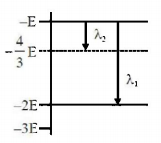
A
$$r = \frac{3}{4}$$
B
$$r = \frac{1}{3}$$
C
$$r = \frac{4}{3}$$
D
$$r = \frac{2}{3}$$
Answer :
$$r = \frac{1}{3}$$
130. Energy $$E$$ of a hydrogen atom with principal quantum number $$n$$ is given by $$E = \frac{{ - 13.6}}{{{n^2}}}eV.$$ The energy of a photon ejected when the electron jumps from $$n = 3$$ state to $$n = 2$$ state of hydrogen, is approximately
A
$$1.5\,eV$$
B
$$0.85\,eV$$
C
$$3.4\,eV$$
D
$$1.9\,eV$$
Answer :
$$1.9\,eV$$