Atoms or Nuclear Fission and Fusion MCQ Questions & Answers in Modern Physics | Physics
Learn Atoms or Nuclear Fission and Fusion MCQ questions & answers in Modern Physics are available for students perparing for IIT-JEE, NEET, Engineering and Medical Enternace exam.
41.
The nuclei $$_6{C^{13}}$$ and $$_7{N^{14}}$$ can be described as
A
isotones
B
isobars
C
isotopes of carbon
D
isotopes of nitrogen
Answer :
isotones
Isotones are the nuclides which contain the same number of neutrons. In $$_6{C^{13}}$$ and $$_7{N^{14}},$$ number of neutrons in carbon $$= 13 - 6 = 7$$ and number of neutrons in nitrogen $$= 14 - 7 = 7.$$ NOTE
No. of neutrons is given by mass no. $$\left( A \right) - $$ atomic no. $$\left( Z \right)$$
42.
Complete the equation for the following fission process
$$_{92}{U^{235}}{ + _0}{n^1}{ \to _{38}}{n^{90}} + .........$$
A
$$_{54}X{e^{143}} + {3_0}{n^1}$$
B
$$_{54}X{e^{145}}$$
C
$$_{57}X{e^{142}}$$
D
$$_{57}X{e^{142}}{ + _0}{n^1}$$
Answer :
$$_{54}X{e^{143}} + {3_0}{n^1}$$
$$_{92}{U^{235}}{ + _0}{n^1}{ \to _{38}}S{r^{90}}{ + _{54}}X{e^{143}} + {3_0}{n^1}$$
If total atomic number on $$LHS = 92 + 0 = 92$$
Total atomic number on $$RHS = 38 + 54 + 0 = 92$$
Total mass number on $$LHS = 235 + 1 = 236$$
Total mass number on $$RHS = 90 + 143 + 3 \times 1 = 236$$
So, option (A) is correct. NOTE
For a nuclear reaction to be completed, the mass number and charge number on both sides should be same.
43.
Nuclear fission can be explained by
A
proton-proton cycle
B
liquid drop model of nucleus
C
independent of nuclear particle model
D
nuclear shell model
Answer :
liquid drop model of nucleus
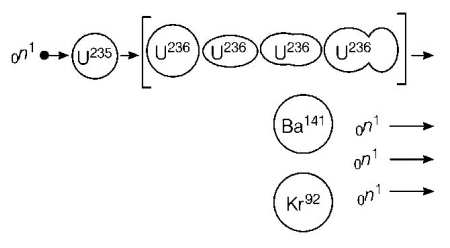
Neil Bohr and J.A. Wheeler explained the nuclear fission on the basis of liquid drop model of the nucleus. The $$_{92}{U^{235}}$$ nucleus behaves like a liquid drop and owing to surface tension is perfectly spherical in shape. When the neutron strikes the nucleus, some energy called the excitation energy is imparted to the nucleus.
The phenomenon of surface tension tries to keep the nucleus spherical in shape, whereas the excitation energy tries to deform it. Due to the struggle between the surface tension and the excitation energy, the oscillations are set up inside the compound nucleus.
As a result, the nucleus gets deformed from spherical shape to ellipsoidal and then to a dumb bell as shown, till the Coulomb’s repulsive force between protons succeeds in tearing the two bells apart.
44.
If radius of the $$_{13}^{27}Al$$ nucleus is taken to be $${R_{AI}},$$ then the radius of $$_{53}^{125}Te$$ nucleus is nearly
A
$${\left( {\frac{{53}}{{13}}} \right)^{\frac{1}{3}}}{R_{AI}}$$
B
$$\frac{5}{3}{R_{AI}}$$
C
$$\frac{3}{5}{R_{AI}}$$
D
$${\left( {\frac{{13}}{{53}}} \right)^{\frac{1}{3}}}{R_{AI}}$$
Answer :
$$\frac{5}{3}{R_{AI}}$$
Radius of the nucleus is given by
$$\eqalign{
& R = {R_0}{A^{\frac{1}{3}}} \Rightarrow R \propto {A^{\frac{1}{3}}} \cr
& \frac{{{R_{Al}}}}{{{R_{Te}}}} = {\left( {\frac{{{A_{Al}}}}{{{A_{Te}}}}} \right)^{\frac{1}{3}}} = {\left( {\frac{{27}}{{125}}} \right)^{\frac{1}{3}}} = \frac{3}{5} \cr
& {R_{Te}} = \frac{5}{3}{R_{Al}} \cr} $$
45.
Which of the following is used as a moderator in nuclear reactors ?
A
Plutonium
B
Cadmium
C
Heavy water
D
Uranium
Answer :
Heavy water
Moderator in a nuclear reactor is used to slow down the fast moving neutrons. Heavy water, graphite or beryllium oxide are used as moderators. Heavy water is best moderator. NOTE
In an ordinary uranium reactor, plutonium $$\left( {P{u^{239}}} \right)$$ is produced which is a better fissionable material than uranium $$\left( {{U^{235}}} \right).$$ It is a heavy isotope of uranium.
46.
The radius of germanium $$\left( {Ge} \right)$$ nuclide is measured to be twice the radius of $$_4^9Be.$$ The number of nucleons in $$Ge$$ are
A
73
B
74
C
75
D
72
Answer :
72
According to question, radius of $$_4^9Be$$ nucleus be $$r,$$ and radius of germanium $$\left( {Ge} \right)$$ nucleus will be $$2r.$$
Radius of a nucleus is given by $$R = {R_0}{A^{\frac{1}{3}}}$$
$$R$$ = Radius of atom having mass number. $$A$$
$$\eqalign{
& R \propto {A^{\frac{1}{3}}} \cr
& {\text{So,}}\,\frac{{{R_1}}}{{{R_2}}} = {\left( {\frac{{{A_1}}}{{{A_2}}}} \right)^{\frac{1}{3}}} \cr
& \Rightarrow \frac{r}{{2r}} = {\left( {\frac{9}{{{A_2}}}} \right)^{\frac{1}{3}}}\,\,\left( {\because {A_1} = 9} \right) \cr
& {\text{or}}\,\,{\left( {\frac{1}{2}} \right)^3} = \frac{9}{{{A_2}}} \cr
& {\text{Hence,}}\,\,{A_2} = 9 \times {\left( 2 \right)^3} \cr
& = 9 \times 8 = 72 \cr} $$
Thus, in germanium $$\left( {Ge} \right)$$ nucleus number of nucleons is 72.
47.
Assume that a neutron breaks into a proton and an electron.
The energy released during this process is : (mass of neutron $$ = 1.6725 \times {10^{ - 27}}kg,$$ mass of proton $$ = 1.6725 \times {10^{ - 27}}kg,$$ mass of electron $$ = 9 \times {10^{ - 31}}kg$$ ).
A
$$0.73\,MeV$$
B
$$7.10\,MeV$$
C
$$6.30\,MeV$$
D
$$5.4\,MeV$$
Answer :
$$0.73\,MeV$$
$$_0^1n \to _1^1H{ + _{ - 1}}{e^0} + \bar v + Q$$
The mass defect during the process
$$\eqalign{
& \Delta m = {m_n} - {m_H} - {m_e} \cr
& = 1.6725 \times {10^{ - 27}} - \left( {1.6725 \times {{10}^{ - 27}} + 9 \times {{10}^{ - 31}}kg} \right) \cr
& = - 9 \times {10^{ - 31}}kg \cr} $$
The energy released during the process
$$\eqalign{
& E = \Delta m{c^2} \cr
& E = 9 \times {10^{ - 31}} \times 9 \times {10^{16}} = 81 \times {10^{ - 15}}Joules \cr
& E = \frac{{81 \times {{10}^{ - 15}}}}{{1.6 \times {{10}^{ - 19}}}} = 0.511MeV \cr} $$
48.
In a fission reaction,
$$_{92}^{236}U{ \to ^{117}}X{ + ^{117}}Y + n + n$$
the binding energy per nucleon of $$X$$ and $$Y$$ is $$8.5\,MeV$$ whereas of $$^{236}U$$ is $$7.6\,MeV.$$ The total energy liberated will be about
A
$$2000\,MeV$$
B
$$200\,MeV$$
C
$$2\,MeV$$
D
$$1\,MeV$$
Answer :
$$200\,MeV$$
Binding energy of fissioned nucleus $$ = 236 \times 7.6\,MeV$$
Binding energy of products $$ = 117 \times 8.5 + 117 \times 8.5$$
$$ = 2 \times 117 \times 8.5$$
Hence, net binding energy = binding energy of products — binding energy of fissioned nucleus
$$\eqalign{
& = 234 \times 8.5 - 236 \times 7.6 \cr
& = 1989 - 1793.6 \cr
& = 195.4\,MeV \cr
& \approx 200\,MeV \cr} $$
Thus, in per fission of uranium nearly $$200\,MeV$$ energy is released.
49.
A free neutron decays into a proton, an electron and
A
a beta particle
B
an alpha particle
C
an antineutrino
D
a neutrino
Answer :
an antineutrino
Pauli suggested that after emission of $$\beta $$-particle (electron) a neutron is converted into a proton in a nucleus and in this reaction an electron and an antineutrino $$\left( {\overline v } \right)$$ will be formed. This reaction is represented as
\[\begin{array}{*{20}{c}}
{_0{n^1}}\\
{\left( {{\rm{Neutron}}} \right)}
\end{array} \to \begin{array}{*{20}{c}}
{_1{H^1}}\\
{\left( {{\rm{Proton}}} \right)}
\end{array} + \begin{array}{*{20}{c}}
{_{ - 1}{\beta ^0}}\\
{\left( {{\rm{Electron}}} \right)}
\end{array} + \begin{array}{*{20}{c}}
{\bar \upsilon }\\
{\left( {{\rm{Antineutrino}}} \right)}
\end{array}\]
Antineutrino is a particle whose mass is negligible and on which no charge is present. NOTE
After emission of $$\beta $$-particle, the total number of particles (mass-number) in a nucleus remains unchanged but no. of neutrons reduces by 1 making the no. of protons (i.e. charge-number) to increase by 1.
50.
If a star can convert all the $$He$$ nuclei completely into oxygen nuclei, the energy released per oxygen nuclei is [Mass of $$He$$ nucleus is $$4.0026\,amu$$ and mass of Oxygen nucleus is $$15.9994\,amu$$ ]