Radioactivity MCQ Questions & Answers in Modern Physics | Physics
Learn Radioactivity MCQ questions & answers in Modern Physics are available for students perparing for IIT-JEE, NEET, Engineering and Medical Enternace exam.
31.
The mass of a $$_3^7Li$$ nucleus is $$0.042\,u$$ less than the sum of the masses of all its nucleons. The binding energy per nucleon of $$_3^7Li$$ nucleus is nearly
32.
A radioactive sample contains $${10^{ - 3}}kg$$ each of two nuclear species $$A$$ and $$B$$ with half-life 4 days and 8 days respectively. The ratio of the amounts of $$A$$ and $$B$$ after a period of 16 days is
A
$$1:2$$
B
$$4:1$$
C
$$1:4$$
D
$$2:1$$
Answer :
$$1:4$$
Ratio of number of half life taken is given as :
After 16 days
$$\eqalign{
& {T_{A\frac{1}{2}}} = \frac{{16}}{4} = 4; \cr
& {T_{B\frac{1}{2}}} = \frac{{16}}{8} = 2; \cr
& N = {N_0}{\left( {\frac{1}{2}} \right)^n} \cr
& \Rightarrow \frac{{{N_A}}}{{{N_B}}} = \frac{1}{{{2^4}}}:\frac{1}{{{2^2}}} = {2^2}:{2^4} \cr
& = 4:16, = 1:4 \cr} $$
33.
At radioactive equilibrium, the ratio between the atoms of two radioactive elements $$\left( X \right)$$ and $$\left( Y \right)$$ was found to be $$3.2 \times {10^9}:1$$ respectively. If half-life of the element $$\left( X \right)$$ is $$1.6 \times {10^{10}}{\text{years,}}$$ then half-life of the element $$\left( Y \right)$$ would be
34.
The half-life of $$^{215}At$$ is $$100\,\mu s.$$ The time taken for the radioactivity of a sample of $$^{215}At$$ to decay to $${\frac{1}{{16}}^{th}}$$ of its initial value is
A
$$400\mu s$$
B
$$6.3\,\mu s$$
C
$$40\,\mu s$$
D
$$300\,\mu s$$
Answer :
$$400\mu s$$
$$\eqalign{
& A = {A_0}{\left( {\frac{1}{2}} \right)^n};n = {\text{number of half lives}}{\text{.}} \cr
& \frac{{{A_0}}}{{16}} = {A_0}{\left( {\frac{1}{2}} \right)^n}\,\,\,\,\,\therefore {\left( {\frac{1}{2}} \right)^4} = {\left( {\frac{1}{2}} \right)^n} \cr
& \Rightarrow n = 4 \cr
& \therefore t = \left( {4 \times 100} \right)\mu {\text{s}} = 400\mu s \cr} $$
35.
A radio isotope $$X$$ with a half life $$1.4 \times {10^9}yr$$ decays of $$Y$$ which is stable. A sample of the rock from a cave was found to contain $$X$$ and $$Y$$ in the ratio $$1:7.$$ The age of the rock is
A
$$1.96 \times {10^9}yr$$
B
$$3.92 \times {10^9}yr$$
C
$$4.20 \times {10^9}yr$$
D
$$8.40 \times {10^9}yr$$
Answer :
$$4.20 \times {10^9}yr$$
Ratio of $$X:Y$$ is given $$ = 1:7$$
$$\frac{{{m_x}}}{{{m_y}}} = \frac{1}{7} \Rightarrow 7{m_x} = {m_y}$$
Let the initial total mass be $$m.$$
$$\eqalign{
& \Rightarrow {m_x} + {m_y} = m \Rightarrow \frac{{{m_y}}}{7} + {m_y} = m \cr
& \Rightarrow \frac{{8{m_y}}}{7} = m \Rightarrow {m_y} = \frac{7}{8}m \cr} $$
only $$\frac{1}{8}$$ part remains
So, time taken to become $$\frac{1}{8}$$ unstable part
$$ = 3 \times {T_{\frac{1}{2}}} = 3 \times 1.4 \times {10^9} = 4.2 \times {10^9}y$$ Alternative
$$_{{\text{Active}}}^X \to _{{\text{Stable}}}^Y$$
As we know that
$$\eqalign{
& \frac{N}{{{N_0}}} = {\left( {\frac{1}{2}} \right)^n} \cr
& \frac{1}{{1 + 7}} = \frac{1}{8} = {\left( {\frac{1}{2}} \right)^3} \cr
& \Rightarrow n = 3 \cr
& {\text{As,}}\,\,{T_{\frac{1}{2}}} = \frac{t}{n} \cr
& \therefore t = {T_{\frac{1}{2}}} \times n \cr
& = 1.4 \times {10^9} \times 3 = 4.2 \times {10^9}y \cr} $$
36.
Two radioactive substances $$X$$ and $$Y$$ emit $$\alpha $$ and $$\beta $$ particles respectively. Their disintegration constants are in the ratio $$2 : 3.$$ To have equal probabilities of getting emission of $$\alpha $$ and $$\beta $$ particles, the ratio of number of atoms $$X$$ to that of $$Y$$ at any time instant is
A
$$2:3$$
B
$$3:2$$
C
$$e:1$$
D
$$\left( {e - 1} \right):1$$
Answer :
$$3:2$$
$$\eqalign{
& {N_1}{\lambda _1} = {N_2}{\lambda _2}\frac{{{\lambda _1}}}{{{\lambda _2}}} = \frac{2}{3} \cr
& \Rightarrow \frac{{{N_2}}}{{{N_1}}} = \frac{2}{3} \cr} $$
⇒ ratio of no. of nuclei of $$X$$ to that of $$Y = \frac{3}{2}$$
37.
A container is filled with a radioactive substance for which the half-life is $$2$$ days. A week later, when the container is opened, it contains $$5\,g$$ of the substance. Approximately how many grams of the substance were initially placed in the container?
A
40
B
60
C
80
D
100
Answer :
80
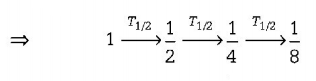
For this substance $$7$$ days correspond to $$3.5$$ half - lives. Over $$3$$ half- lifes the sample reduces to $$\frac{1}{{{2^3}}} = \frac{1}{8}$$ of its initial mass. After 4 half- lifes, the sample has only $$\frac{1}{{{2^4}}} = \frac{1}{{16}}$$ of its initial mass. Hence, after $$3.5$$ half -
lives the sample must contain somewhere between $$\frac{1}{8}$$ and $$\frac{1}{16}$$ of its initial mass. Hence $$5\,g$$ is somewhere between $$\frac{1}{8}$$ and $$\frac{1}{16}$$ of the initial mass.
So, the initial mass is somewhere between
$$8 \times 5 = 40\,g\,\,{\text{and}}\,\,16 \times 5 = 80\,g.$$
38.
The half-life of a radioactive material is $$3\,h.$$ If the initial amount is $$300\,g,$$ then after $$18\,h,$$ it will remain
A
$$4.68\,g$$
B
$$46.8\,g$$
C
$$9.375\,g$$
D
$$93.75\,g$$
Answer :
$$4.68\,g$$
Number of half-lives
$$n = \frac{t}{{{T_{\frac{1}{2}}}}} = \frac{{18}}{3} = 6\,\,\left[ {{T_{\frac{1}{2}}} = {\text{half life period}}} \right]$$
Amount remained after $$n$$ half-lives
$$N = {N_0}{\left( {\frac{1}{2}} \right)^n}\,\,\left[ {_{N = {\text{ final count}}}^{{N_0} = \,\,{\text{initial count}}}} \right]$$
$$\eqalign{
& {\text{Given,}}\,\,{N_0} = 300\,g \cr
& \therefore N = 300{\left( {\frac{1}{2}} \right)^6} = 300 \times \frac{1}{{64}} = 4.68\,g \cr} $$ Alternative
Total time of decay given
$$\eqalign{
& t = \frac{{2.303}}{\lambda }{\log _{10}}\left( {\frac{{300}}{N}} \right) \cr
& {\text{but}}\,\,\lambda = \frac{{0.693}}{T} = \frac{{0.693}}{3} = 0.231/h \cr
& \therefore t = \frac{{2.303}}{{0.231}}{\log _{10}}\left( {\frac{{300}}{N}} \right) \cr
& {\text{Given}}\,\,t = 18\;h \cr
& {\text{So,}}\,\,18 = \frac{{2.303}}{{0.231}}{\log _{10}}\left( {\frac{{300}}{N}} \right) \cr
& {\text{or}}\,\,{\log _{10}}\left( {\frac{{300}}{N}} \right) = \frac{{0.231}}{{2.303}} \times 18 \cr
& {\text{or}}\,\,\frac{{300}}{N} = {\left( {10} \right)^{18}}\,\,{\text{or}}\,\,N = \frac{{300}}{{{{\left( {10} \right)}^{18}}}} = 4.68\,g \cr} $$
39.
The ratio of half-life time of two elements $$A$$ and $$B$$ is $$\frac{{{T_A}}}{{{T_B}}}.$$ The ratio of respective decay constant $$\frac{{{\lambda _A}}}{{{\lambda _B}}},$$ is
40.
A piece of bone of an animal from a ruin is found to have $$^{14}C$$ activity of $$12$$ disintegrations per minute per $$gm$$ of its carbon content. The $$^{14}C$$ activity of a living animal is $$16$$ disintegrations per minute per $$gm.$$ How long ago nearly did the animal die? (Given half life of $$^{14}C$$ is $${t_{\frac{1}{2}}} = 5760\,{\text{years}}$$ )