Radioactivity MCQ Questions & Answers in Modern Physics | Physics
Learn Radioactivity MCQ questions & answers in Modern Physics are available for students perparing for IIT-JEE, NEET, Engineering and Medical Enternace exam.
61.
A heavy nucleus having mass number 200 gets disintegrated into two small fragments of mass number 80 and 120. If binding energy per nucleon for parent atom is $$6.5\,MeV$$ and for daughter nuclei is $$7\,MeV$$ and $$8\,MeV$$ respectively, then the energy released in the decay will be -
A
$$200\,MeV$$
B
$$ - 200\,MeV$$
C
$$220\,MeV$$
D
$$180\,MeV$$
Answer :
$$220\,MeV$$
Energy released $$ = \left( {80 \times 7 + 120 \times 8 - 200 \times 6.5} \right)$$
$$ = 220\,MeV.$$
62.
An archaeologist analyses the wood in a prehistoric structure and finds that $${C^{14}}$$ (Half life = 5700 years) to $${C^{12}}$$ is only one-fourth of that found in the cells of buried plants. The age of the wood is about
63.
Half-lives of two radioactive substances $$A$$ and $$B$$ are respectively $$20\,min$$ and $$40\,min.$$ Initially, the samples of $$A$$ and $$B$$ have equal number of nuclei. After $$80\,min$$ the ratio of remaining number of $$A$$ and $$B$$ nuclei is
A
$$1:16$$
B
$$4:1$$
C
$$1:4$$
D
$$1:1$$
Answer :
$$1:4$$
Total time given $$= {80\,\min }$$
Number of half-lives of $$A,$$ $${n_A} = \frac{{80\,\min }}{{20\;\,\min }} = 4$$
Number of half-lives of $$B,$$ $${n_B} = \frac{{80\,\min }}{{40\;\,\min }} = 2$$
Number of nuclei remained undecayed $$N = {N_0}{\left( {\frac{1}{2}} \right)^n}$$
where $${N_0}$$ is initial number of nuclei and $$N$$ is final number of nuclei
So for two different cases $$\left( A \right)$$ and $$\left( B \right),$$
$$\eqalign{
& \frac{{{N_A}}}{{{N_B}}} = \frac{{{{\left( {\frac{1}{2}} \right)}^{{n_A}}}}}{{{{\left( {\frac{1}{2}} \right)}^{{n_B}}}}}\,\,{\text{or}}\,\,\frac{{{N_A}}}{{{N_B}}} = \frac{{{{\left( {\frac{1}{2}} \right)}^4}}}{{{{\left( {\frac{1}{2}} \right)}^2}}} = \frac{{\left( {\frac{1}{{16}}} \right)}}{{\left( {\frac{1}{4}} \right)}} \cr
& {\text{or}}\,\,\frac{{{N_A}}}{{{N_B}}} = \frac{1}{4} \cr} $$
64.
A nucleus $$_n{X^m}$$ emits one $$\alpha $$ and two $$\beta $$-particles. The resulting nucleus is
A
$$_n{X^{m - 4}}$$
B
$$_{n - 2}{Y^{m - 4}}$$
C
$$_{n - 4}{Z^{m - 4}}$$
D
None of these
Answer :
$$_n{X^{m - 4}}$$
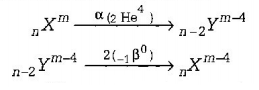
The reaction can be shown as
Thus, the resulting nucleus is the isotope of parent nucleus and is $$_n{X^{m - 4}}.$$
65.
The half life of a radioactive substance is 20 minutes. The approximate time interval $$\left( {{t_2} - {t_1}} \right)$$ between the time $${t_2}$$ when $$\frac{2}{3}$$ of it had decayed and time $${t_1}$$ when $$\frac{1}{3}$$ of it had decayed is :
A
$$14\,min$$
B
$$20\,min$$
C
$$28\,min$$
D
$$7\,min$$
Answer :
$$20\,min$$
Number of undecayed atom after time $${t_2};$$
$$\frac{{{N_0}}}{3} = {N_0}{e^{ - \lambda {t_2}}}\,......\left( {\text{i}} \right)$$
Number of undecayed atom after time $${t_1};$$
$$\eqalign{
& \frac{{2{N_0}}}{3} = {N_0}{e^{ - \lambda {t_1}}}\,......\left( {{\text{ii}}} \right) \cr
& {\text{From}}\,\left( {\text{i}} \right),{e^{ - \lambda {t_2}}} = \frac{1}{3} \cr
& \Rightarrow - \lambda {t_2} = {\log _e}\left( {\frac{1}{3}} \right)\,......\left( {{\text{iii}}} \right) \cr
& {\text{From}}\,\left( {{\text{ii}}} \right) - {e^{ - \lambda {t_2}}} = \frac{2}{3} \cr
& \Rightarrow - \lambda {t_1} = {\log _e}\left( {\frac{2}{3}} \right)\,......\left( {{\text{iv}}} \right) \cr} $$
Solving (iii) and (iv), we get
$${t_2} - {t_1} = 20min$$
66.
In gamma ray emission from a nucleus
A
only the proton number changes
B
both the neutron number and the proton number change
C
there is no change in the proton number and the neutron number
D
only the neutron number changes
Answer :
there is no change in the proton number and the neutron number
There is no change in the proton number and the
neutron number as the $$\gamma $$-emission takes place as a result of excitation or de-excitation of nuclei. $$\gamma $$-rays have no charge or mass.
67.
The number of beta particles emitted by a radioactive substance is twice the number of alpha particles emitted by it. The resulting daughter is an
A
isobar of parent
B
isomer of parent
C
isotone of parent
D
isotope of parent
Answer :
isotope of parent
Let the radioactive substance be $$_Z^AX.$$
Radioactive transition is given by
\[_Z^AX\xrightarrow{{ - \alpha }}_{Z - 2}^{A - 4}X\xrightarrow{{ - 2\beta }}_Z^{A - 4}X\]
The atoms of element having same atomic number but different mass numbers are called isotopes.
So, $$_Z^AX$$ and $$_Z^{A - 4}X$$ are isotopes.
68.
A radioactive material decays by simultaneous emission of two particles with respective half-lives 1620 and 810 years. The time, in years, after which one-fourth of the material remains is
69.
The activity of a radioactive sample is measured as $${N_0}$$ counts per minute at $$t = 0$$ and $$\frac{{{N_0}}}{e}$$ counts per minute at $$t = 5\,min.$$ The time (in minute) at which the activity reduces to half its value is
A
$${\log _e}\frac{2}{5}$$
B
$$\frac{5}{{{{\log }_e}2}}$$
C
$$5{\log _{10}}2$$
D
$$5{\log _e}2$$
Answer :
$$5{\log _e}2$$
Fraction remains after $$n$$ half lives
$$\eqalign{
& \frac{N}{{{N_0}}} = {\left( {\frac{1}{2}} \right)^n} = {\left( {\frac{1}{2}} \right)^{\frac{t}{T}}} \cr
& {\text{Given}}\,\,N = \frac{{{N_0}}}{e} \Rightarrow \frac{{{N_0}}}{{e{N_0}}} = {\left( {\frac{1}{2}} \right)^{\frac{5}{T}}} \cr
& {\text{or}}\,\,\frac{1}{e} = {\left( {\frac{1}{2}} \right)^{\frac{5}{T}}} \cr} $$
Taking log on both sides, we get
$$\eqalign{
& \log 1 - \log e = \frac{5}{T}\log \frac{1}{2} \cr
& \Rightarrow - 1 = \frac{5}{T}\left( { - \log 2} \right) \cr
& \Rightarrow T = 5{\log _e}2 \cr} $$
Now, let $$t’$$ be the time after which activity reduces to half
$$\left( {\frac{1}{2}} \right) = {\left( {\frac{1}{2}} \right)^{\frac{{t'}}{{5{{\log }_e}2}}}} \Rightarrow t' = 5{\log _e}2$$
70.
A radioactive nucleus of mass $$M$$ emits a photon of frequency $$\nu $$ and the nucleus recoils. The recoil energy will be
A
$$\frac{{{h^2}{\nu ^2}}}{{2M{c^2}}}$$
B
zero
C
$$h\nu $$
D
$$M{c^2} - h\nu $$
Answer :
$$\frac{{{h^2}{\nu ^2}}}{{2M{c^2}}}$$
Momentum of a photon $$p = \frac{{h\nu }}{c}$$
Hence, recoil energy, $$E = \frac{{{p^2}}}{{2M}}$$
$$\therefore E = \frac{{{{\left( {\frac{{h\nu }}{c}} \right)}^2}}}{{2M}}\,{\text{or}}\,\,E = \frac{{{h^2}{\nu ^2}}}{{2M{c^2}}}$$