111.
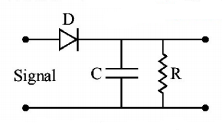
A diode detector is used to detect an amplitude modulated
wave of $$60\% $$ modulation by using a condenser of capacity 250 picofarad in parallel with a load resistance $$100\,kilo\,ohm.$$ Find the maximum modulated frequency which could be detected by it.
A
$$10.62\,MHz$$
B
$$10.62\,kHz$$
C
$$5.31\,MHz$$
D
$$5.31\,kHz$$
Answer :
$$10.62\,kHz$$
112. Application of a forward bias to a $$p-n$$ junction
A
increases the number of donors on the $$n$$-side
B
increases the electric field in the depletion zone
C
increases the potential difference across the depletion zone
D
widens the depletion zone
Answer :
increases the number of donors on the $$n$$-side
113.
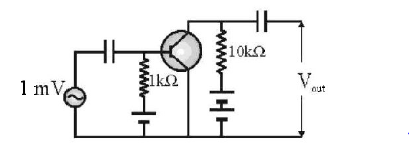
In the following common emitter configuration an $$NPN$$ transistor with current gain $$\beta = 100$$ is used. The output voltage of the amplifier will be
A
$$10\,mV$$
B
$$0.1\,V$$
C
$$1.0\,V$$
D
$$10\,V$$
Answer :
$$1.0\,V$$
114. In a $$p$$-type semiconductor the acceptor level is situated $$60\,meV$$ above the valence band. The maximum wavelength of light required to produce a hole will be
A
$$0.207 \times {10^{ - 5}}m$$
B
$$2.07 \times {10^{ - 5}}m$$
C
$$20.7 \times {10^{ - 5}}m$$
D
$$2075 \times {10^{ - 5}}m$$
Answer :
$$2.07 \times {10^{ - 5}}m$$
115. Which of the following statements is not true?
A
The resistance of intrinsic semiconductors decrease with increase of temperature
B
Doping pure $$Si$$ with trivalent impurities give $$p$$-type semiconductors
C
The majority carriers in $$n$$-type semiconductors are holes
D
A $$p$$-$$n$$ junction can act as a semiconductor diode
Answer :
The majority carriers in $$n$$-type semiconductors are holes
116. In an experiment with $$npn$$ transistor amplifier in common emitter configuration, the current gain of the transistor is 100. If the collector current changes by $$1\,mA,$$ what will be the change in emitter current?
A
$$1.1\,mA$$
B
$$1.01\,mA$$
C
$$0.01\,mA$$
D
$$10\,mA$$
Answer :
$$1.01\,mA$$
117.
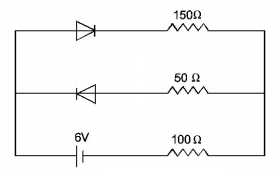
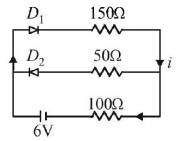
The circuit shown in the figure contains two diodes each
with a forward resistance of $$50\,ohms$$ and with infinite backward resistance. If the battery voltage is $$6V,$$ the current through the $$100\,ohm$$ resistance (in amperes) is
A
zero
B
0.02
C
0.03
D
0.036
Answer :
0.02
118. A transistor is operated in common emitter configuration at constant collector voltage $${V_c} = 1.5\,V$$ such that a change in the base current from $$100\,\mu A$$ to $$150\,\mu A$$ produces a change in the collector current from $$5\,mA$$ to $$10\,mA.$$ The current gain $$\left( \beta \right)$$ is
A
67
B
75
C
100
D
50
Answer :
100
119.
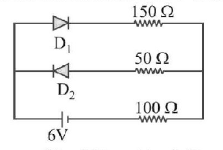
The circuit shown in following figure contains two diode $${D_1}$$ and $${D_2}$$ each with a forward resistance of 50 ohms and with infinite backward resistance. If the battery voltage is $$6\,V,$$ the current through the 100 ohm resistance (in amperes) is
A
zero
B
0.02
C
0.03
D
0.036
Answer :
0.02
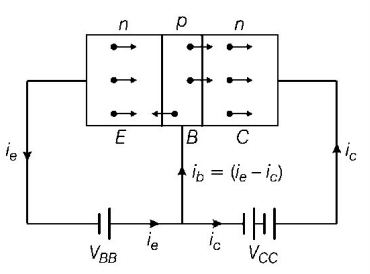
120. When a $$n-p-n$$ transistor is used as an amplifier, then
A
the electrons flow from emitter to collector
B
the holes flow from emitter to collector
C
the electrons flow from collector to emitter
D
the electrons flow from battery to emitter
Answer :
the electrons flow from emitter to collector