Semiconductors and Electronic Devices MCQ Questions & Answers in Modern Physics | Physics
Learn Semiconductors and Electronic Devices MCQ questions & answers in Modern Physics are available for students perparing for IIT-JEE, NEET, Engineering and Medical Enternace exam.
121.
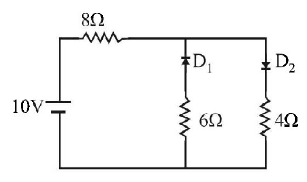
The circuit has two oppositively connected ideal diodes in parallel. What is the current flowing in the circuit?
A
$$0.4\,A$$
B
$$0.8\,A$$
C
$$0.6\,A$$
D
$$0.5\,A$$
Answer :
$$0.8\,A$$
$${D_2}$$ is forward biased whereas $${D_1}$$ is reversed biased.
So effective resistance of the circuit
$$\eqalign{
& R = 8 + 4 = 12\Omega \cr
& \therefore i = \frac{{10}}{{12}} = 0.8\,A \cr} $$
122.
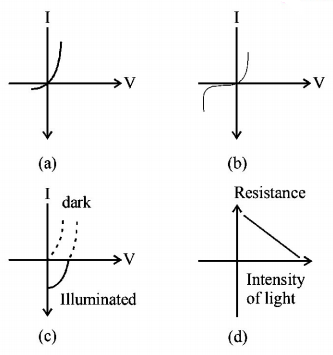
Identify the semiconductor devices whose characteristics are given below, in the order (a), (b), (c), (d) :
A
Solar cell, Light dependent resistance, Zener diode simple diode
B
Zener diode, Solar cell, simple diode, Light dependent resistance
C
Simple diode, Zener diode, Solar cell, Light dependent resistance
D
Zener diode, Simple diode, Light dependent resistance, Solar cell
Graph (a) is for a simple diode.
Graph (b) is showing the $$V$$ Break down used for zener diode.
Graph (c) is for solar cell which shows cut-off voltage and open circuit current.
Graph (d) shows the variation of resistance $$h$$ and hence current with intensity of light.
123.
When a $$p$$ - $$n$$ junction diode is reverse biased the flow of current across the junction is mainly due to
A
diffusion of charges
B
drift charges
C
Depends on the nature of material
D
Both drift and diffusion of charges
Answer :
drift charges
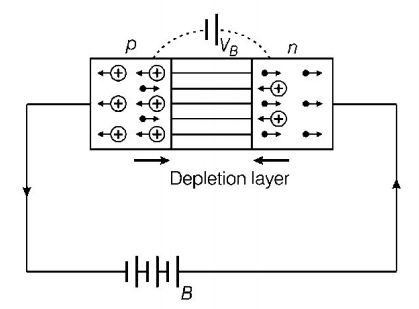
A $$p$$ - $$n$$ junction is said to be reverse biased, if the positive terminal of the external battery $$B$$ is connected to $$n$$-side and the negative terminal to $$p$$-side of the $$p$$ - $$n$$ junction.
In reverse biasing, the reverse bias voltage supports the potential barrier $${V_B}.$$ Now the majority carriers are pulled away from the junction and the depletion region becomes thick.
There is no conduction across the junction due to majority carriers. However, a few minority carriers (holes in $$n$$-section and electrons in $$p$$-section) of $$p$$ - $$n$$ junction diode cross the junction after being accelerated by high reverse bias voltage. They constitute a current that flows in the opposite direction.
So when $$p$$ - $$n$$ junction is reverse biased, the flow of current is due to drifting of minority charge carries across the junction.
124.
In a $$p-n$$ junction having depletion layer of thickness $${10^{ - 6}}m$$ the potential across it is $$0.1\,V.$$ The electric field is
125.
Copper, a monovalent, has molar mass $$63.54\,g/mol$$ and density $$8.96\,g/c{m^3}.$$ What is the number density $$n$$ of conduction electron in copper?
A
$$3.2 \times {10^{20}}{m^{ - 3}}$$
B
$$8.49 \times {10^{26}}{m^{ - 3}}$$
C
$$6.2 \times {10^{31}}{m^{ - 3}}$$
D
None
Answer :
$$8.49 \times {10^{26}}{m^{ - 3}}$$
If $$M$$ is the molar mass and $$\rho $$ is the density then volume of one mole
$$V = \frac{M}{\rho }.$$
The number of atoms per unit volume
$$\eqalign{
& = \frac{{{N_A}}}{V} = \frac{{{N_A}}}{{\frac{M}{\rho }}} = \frac{{{N_A}\rho }}{M} = \frac{{\left( {6.02 \times {{10}^{23}}} \right) \times \left( {8.96} \right)}}{{63.54}} \cr
& = 8.49 \times {10^{22}}c{m^{ - 3}} \cr
& = 8.49 \times {10^{28}}{m^{ - 3}} \cr} $$
As each copper (monovalent) atom has one electron, so number of electrons per unit volume
$$ = 8.49 \times {10^{26}}{m^{ - 3}}$$
126.
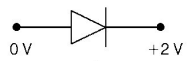
In which of the following figures, junction diode is forward biased ?
A
B
C
D
Answer :
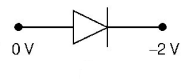
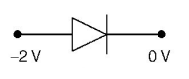
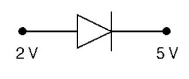
For forward biasing of $$p$$ - $$n$$ junction, $$p$$-side should be at higher potential than $$n$$ -side. Now we apply this rule to the four options.
(A) Here, $$p$$-side is at lower potential $$\left( {0\,V} \right)$$ and $$n$$ -side at higher potential $$\left( {2\,V} \right).$$ So, this diode is not forward biased.
(B) Here, $$p$$ -side is at higher potential $$\left( {0\,V} \right)$$ and $$n$$-side at lower potential $$\left( { - 2\,V} \right).$$ So, this diode is forward biased.
(C) Here, $$p$$ -side is at lower potential $$\left( { - 2\,V} \right)$$ and $$n$$-side at higher potential $$\left( {0\,V} \right).$$ So, this diode is not forward biased.
(D) Here $$p$$ -side is at lower potential $$\left( {2\,V} \right)$$ and $$n$$ -side at higher potential $$\left( {5\,V} \right).$$ So, this is not forward biased.
Hence, choice (B) is correct.
127.
The given electrical network is equivalent to

A
AND gate
B
OR gate
C
NOR gate
D
NOT gate
Answer :
NOR gate
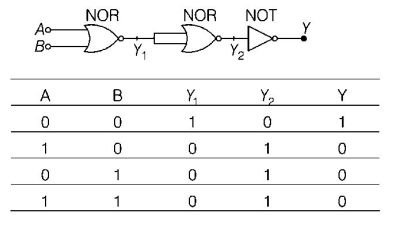
Truth table for given network is
A
B
$${Y_1}$$
$${Y_2}$$
Y
0
0
1
0
1
1
0
0
1
0
0
1
0
1
0
1
1
0
1
0
Output $$Y$$ of network matches with that of NOR gate.
128.
In a junction diode, the holes are due to
A
protons
B
extra electrons
C
neutrons
D
missing electrons
Answer :
missing electrons
In a junction diode, when electron jumps to conduction band from valence band due to thermal agitation or any other circumstances, then a vacancy is created in valence band which has positive charge equal to charge of electron in magnitude. This is called a hole.
Thus, holes in junction diode are due to missing electrons.
129.
When arsenic is added as an impurity to silicon, the resulting material is
A
$$n$$-type semiconductor
B
$$p$$-type semiconductor
C
$$n$$-type conductor
D
insulator
Answer :
$$n$$-type semiconductor
When a small amount of pentavalent impurity is added to a pure semiconductor, it is known as $$n$$-type semiconductor. Arsenic (33) is pentavalent impurity. The addition of pentavalent impurity provides a large number of free electrons in the semiconductor crystal.
130.
In germanium the energy gap is about $$0.75\,eV.$$ The wavelength of light which germanium starts absorbing is