141.
The symbolic representation of four logic gates
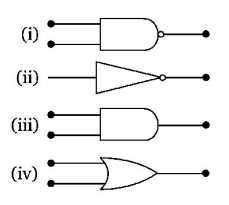
The logic symbols for OR, NOT and NAND gates are respectively
A
(iii), (iv), (ii)
B
(iv), (i), (iii)
C
(iv), (ii), (i)
D
(i), (iii), (iv)
Answer :
(iv), (ii), (i)
142. In a full wave rectifier circuit operating from $$150\,Hz$$ mains frequency, the fundamental frequency in the ripple would be
A
$$25\,Hz$$
B
$$50\,Hz$$
C
$$70.7\,Hz$$
D
$$300\,Hz$$
Answer :
$$300\,Hz$$
143. The correct relationship between the two current gains $$\alpha $$ and $$\beta $$ in a transistor is
A
$$\beta = \frac{{1 + \alpha }}{\beta }$$
B
$$\alpha = \frac{\beta }{{1 + \beta }}$$
C
$$\alpha = \frac{\beta }{{1 - \beta }}$$
D
$$\beta = \frac{\alpha }{{1 + \alpha }}$$
Answer :
$$\alpha = \frac{\beta }{{1 + \beta }}$$
144. Carbon, silicon and germanium atoms have four valence electrons each. Their valence and conduction bands are separated by energy band gaps represented by $${\left( {{E_g}} \right)_C},{\left( {{E_g}} \right)_{Si}}$$ and $${\left( {{E_g}} \right)_{Ge}}$$ respectively. Which one of the following relationships is true in their case ?
A
$${\left( {{E_g}} \right)_C} > {\left( {{E_g}} \right)_{Si}}$$
B
$${\left( {{E_g}} \right)_C} = {\left( {{E_g}} \right)_{Si}}$$
C
$${\left( {{E_g}} \right)_C} < {\left( {{E_g}} \right)_{Ge}}$$
D
$${\left( {{E_g}} \right)_C} < {\left( {{E_g}} \right)_{Si}}$$
Answer :
$${\left( {{E_g}} \right)_C} > {\left( {{E_g}} \right)_{Si}}$$
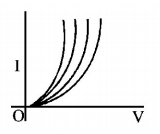
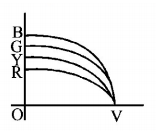
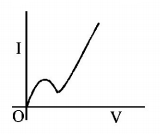
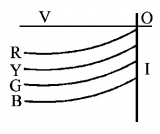
145. The $$I-V$$ characteristic of an LED is
A
B
C
D
Answer :
146. The part of a transistor which is most heavily doped to produce large number of majority carriers is
A
emmiter
B
base
C
collector
D
can be any of the above three.
Answer :
emmiter
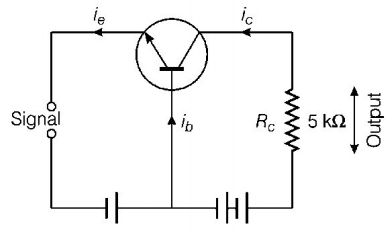
147. To use a transistor as an amplifier
A
the emitter base junction is forward biased and the base collector junction is reversed biased
B
no bias voltage is required
C
both junctions are forward biased
D
both junctions are reverse biased
Answer :
the emitter base junction is forward biased and the base collector junction is reversed biased
148. A signal of $$5\,kHz$$ frequency is amplitude modulated on a carrier wave of frequency $$2\,MHz.$$ The frequencies of the resultant signal is/are :
A
$$2005\,kHz,\,2000\,kHz$$ and $$1995\,kHz$$
B
$$2000\,kHz$$ and $$1995\,kHz$$
C
$$2\,MHz$$ only
D
$$2005\,kHz$$ and $$1995\,kHz$$
Answer :
$$2005\,kHz,\,2000\,kHz$$ and $$1995\,kHz$$
149. When $$NPN$$ transistor is used as an amplifier
A
electrons move from base to emitter
B
holes move from emitter to base
C
electrons move from collector to base
D
holes move from base to emitter
Answer :
holes move from base to emitter
150.
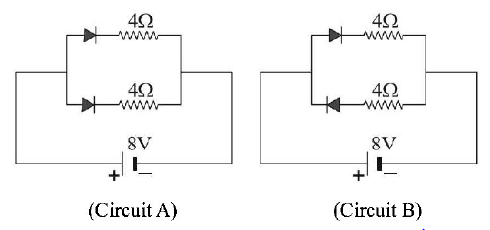
Currents flowing in each of the circuits $$A$$ and $$B$$ respectively are
A
$$1\,A,2\,A$$
B
$$2\,A,1\,A$$
C
$$4\,A,2\,A$$
D
$$2\,A,4\,A$$
Answer :
$$4\,A,2\,A$$