151. Which one of the following statement is false?
A
Pure $$Si$$ doped with trivalent impurities gives a $$p$$-type semiconductor
B
Majority carriers in a $$n$$-type semiconductor are holes
C
Minority carriers in a $$p$$-type semiconductor are electrons
D
The resistance of intrinsic semiconductor decreases with increase of temperature.
Answer :
Majority carriers in a $$n$$-type semiconductor are holes
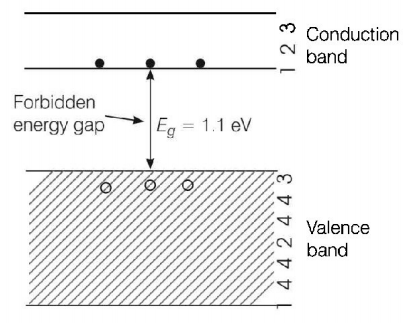
152. In semiconductors at a room temperature
A
the valence band is partially empty and the conduction band is partially filled
B
the valence band is completely filled and the conduction band is partially filled
C
the valence band is completely filled
D
the conduction band is completely empty
Answer :
the valence band is partially empty and the conduction band is partially filled
153. The ratio of work function and temperature of two emitters are $$1 : 2,$$ then the ratio of current densities obtained by them will be
A
$$4 : 1$$
B
$$2 : 1$$
C
$$1 : 2$$
D
$$1 : 4$$
Answer :
$$1 : 4$$
154. In the case of a common emitter transistor amplifier the ratio of the collector current to the emitter current $$\frac{{{I_c}}}{{{I_e}}}$$ is 0.96. The current gain of the amplifier is
A
6
B
48
C
24
D
12
Answer :
24
155. For CE transistor amplifier, the audio signal voltage across the collector resistance of $$2\,k\Omega $$ is $$4\,V.$$ If the current amplification factor of the transistor is 100 and the base resistance is $$1\,k\Omega ,$$ then the input signal voltage is
A
$$10\,mV$$
B
$$20\,mV$$
C
$$30\,mV$$
D
$$15\,mV$$
Answer :
$$20\,mV$$
156. In a $$CE$$ transistor amplifier, the audio signal voltage across the collector resistance of $$2\,k\Omega $$ is $$2\,V.$$ If the base resistance is $$1\,k\Omega $$ and the current amplification of the transistor is 100, the input signal voltage is
A
$$0.1\,V$$
B
$$1.0\,V$$
C
$$1\,mV$$
D
$$10\,mV$$
Answer :
$$10\,mV$$
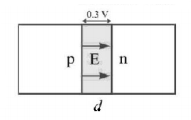
157. A potential barrier of 0.3 Volt exists across a $$p-n$$ junction. The depletion region is $$1\,\mu m$$ wide. The intensity of electric field in this region is $$E.$$ If electron with speed $$5 \times {10^5}\,m/s$$ approaches this $$p-n$$ junction from n-side, what will be its speed $$V$$ on entering the $$p$$-side?
A
$$V = 12 \times {10^5}\,m/s$$
B
$$V = 1 \times {10^4}\,m/s$$
C
$$V = 3.8 \times {10^5}\,m/s$$
D
$$V = 1.6 \times {10^4}\,m/s$$
Answer :
$$V = 3.8 \times {10^5}\,m/s$$
158. At absolute zero, $$Si$$ acts as
A
non-metal
B
metal
C
insulator
D
none of these
Answer :
insulator
159. For a common base amplifier, the values of resistance gain and voltage gain are 3000 and 2800 respectively, The current gain will be
A
1.1
B
0.98
C
0.93
D
0.83
Answer :
0.93
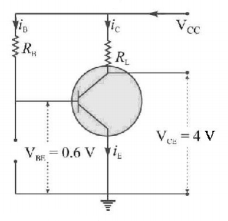
160. A $$npn$$ transistor in a common emitter mode is used as a simple voltage amplifier with a collector current of $$4\,mA.$$ the terminal of a $$8\,V$$ battery is connected to the collector through a load resistance $${R_L}$$ and to the base through a resistance $${R_B}.$$ The collector emitter voltage $${V_{CE}} = 4\,V,$$ base-emitter voltage $${V_{BE}} = 0.6$$ and the base current amplification factor $${\beta _{dc}} = 100,$$ calculate the value of $${R_B}.$$
A
$${R_B} = 15\,k\Omega $$
B
$${R_B} = 200\,k\Omega $$
C
$${R_B} = 1\,k\Omega $$
D
$${R_B} = 185\,k\Omega $$
Answer :
$${R_B} = 185\,k\Omega $$