161.
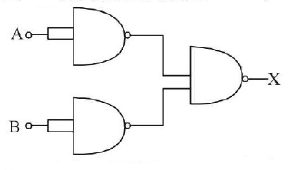
The combination of gates shown below yields
A
OR gate
B
NOT gate
C
XOR gate
D
NAND gate
Answer :
OR gate
162.
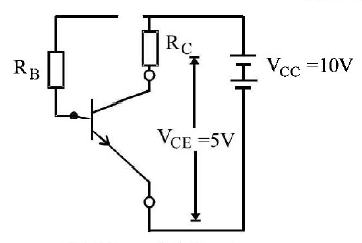
A transistor connected in common emitter configuration has input resistance $${R_B} = 2\,k\Omega $$ and load resistance of $$5\,k\Omega .$$ If $$\beta = 60$$ and an input signal $$12\,mV$$ is applied, calculate the voltage gain, the power gain and the value of output voltage
A
$${A_v} = 150,{V_{{\text{out}}}} = 1.8\,V,$$ and power gain = 9000
B
$${A_v} = 20,{V_{{\text{out}}}} = 1\,V,$$ and power gain = 2000
C
$${A_v} = 150,{V_{{\text{out}}}} = 1.5\,V,$$ and power gain = 8500
D
$${A_v} = 20,{V_{{\text{out}}}} = 1.5\,V,$$ and power gain = 2000
Answer :
$${A_v} = 150,{V_{{\text{out}}}} = 1.8\,V,$$ and power gain = 9000
163. If the lattice parameter for a crystalline structure is $$3.6\,\mathop {\text{A}}\limits^ \circ $$ then the atomic radius in fcc crystals is
A
$$1.81\,\mathop {\text{A}}\limits^ \circ $$
B
$$2.10\,\mathop {\text{A}}\limits^ \circ $$
C
$$2.92\,\mathop {\text{A}}\limits^ \circ $$
D
$$1.27\,\mathop {\text{A}}\limits^ \circ \,$$
Answer :
$$1.27\,\mathop {\text{A}}\limits^ \circ \,$$
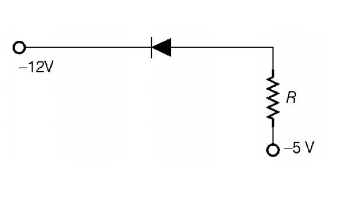
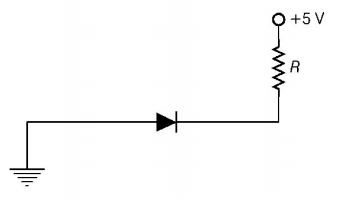
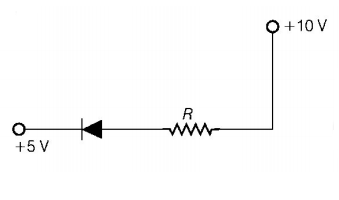
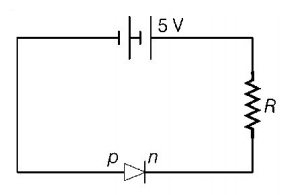
164. Of the diodes shown in the following diagrams, which one is reverse biased?
A
B

C
D
Answer :
165.
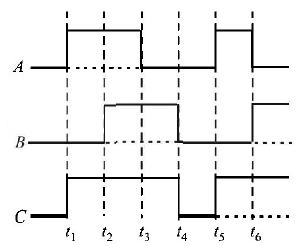
The figure shows a logic circuit with two inputs $$A$$ and $$B$$ and the output $$C.$$ The voltage wave forms across $$A,B$$ and $$C$$ are as given. The logic gate circuit is :
A
OR gate
B
NOR gate
C
AND gate
D
NAND gate
Answer :
OR gate
166.
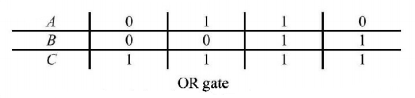
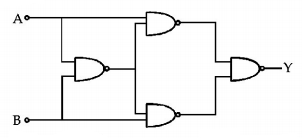
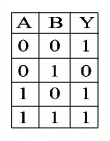
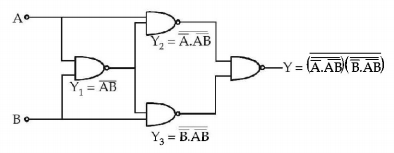
Truth table for system of four $$NAND$$ gates as shown in figure is :
A
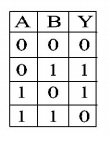
B
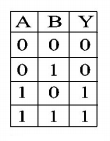
C
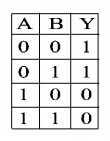
D
Answer :
167.
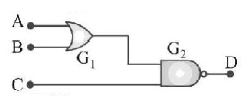
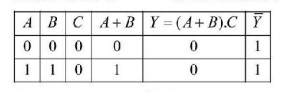
For the given combination of gates, if the logic states of inputs $$A, B, C$$ areas follows $$A = B = C = 0$$ and $$A = B = 1, C = 0$$ then the logic states of output $$D$$ are
A
0, 0
B
0, 1
C
1, 0
D
1, 1
Answer :
1, 1
168. The cause of the potential barrier in a $$p$$ - $$n$$ diode is
A
depletion of positive charges near the junction
B
concentration of positive charges near the junction
C
depletion of negative charges near the junction
D
concentration of positive and negative charges near the junction
Answer :
concentration of positive and negative charges near the junction
169.
In fig., the input is across the terminals $$A$$ and $$C$$ and the output is across $$B$$ and $$D.$$ Then the output is
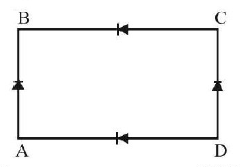
A
zero
B
same as the input
C
half wave rectified
D
full wave rectified
Answer :
full wave rectified
170. When a potential difference is applied across, the current passing through
A
an insulator at $$0\,K$$ is maximum
B
a semiconductor at $$0\,K$$ is zero
C
a metal at $$0\,K$$ is finite
D
a $$P-N$$ diode at $$300\,K$$ is zero, if it is reverse biased
Answer :
a semiconductor at $$0\,K$$ is zero