171.
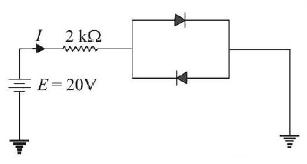
Assuming the diodes to be of silicon with forward resistance zero, the current $$I$$ in the following circuit is
A
$$0$$
B
$$9.65\,mA$$
C
$$10\,mA$$
D
$$10.36\,mA$$
Answer :
$$10\,mA$$
172. The current gain for a transistor working as common base amplifier is 0.96. If the emitter current is $$7.2\,mA,$$ then the base current is
A
$$0.29\,mA$$
B
$$0.35\,mA$$
C
$$0.39\,mA$$
D
$$0.43\,mA$$
Answer :
$$0.29\,mA$$
173. In common emitter amplifier, the current gain is 62. The collector resistance and input resistance are $$5\,k\Omega $$ an $$500\,\Omega $$ respectively. If the input voltage is $$0.01\,V,$$ the output voltage is
A
$$0.62\,V$$
B
$$6.2\,V$$
C
$$62\,V$$
D
$$620\,V$$
Answer :
$$6.2\,V$$
174. In $$p$$-type semiconductor, the majority charge carriers are
A
holes
B
electrons
C
protons
D
neutrons
Answer :
holes
175. A common emitter amplifier has a voltage gain of 50, an input impedance of $$100\,\Omega $$ and an output impedance of $$200\,\Omega .$$ The power gain of the amplifier is
A
1000
B
1250
C
100
D
500
Answer :
1250
176. The input signal given to a $$CE$$ amplifier having a voltage gain of 150 is $${V_i} = 2\cos \left( {15t + \frac{\pi }{3}} \right).$$ The corresponding output signal will be
A
$$300\cos \left( {15t + \frac{\pi }{3}} \right)$$
B
$$75\cos \left( {15t + \frac{{2\pi }}{3}} \right)$$
C
$$2\cos \left( {15t + \frac{{5\pi }}{3}} \right)$$
D
$$300\cos \left( {15t + \frac{{4\pi }}{3}} \right)$$
Answer :
$$300\cos \left( {15t + \frac{{4\pi }}{3}} \right)$$
177. On doping germanium with donor atoms of density $${10^{17}}c{m^{ - 3}}$$ its conductivity in $$mho/cm$$ will be [Given $${\mu _e} = 3800\,c{m^2}/V - s$$ and $${n_i} = 2.5 \times {10^{13}}c{m^{ - 13}}$$ ]
A
30.4
B
60.8
C
91.2
D
121.6
Answer :
60.8
178. When a triode is used as an amplifier the phase difference between the input signal voltage and the output is
A
zero
B
$$\pi $$
C
$$\frac{\pi }{2}$$
D
$$\frac{\pi }{4}$$
Answer :
$$\pi $$
179.
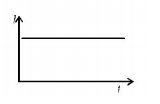
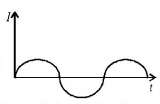
A $$p-n$$ junction $$\left( D \right)$$ shown in the figure can act as a rectifier. An alternating current source $$\left( V \right)$$ is connected in the circuit.
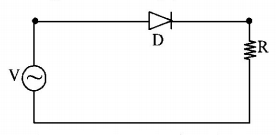
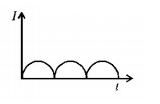
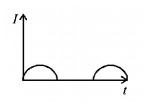
The current $$\left( I \right)$$ in the resistor $$\left( R \right)$$ can be shown by :
A
B
C
D
Answer :
180. A $$npn$$ transistor is connected in common emitter configuration in a given amplifier. A load resistance of $$800\,\Omega $$ is connected in the collector circuit and the voltage drop across it is $$0.8\,V.$$ If the current amplification factor is 0.96 and the input resistance of the circuit is $$192\,\Omega ,$$ the voltage gain and the power gain of the amplifier will respectively be :
A
4, 3.84
B
3.69, 3.84
C
4, 4
D
4, 3.69
Answer :
4, 3.84