181.
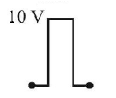
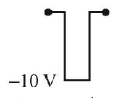
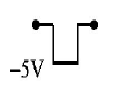
If in a $$p-n$$ junction diode, a square input signal of $$10\,V$$ is applied as shown
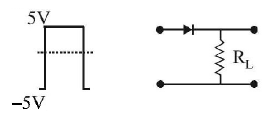
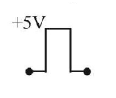
Then the output signal across $${R_L}$$ will be
A
B
C
D
Answer :
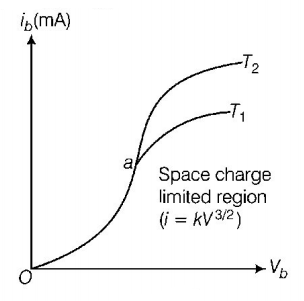
182. For an electronic valve, the plate current $$i$$ and plate voltage $$V$$ in the space charge limited region are related as
A
$$i$$ is proportional to $${V^{\frac{3}{2}}}$$
B
$$i$$ is proportional to $${V^{\frac{2}{3}}}$$
C
$$i$$ is proportional to $$V$$
D
$$i$$ is proportional to $${V^2}$$
Answer :
$$i$$ is proportional to $${V^{\frac{3}{2}}}$$
183. In forward bias the width of depletion layer in a $$p-n$$ junction diode
A
increases
B
decreases
C
remains constant
D
first increases then decreases
Answer :
decreases
184.
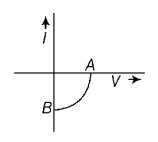
The given graph represents $$V-I$$ characteristic for a semiconductor device. Which of the following statement is correct?
A
It is $$V-I$$ characteristic for solar cell where point $$A$$ represents open circuit voltage and point $$B$$ short circuit current
B
It is for a solar cell and points $$A$$ and $$B$$ represent open circuit voltage and current, respectively
C
It is for a photodiode and points $$A$$ and $$B$$ represent open circuit voltage and current, respectively
D
It is for a LED and points $$A$$ and $$B$$ represent open circuit voltage and short circuit current respectively
Answer :
It is $$V-I$$ characteristic for solar cell where point $$A$$ represents open circuit voltage and point $$B$$ short circuit current
185. The concentration of hole - electron pairs in pure silicon at $$T= 300\,K$$ is $$7 \times {10^{15}}$$ per cubic meter. Antimony is doped into silicon in a proportion of 1 atom in $${10^7}Si$$ atoms. Assuming that half of the impurity atoms contribute electron in the conduction band, calculate the factor by which the number of charge carriers increases due to doping. The number of silicon atoms per cubic meter is $$5 \times {10^{28}}$$
A
$$2.8 \times {10^5}$$
B
$$3.1 \times {10^2}$$
C
$$4.2 \times {10^5}$$
D
$$1.8 \times {10^5}$$
Answer :
$$1.8 \times {10^5}$$
186. A silicon diode has a threshold voltage of $$0.7\,V.$$ If an input voltage given by $$2\sin \left( {\pi t} \right)$$ is supplied to a half wave rectifier circuit using this diode, the rectified output has a peak value of
A
$$2\,V$$
B
$$1.4\,V$$
C
$$1.3\,V$$
D
$$0.7\,V$$
Answer :
$$1.3\,V$$
187.
If in a $$p$$-$$n$$ junction diode, a square input signal of $$10\,V$$ is applied as shown
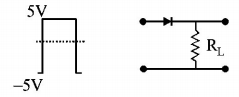
Then the output signal across $${R_L}$$ will be
A

B

C

D

Answer :
188. The peak voltage in the output of a half-wave diode rectifier fed with a sinusoidal signal without filter is $$10\,V.$$ The DC component of the output voltage is
A
$$\frac{{10}}{{\sqrt 2 }}V$$
B
$$\frac{{10}}{\pi }V$$
C
$$10\,V$$
D
$$\frac{{20}}{\pi }V$$
Answer :
$$\frac{{10}}{\pi }V$$
189.
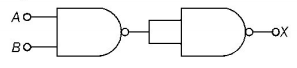
The output $$\left( X \right)$$ of the logic circuit shown in figure will be
A
$$X = \overline{\overline A} \cdot \overline{\overline B} $$
B
$$X = \overline {A \cdot B} $$
C
$$X = A \cdot B$$
D
$$X = \overline {A + B} $$
Answer :
$$X = A \cdot B$$
190.
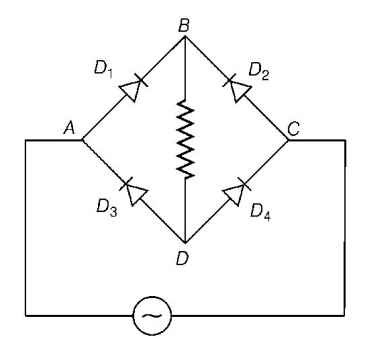
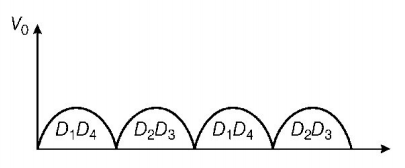
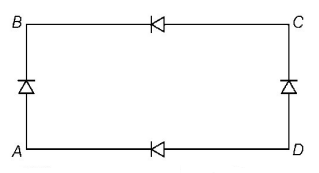
In figure the input is across the terminals $$A$$ and $$C$$ and the output is across $$B$$ and $$D.$$ Then the output is
A
zero
B
same as the input
C
half wave rectified
D
full wave rectified
Answer :
full wave rectified