11.
The following figure shows a logic gate circuit with two inputs $$A$$ and $$B$$ and the output $$C.$$ The voltage waveforms of $$A,B$$ and $$C$$ are as shown below
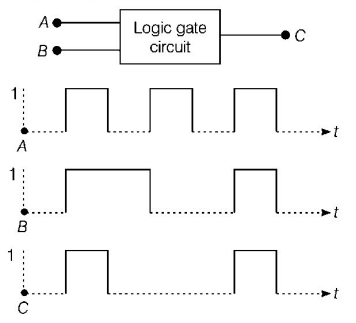
The logic circuit gate is
A
AND gate
B
NAND gate
C
NOR gate
D
OR gate
Answer :
AND gate
12.
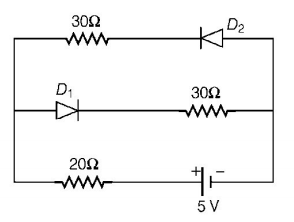
If internal resistance of cell is negligible, then current flowing through the circuit is
A
$$\frac{3}{{50}}A$$
B
$$\frac{5}{{50}}A$$
C
$$\frac{4}{{50}}A$$
D
$$\frac{2}{{50}}A$$
Answer :
$$\frac{5}{{50}}A$$
13. The difference in the variation of resistance with temeperature in a metal and a semiconductor arises essentially due to the difference in the
A
crystal sturcture
B
variation of the number of charge carriers with temperature
C
type of bonding
D
variation of scattering mechanism with temperature
Answer :
variation of the number of charge carriers with temperature
14.
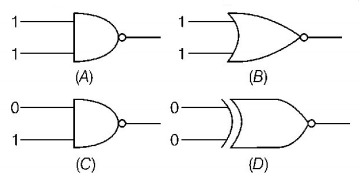
Which one of the following gates will have an output of 1?
A
A
B
B
C
C
D
D
Answer :
C
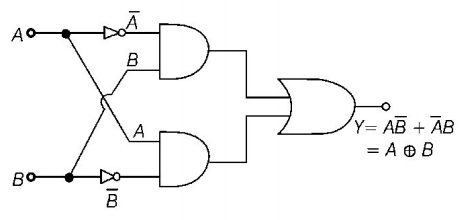
15. In a common emitter transistor amplifier, the audio signal voltage across the collector is $$3\,V.$$ The resistance of collector is $$3\,k\Omega .$$ If current gain is 100 and the base resistance is $$2\,k\Omega ,$$ the voltage and power gain of the amplifier is
A
200 and 1000
B
15 and 200
C
150 and 15000
D
20 and 2000
Answer :
150 and 15000
16. The ratio of electron and hole currents in a semiconductor is $$\frac{7}{4}$$ and the ratio of drift velocities of electrons and holes is $$\frac{5}{4},$$ then ratio of concentrations of electrons and holes will be
A
$$\frac{5}{7}$$
B
$$\frac{7}{5}$$
C
$$\frac{25}{49}$$
D
$$\frac{49}{25}$$
Answer :
$$\frac{7}{5}$$
17. A red LED emits light at $$0.1\,watt$$ uniformly around it. The amplitude of the electric field of the light at a distance of $$1m$$ from the diode is :
A
$$5.48\,V/m$$
B
$$7.75\,V/m$$
C
$$1.73\,V/m$$
D
$$2.45\,V/m$$
Answer :
$$2.45\,V/m$$
18. To obtain a $$p$$-type germanium semiconductor, it must be doped with
A
phosphorus
B
indium
C
antimony
D
arsenic
Answer :
indium
19. The input resistance of a silicon transistor is $$100\,W.$$ Base current is changed by $$40\,\mu A$$ which results in a change in collector current by $$2\,mA.$$ This transistor is used as a common emitter amplifier with a load resistance of $$4\,K\Omega .$$ The voltage gain of the amplifier is :
A
2000
B
3000
C
4000
D
1000
Answer :
2000
20. In a common emitter $$\left( {CE} \right)$$ amplifier having a voltage gain $$G,$$ the transistor used has transconductance $$0.03\,mho$$ and current gain 25. If the above transistor is replaced with another one with transconductance $$0.02\,mho$$ and current gain 20, the voltage gain will
A
$$\frac{2}{3}G$$
B
$$1.5\,G$$
C
$$\frac{1}{3}G$$
D
$$\frac{5}{4}G$$
Answer :
$$\frac{2}{3}G$$