201. In a transistor, the change in base current from $$100\,\mu A$$ to $$125\,\mu A$$ causes a change in collector current from $$5\,mA$$ to $$7.5\,mA,$$ keeping collector-to- emitter voltage constant at $$10\,V.$$ What is the current gain of the transistor?
A
200
B
100
C
50
D
25
Answer :
100
202. A transistor-oscillator using a resonant circuit with an inductor $$L$$ (of negligible resistance) and a capacitor $$C$$ in series produce oscillations of frequency $$f.$$ If $$L$$ is doubled and $$C$$ is changed to $$4\,C,$$ the frequency will be
A
$$\frac{f}{4}$$
B
$$8f$$
C
$$\frac{f}{{2\sqrt 2 }}$$
D
$$\frac{f}{2}$$
Answer :
$$\frac{f}{{2\sqrt 2 }}$$
203. When $$n$$-type semiconductor is heated
A
number of electrons increases while that of holes decreases
B
number of holes increases while that of electrons decreases
C
number of electrons and holes remain same
D
number of electrons and holes increases equally
Answer :
number of electrons and holes increases equally
204.
Zener diode is connected to a battery and a load as show below:
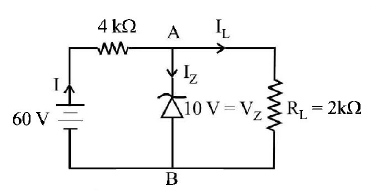
The currents, $$I,{I_Z}$$ and $${I_L}$$ are respectively.
A
$$15\,mA,5\,mA,10\,mA$$
B
$$15\,mA,7.5\,mA,7.5\,mA$$
C
$$12.5\,mA,5\,mA,7.5\,mA$$
D
$$12.5\,mA,7.5\,mA,5\,mA$$
Answer :
$$12.5\,mA,7.5\,mA,5\,mA$$
205.
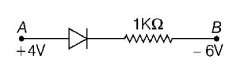
Consider the junction diode as ideal. The value of current flowing through $$AB$$ is
A
$${10^{ - 2}}\,A$$
B
$${10^{ - 1}}\,A$$
C
$${10^{ - 3}}\,A$$
D
$$0\,A$$
Answer :
$${10^{ - 2}}\,A$$
206. A transistor has a base current of $$1\,mA$$ and emitter current $$90\,mA.$$ The collector current will be
A
$$90\,mA$$
B
$$1\,mA$$
C
$$89\,mA$$
D
$$91\,mA$$
Answer :
$$89\,mA$$
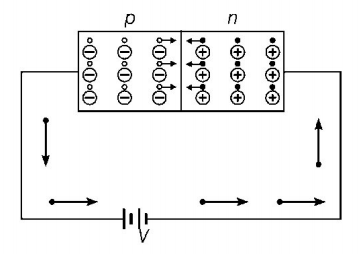
207. $$p$$ - $$n$$ junction is said to be forward biased, when
A
the positive pole of the battery is joined to the $$p$$-semiconductor and negative pole to the $$n$$-semiconductor
B
the positive pole of the battery is joined to the $$n$$-semiconductor and negative pole to the $$p$$-semiconductor
C
the positive pole of the battery is connected to $$n$$-semiconductor and $$p$$-semiconductor
D
a mechanical force is applied in the forward direction
Answer :
the positive pole of the battery is joined to the $$p$$-semiconductor and negative pole to the $$n$$-semiconductor
208. At absolute zero, $$Si$$ acts as
A
non-metal
B
metal
C
insulator
D
None of the above
Answer :
insulator
209.
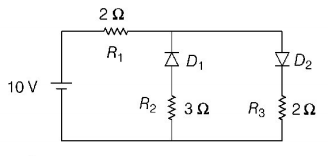
The given circuit has two ideal diodes connected as shown in the figure below. The current flowing through the resistance $${R_1}$$ will be
A
$$2.5\,A$$
B
$$10.0\,A$$
C
$$1.43\,A$$
D
$$3.13\,A$$
Answer :
$$2.5\,A$$
210. Suppose a $$'n'$$ -type wafer is created by doping $$Si$$ crystal having $$5 \times {10^{28}}\,atoms/{m^3}$$ with $$1\,ppm$$ concentration of $$As.$$ On the surface $$200\,ppm$$ Boron is added to create $$'P'$$ region in this wafer. Considering $${n_i} = 1.5 \times {10^{16}}{m^{ - 3}}$$ calculate the density of the minority charge carriers in the $$p$$ regions.
A
$$2.25 \times {10^7}/{m^3}$$
B
$$1.12 \times {10^3}/{m^3}$$
C
$$3.11 \times {10^6}/{m^3}$$
D
$$2.11 \times {10^5}/{m^3}$$
Answer :
$$2.25 \times {10^7}/{m^3}$$