211.
The barrier potential of a $$p-n$$ junction depends on
(i) type of semiconductor material
(ii) amount of doping
(iii) temperature
Which one of the following is correct?
A
(i) and (ii) only
B
(ii) only
C
(ii) and (iii) only
D
(i), (ii) and (iii)
Answer :
(i), (ii) and (iii)
212. A $$pnp$$ transistor is used in common-emitter mode in an amplifier circuit. A change of $$40\,\mu A$$ in the base current brings a change of $$2\,mA$$ in collector current and $$0.04\,V$$ in base emitter voltage. Which of the following is the correct value of the input resistor $${R_{{\text{in}}}}$$ ?
A
$${R_{{\text{in}}}} = 9\,k\Omega $$
B
$${R_{{\text{in}}}} = 75\,k\Omega $$
C
$${R_{{\text{in}}}} = 1\,k\Omega $$
D
None of these
Answer :
$${R_{{\text{in}}}} = 1\,k\Omega $$
213.
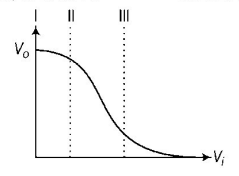
Transfer characteristic [output voltage $$\left( {{V_0}} \right)$$ vs input voltage $$\left( {{V_i}} \right)$$ ] for a base biased transistor in $$CE$$ configuration is as shown in the figure. For using transistor as a switch, it is used
A
in region III
B
both in region (I) and (III)
C
in region II
D
in region I
Answer :
both in region (I) and (III)
214. In the middle of the depletion layer of a reverse- biased $$p$$-$$n$$ junction, the
A
electric field is zero
B
potential is maximum
C
electric field is maximum
D
potential is zero
Answer :
electric field is zero
215.
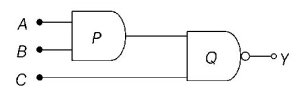
What is the output $$Y$$ in the following circuit, when all the three inputs $$A,B,C$$ are first 0 and then 1?
A
0, 1
B
0, 0
C
1, 0
D
1, 1
Answer :
1, 0
216. Which of the following, when added as an impurity, into the silicon, produces $$n$$-type semiconductor ?
A
Phosphorus
B
Aluminium
C
Magnesium
D
Both (B) and (C)
Answer :
Phosphorus
217. Zener breakdown in a semi-conductor diode occurs when
A
forward current exceeds certain value
B
reverse bias exceeds certain value
C
forward bias is equal to certain value
D
potential barrier is reduced to zero
Answer :
reverse bias exceeds certain value
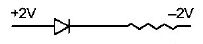
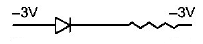
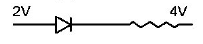
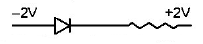
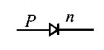
218. The forward biased diode connection is:
A
B
C
D
Answer :
219. Which of the following statements is incorrect ?
A
The drift current in a $$p-n$$ junction is from the $$n$$-side to the $$p$$-side.
B
Drift current is due to free electrons only.
C
Silicon is preferred over germanium for making semiconductor devices.
D
The energy gap in germanium is more than the energy gap in silicon.
Answer :
The energy gap in germanium is more than the energy gap in silicon.
220. $$Si$$ and $$Cu$$ are cooled to a temperature of $$300\,K,$$ then resistivity
A
for $$Si$$ increases and for $$Cu$$ decreases
B
for $$Cu$$ increases and for $$Si$$ decreases
C
decreases for both $$Si$$ and $$Cu$$
D
increases for both $$Si$$ and $$Cu$$
Answer :
for $$Si$$ increases and for $$Cu$$ decreases