Semiconductors and Electronic Devices MCQ Questions & Answers in Modern Physics | Physics
Learn Semiconductors and Electronic Devices MCQ questions & answers in Modern Physics are available for students perparing for IIT-JEE, NEET, Engineering and Medical Enternace exam.
31.
The electric conductivity of an intrinsic semiconductor increases when the electromagnetic waves of wavelength equal or shorter than $$2475\,nm$$ is incident on it. The charge carrier concentration of this semiconductor at room temperature is $$1.6 \times {10^{16}}\,{m^{ - 3}}$$ and the mobilities of electrons and holes at the same temperature are $$0.4\,{m^2}\,{V^{ - 1}}\,{S^{ - 1}}$$ and $$0.2\,{m^2}\,{V^{ - 1}}\,{S^{ - 1}}$$ respectively. Regarding these information the band gap $$B$$ is
32.
The current gain in the common emitter mode of a transistor is 10. The input impedance is $$20\,k\Omega $$ and load of resistance is $$100\,k\Omega .$$ The power gain is
A
300
B
500
C
200
D
100
Answer :
500
The power gain in case of $$CE$$ amplifier,
$$\eqalign{
& {\text{Power gain}} = {\beta ^2} \times {\text{Resistance gain}} \cr
& = {\beta ^2} \times \frac{{{R_o}}}{{{R_i}}} = {\left( {10} \right)^2} \times 5 = 500. \cr} $$
33.
A piece of copper and other of germanium are cooled from the room temperature to $$80\,K,$$ then
A
resistance in each will increase
B
resistance in each will decrease
C
the resistance of copper will increase while that of germanium will decrease
D
the resistance of copper will decrease while that of germanium will increase
Answer :
the resistance of copper will decrease while that of germanium will increase
Semiconductor have negative temperature coefficient of resistance i.e. the resistance of a semiconductor decreases with the increase in temperature as no. of electrons increases in conduction bond. Copper has positive temperature coefficient of resistance, i.e. the resistance of copper increases with the increase in temperature due to the collision of electrons. Hence, at $$80\,K,$$ the resistance of copper will decrease while that of germanium will increase.
34.
The truth table given below
Inputs
Output
A
B
Y
0
0
0
1
0
0
0
1
0
1
1
1
represents
A
AND gate
B
NOR gate
C
OR gate
D
NAND gate
Answer :
AND gate
We can see from the truth table that output is 1 only when its both inputs are 1.
This is possible only for AND gate. The Boolean expression for AND gate is $$Y = A \cdot B$$
which satisfies the truth table as below
$$\eqalign{
& 0 \cdot 0 = 0 \cr
& 1 \cdot 0 = 0 \cr
& 0 \cdot 1 = 0 \cr
& 1 \cdot 1 = 1 \cr} $$
Here symbol $$\left( \cdot \right)$$ represents AND operation.
35.
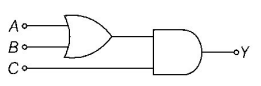
To get output 1 for the following circuit, the correct choice for the input is
A
$$A = 1,B = 0,C = 0$$
B
$$A = 1,B = 1,C = 0$$
C
$$A = 1,B = 0,C = 1$$
D
$$A = 0,B = 1,C = 0$$
Answer :
$$A = 1,B = 0,C = 1$$
Consider the given figure,
The resultant boolean expression of the above logic circuit will be
$$Y = (A + B).C$$
Now, let us try with inputs $$A,B$$ and $$C$$ given in the options and lets see, which one of them will give output 1 at $$Y.$$
$$\eqalign{
& {\text{If}}\,\,A = 0,B = 0,C = 0 \cr
& \Rightarrow Y = \left( {0 + 0} \right).0 \Rightarrow Y = 0 \cr
& {\text{If}}\,\,A = 1,B = 1,C = 0 \cr
& \Rightarrow Y = \left( {1 + 1} \right).0 \cr
& \Rightarrow Y = 1.0 \Rightarrow Y = 0 \cr
& {\text{If}}\,\,A = 1,B = 0,C = 1 \cr
& \Rightarrow Y = \left( {1 + 0} \right).1 \Rightarrow Y = 1.1 \Rightarrow Y = 1 \cr
& {\text{If}}\,\,A = 0,B = 1,C = 0 \cr
& \Rightarrow Y = \left( {0 + 1} \right).0 \cr
& \Rightarrow Y = 1.0 \Rightarrow Y = 0 \cr} $$
So, we have seen that among the given options, only option (C) is the correct choice, i.e.
Output $$Y = 1$$ only when inputs $$A = 1,B = 0$$ and $$C = 1.$$
36.
In a common emitter amplifier circuit using an $$n-p-n$$ transistor, the phase difference between the input and the output voltages will be :
A
$${135^ \circ }$$
B
$${180^ \circ }$$
C
$${45^ \circ }$$
D
$${90^ \circ }$$
Answer :
$${180^ \circ }$$
In common emitter configuration for $$n-p-n$$ transistor input and output signals are $${180^ \circ }$$ out of phase i.e., phase difference between output and input voltage is $${180^ \circ }.$$
37.
The electric conductivity of an intrinsic semiconductor increases when the electromagnetic waves of wavelength equal or shorter than $$3895\,nm$$ is incident on it. The band gap of the semiconductor is
38.
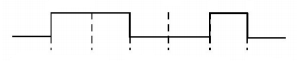
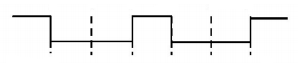
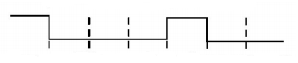
The logic circuit shown below has the input waveforms $$'A'$$ and $$'B'$$ as shown. Pick out the correct output waveform.
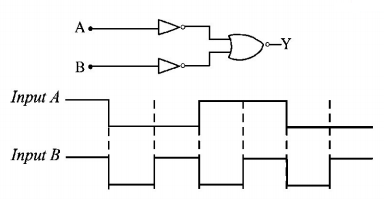
Output is
A
B
C
D
Answer :
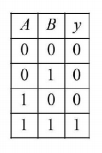
Here$$y = \overline {\left( {\overline A + \overline B } \right)} = \overline{\overline A} .\overline{\overline B} = A \cdot B.$$ Thus it is an $$AND$$ gate for which truth table is
A
B
y
0
0
0
0
1
0
1
0
0
1
1
1
39.
If $$\alpha $$ and $$\beta $$ are current gains in common-base and common-emitter configurations of a transistor, then $$\beta $$ is equal to
A
$$\frac{1}{\alpha }$$
B
$$\frac{\alpha }{{1 + \alpha }}$$
C
$$\frac{\alpha }{{1 - \alpha }}$$
D
$$\alpha - \frac{1}{\alpha }$$
Answer :
$$\frac{\alpha }{{1 - \alpha }}$$
Current gain in common-base configuration is,
$$\alpha = {\left( {\frac{{\Delta {i_c}}}{{\Delta {i_e}}}} \right)_{{V_{cb}}}}\,\,\left[ {{\text{at constant voltage across}}\,{\text{collector base junction}}} \right]$$
Current gain in common-emitter configuration is,
$$\beta = {\left( {\frac{{\Delta {i_c}}}{{\Delta {i_b}}}} \right)_{{V_{ce}}}}\,\,\left[ {{\text{at constant voltage across}}\,{\text{collector emitter junction}}} \right]$$
$$\eqalign{
& {\text{Also}}\,\,{i_b} = {i_e} - {i_c} \cr
& {\text{or}}\,\,\Delta {i_b} = \Delta {i_e} - \Delta {i_c} \cr
& {\text{As}}\,\,\beta = \frac{{\Delta {i_c}}}{{\Delta {i_b}}} = \frac{{\Delta {i_c}}}{{\Delta {i_e}}} \times \frac{{\Delta {i_e}}}{{\Delta {i_b}}} \cr
& {\text{or}}\,\,\beta = \alpha \times \frac{{\Delta {i_e}}}{{\Delta {i_e} - \Delta {i_c}}} \cr
& {\text{or}}\,\,\beta = \alpha \times \frac{1}{{1 - \frac{{\Delta {i_c}}}{{\Delta {i_e}}}}} \cr
& {\text{or}}\,\,\beta = \frac{\alpha }{{1 - \alpha }} \cr} $$ Alternative
As we know that relation between current gain in common base and common emitter configuration is given by
$$\eqalign{
& \alpha = \frac{\beta }{{1 + \beta }} \cr
& \Rightarrow \alpha + \alpha \beta = \beta \cr
& \Rightarrow \beta - \alpha \beta = \alpha \cr
& \Rightarrow \beta \left( {1 - \alpha } \right) = \alpha \cr
& \Rightarrow \beta = \frac{\alpha }{{1 - \alpha }} \cr} $$ NOTE
$$\beta $$ is always greater than $$\alpha .$$ Also $$\alpha < 1$$ and $$\beta > 1.$$