51.
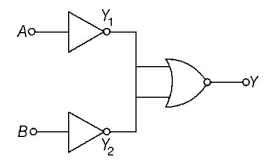
Which logic gate is represented by the following combination of logic gates?
A
OR
B
NAND
C
AND
D
NOR
Answer :
AND
52. Zener diode is used for
A
producing oscillations in an oscillator
B
amplification
C
stabilisation
D
rectification
Answer :
stabilisation
53. The depletion layer in the $$p$$ - $$n$$ junction region is caused by
A
drift of holes
B
diffusion of charge carriers
C
migration of impurity ions
D
drift of electrons
Answer :
diffusion of charge carriers

54.
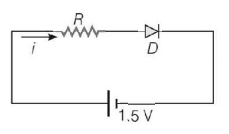
The diode used in the circuit shown in the figure has a constant voltage drop of $$0.5\,V$$ at all currents and a maximum power rating of $$100\,milliwatt.$$ What should be the value of the resistor $$R,$$ connected in series with the diode, for obtaining maximum current $$i$$ ?
A
$$200\,\Omega $$
B
$$6.67\,\Omega $$
C
$$5\,\Omega $$
D
$$1.5\,\Omega $$
Answer :
$$5\,\Omega $$
55. A potential barrier of $$0.50\,V$$ exists across a $$p-n$$ junction. If the depletion region is $$5.0 \times {10^{ - 7}}m$$ wide, the intensity of the electric field in this region is
A
$$1.0 \times {10^6}\,V/m$$
B
$$1.0 \times {10^5}\,V/m$$
C
$$2.0 \times {10^5}\,V/m$$
D
$$2.0 \times {10^6}\,V/m$$
Answer :
$$1.0 \times {10^6}\,V/m$$
56. A $$p-n$$ photodiode is made of a material with a band gap of $$2.0\,eV.$$ The minimum frequency of the radiation that can be absorbed by the material is nearly
A
$$10 \times {10^{14}}Hz$$
B
$$5 \times {10^{14}}Hz$$
C
$$1 \times {10^{14}}Hz$$
D
$$20 \times {10^{14}}Hz$$
Answer :
$$5 \times {10^{14}}Hz$$
57. When $$p-n$$ junction diode is forward biased then
A
both the depletion region and barrier height are reduced
B
the depletion region is widened and barrier height is reduced
C
the depletion region is reduced and barrier height is increased
D
Both the depletion region and barrier height are increased
Answer :
both the depletion region and barrier height are reduced
58. For a transistor $$\frac{{{i_c}}}{{{i_e}}} = 0.96,$$ the current gain in common-emitter configuration is
A
6
B
12
C
24
D
48
Answer :
24
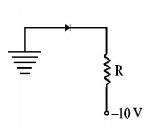
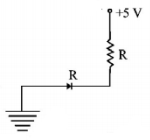
59.
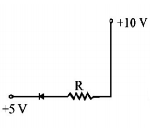
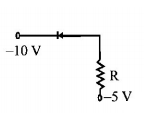
In the following, which one of the diodes reverse biased?
A
B
C
D
Answer :
60. Pure $$Si$$ at $$500\,K$$ has equal number of electron $$\left( {{n_e}} \right)$$ and hole $$\left( {{n_h}} \right)$$ concentrations of $$1.5 \times {10^{16}}{m^{ - 3}}.$$ Doping by indium increases $${{n_h}}$$ to $$4.5 \times {10^{22}}{m^{ - 3}}.$$ The doped semiconductor is of
A
$$n$$-type with electron concentration $${n_e} = 5 \times {10^{22}}{m^{ - 3}}$$
B
$$p$$-type with electron concentration $${n_e} = 2.5 \times {10^{10}}{m^{ - 3}}$$
C
$$n$$-type with electron concentration $${n_e} = 2.5 \times {10^{23}}{m^{ - 3}}$$
D
$$p$$-type with electron concentration $${n_e} = 5 \times {10^{9}}{m^{ - 3}}$$
Answer :
$$p$$-type with electron concentration $${n_e} = 5 \times {10^{9}}{m^{ - 3}}$$