Semiconductors and Electronic Devices MCQ Questions & Answers in Modern Physics | Physics
Learn Semiconductors and Electronic Devices MCQ questions & answers in Modern Physics are available for students perparing for IIT-JEE, NEET, Engineering and Medical Enternace exam.
71.
If the ratio of the concentration of electrons to that of holes in a semiconductor is $$\frac{7}{5}$$ and the ratio of currents is $$\frac{7}{4},$$ then what is the ratio of their drift velocities?
72.
A solid which is not transparent to visible light and whose
conductivity increases with temperature is formed by
A
Ionic bonding
B
Covalent bonding
C
Vander Waals bonding
D
Metallic bonding
Answer :
Covalent bonding
Van der Waal's bonding is attributed to the attractive forces between molecules of a liquid. The conductivity of semiconductors (covalent bonding) and insulators (ionic bonding) increases with increase in temperature while that of metals (metallic bonding) decreases.
73.
A transistor is operated in common-emitter configuration at $${V_c} = 2\,volt$$ such that a change in the base current from $$100\,\mu A$$ to $$200\,\mu A$$ produces a change in the collector current from $$5\,mA$$ to $$10\,mA.$$ The current gain is
A
75
B
100
C
150
D
50
Answer :
50
For a transistor $${I_E} = {I_B} + {I_C}$$
where $${I_E} =$$ emitter current
$${I_B} =$$ base current
$${I_C} =$$ collector current
and current gain $$\beta = \frac{{\Delta {I_C}}}{{\Delta {I_B}}}$$
$$\eqalign{
& {\text{Here,}}\,\,\Delta {I_C} = 10 \times {10^{ - 3}} - 5 \times {10^{ - 3}} \cr
& = 5 \times {10^{ - 3}}\,A \cr
& \Delta {I_B} = 200 \times {10^{ - 6}} - 100 \times {10^{ - 6}} \cr
& = 100 \times {10^{ - 6}}A \cr
& \because \beta = \frac{5}{{100}} \times 1000 = 50 \cr} $$
74.
A $$n-p-n$$ transistor conducts when
A
collector is positive and emitter is at same potential as the base
B
both collector and emitter are negative with respect to the base
C
both collector and emitter are positive with respect to the base
D
collector is positive and emitter is negative with respect to the base
Answer :
collector is positive and emitter is negative with respect to the base
For amplifying action of a transistor, emitter-base junction is always forward biased while base-collector junction is reverse biased. For forward biasing of emitter-base junction in $$n-p-n$$ transistor, left $$n$$-side i.e. emitter should be connected to negative terminal and $$p$$-side (base) should be connected to positive terminal of the battery. On the other hand, in right side, $$n$$-side (collector) should be connected to positive terminal of the battery to make base-collector junction reverse biased. The whole situation is shown in the figure for $$n-p-n$$ transistor
$$\eqalign{
& E \to {\text{Emitter}} \cr
& B \to {\text{Base}} \cr
& C \to {\text{Collector}} \cr} $$
75.
When the forward bias voltage of a diode is changed from $$0.6\,V$$ to $$0.7\,V,$$ the current changes from $$5\,mA$$ to $$15\,mA.$$ Then its forward bias resistance is
76.
In a common base mode of a transistor, the collector current is $$5.488\,mA$$ for an emitter current of $$5.60\,mA.$$ The value of the base current amplification factor $$\left( \beta \right)$$ will be
77.
A common emitter amplifier has a voltage gain of 50, an input impedance of $$100\,\Omega $$ and an output impedance of $$200\,\Omega .$$ The power gain the amplifier is
A
500
B
1000
C
1250
D
50
Answer :
1250
AC power gain $$ = \frac{{{\text{ change in output power }}}}{{{\text{ change in input power }}}}$$
$$\eqalign{
& = \frac{{\Delta {V_c} \times \Delta {i_c}}}{{\Delta {V_i} \times \Delta {i_b}}} \cr
& = \left( {\frac{{\Delta {V_c}}}{{\Delta {V_i}}}} \right) \times \left( {\frac{{\Delta {i_c}}}{{\Delta {i_b}}}} \right) = {A_V} \times {\beta _{AC}} \cr} $$
where, $${A_V}$$ is voltage gain and $${\left( \beta \right)_{AC}}$$ is AC current gain. Also,
$$\eqalign{
& {A_V} = {\beta _{AC}} \times {\text{ resistance gain}}\left( { = \frac{{{R_o}}}{{{R_i}}}} \right) \cr
& {\text{Voltage}}\,{\text{gain}} = \beta \times {\text{impedance}}\,{\text{gain}} \cr
& \Rightarrow 50 = \beta \times \frac{{200}}{{100}} \Rightarrow \beta = 25 \cr
& {\text{Also,}}\,{\text{power}}\,{\text{gain}} = {\beta ^2} \times {\text{impedance}}\,{\text{gain}} \cr
& = {25^2} \times \frac{{200}}{{100}} = 1250 \cr} $$
78.
When npn transistor is used as an amplifier
A
electrons move from collector to base
B
holes move from emitter to base
C
electrons move from base to collector
D
holes move from base to emitter
Answer :
holes move from base to emitter
Electrons move from base to emmitter.
79.
The number of atoms per unit cell in bcc lattice is
A
1
B
2
C
4
D
9
Answer :
2
Number of atoms per unit cell is given by
$$N = {N_b} + \frac{{{N_f}}}{2} + \frac{{{N_c}}}{8}$$
where $${N_b} =$$ number of atoms centred in the body
$${{N_f}} =$$ number of atoms centred in the face
$${{N_c}} =$$ number of atoms centred at the corners
For bcc structure,
$$\eqalign{
& {N_b} = 1,\,{N_f} = 0 \cr
& {\text{and}}\,{N_c} = 8 \cr
& \therefore N = 1 + \frac{0}{2} + \frac{8}{8} = 2 \cr} $$
80.
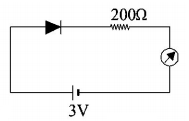
The reading of the ammeter for a silicon diode in the given circuit is :
A
0
B
$$15\,mA$$
C
$$11.5\,mA$$
D
$$13.5\,mA$$
Answer :
$$11.5\,mA$$
Clearly from fig. given in question, Silicon diode is in forward bias.
∴ Potential barrier across diode
$$\Delta V = 0.7\,volts$$
Current, $$I = \frac{{V - \Delta V}}{R} = \frac{{3 - 0.7}}{{200}} = \frac{{2.3}}{{200}} = 11.5\,mA$$