81. Which one of the following statement is false ?
A
Pure $$Si$$ doped with trivalent impurities gives a $$p$$-type semiconductor
B
Majority carriers in a $$n$$-type semiconductor are holes
C
Minority carriers in a $$p$$-type semiconductor are electrons
D
The resistance of intrinsic semiconductor decreases with increase of temperature
Answer :
Majority carriers in a $$n$$-type semiconductor are holes
82. In bcc structure of lattice constant $$a,$$ the minimum distance between atoms is
A
$$\frac{{\sqrt 3 }}{2}a$$
B
$$\sqrt 2 a$$
C
$$\frac{a}{{\sqrt 2 }}$$
D
$$\frac{a}{2}$$
Answer :
$$\frac{{\sqrt 3 }}{2}a$$
83. In the following, which one of the diodes reverse biased?
A

B
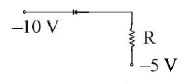
C

D
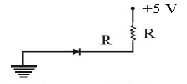
Answer :
84. What is the voltage gain in a common emitter amplifier, where input resistance is $$3\,\Omega $$ and load resistance $$24\,\Omega ,\beta = 0.6$$ ?
A
8.4
B
4.8
C
2.4
D
480
Answer :
4.8
85. The output of OR gate is 1
A
only if both inputs are zero
B
if either or both inputs are 1
C
only if both inputs are 1
D
if either input is zero
Answer :
if either or both inputs are 1
86. When $$p-n$$ junction diode is forward biased then
A
both the depletion region and barrier height are reduced
B
the depletion region is widened and barrier height is reduced
C
the depletion region is reduced and barrier height is increased
D
Both the depletion region and barrier height are increased
Answer :
both the depletion region and barrier height are reduced
87. $$C$$ and $$Si$$ both have same lattice structure, having 4 bonding electrons in each. However, $$C$$ is insulator whereas $$Si$$ is intrinsic semiconductor. This is because
A
in case of $$C,$$ the valence bond is not completely filled at absolute zero temperature
B
in case of $$C,$$ the conduction band is partly filled even at absolute zero temperature
C
the four bonding electrons in the case of $$C$$ lie in the second orbit, whereas in the case of $$Si$$ they lie in the third
D
the four bonding electrons in the case of $$C$$ lie in the third orbit, whereas for $$Si$$ they lie in the fourth orbit
Answer :
the four bonding electrons in the case of $$C$$ lie in the second orbit, whereas in the case of $$Si$$ they lie in the third
88.
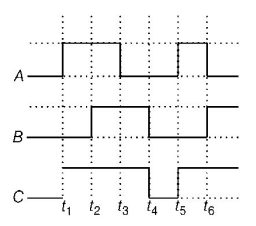
The figure shows a logic circuit with two inputs $$A$$ and $$B$$ and the output $$C.$$ The voltage waveforms across $$A,B$$ and $$C$$ are as given. The logic circuit gate is
A
OR gate
B
NOR gate
C
AND gate
D
NAND gate
Answer :
OR gate
89.
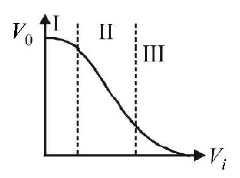
Transfer characteristics [output voltage $$\left( {{V_0}} \right)$$ vs input voltage $$\left( {{V_1}} \right)$$ ] for a base biased transistor in $$CE$$ configuration is as shown in the figure. For using transistor as a switch, it is used
A
in region $$\left( {{\text{III}}} \right)$$
B
both in region $$\left( {{\text{I}}} \right)$$ and $$\left( {{\text{III}}} \right)$$
C
in region $$\left( {{\text{II}}} \right)$$
D
in region $$\left( {{\text{I}}} \right)$$
Answer :
both in region $$\left( {{\text{I}}} \right)$$ and $$\left( {{\text{III}}} \right)$$
90.
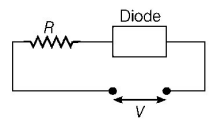
For a given circuit of ideal $$p$$-$$n$$ junction diode, which of the following is correct?
A
In forward biasing the voltage across $$R$$ is $$V$$
B
In reverse biasing the voltage across $$R$$ is $$V$$
C
In forward biasing the voltage across $$R$$ is $$2\,V$$
D
In reverse biasing the voltage across $$R$$ is $$2\,V$$
Answer :
In forward biasing the voltage across $$R$$ is $$V$$