91. The ratio of resolving powers of an optical microscope for two wavelengths $${\lambda _1} = 4000\,\mathop {\text{A}}\limits^ \circ $$ and $${\lambda _2} = 6000\,\mathop {\text{A}}\limits^ \circ $$ is
A
$$8:27$$
B
$$9:4$$
C
$$3:2$$
D
$$16:81$$
Answer :
$$3:2$$
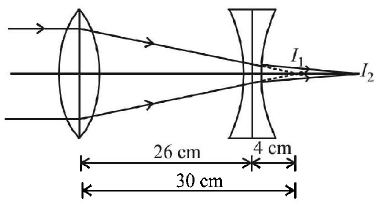
92. The size of the image of an object, which is at infinity, as formed by a convex lens of focal length $$30\,cm$$ is $$2\,cm.$$ If a concave lens of focal length $$20\,cm$$ is placed between the convex lens and the image at a distance of $$26\,cm$$ from the convex lens, calculate the new size of the image.
A
$$\frac{d}{2}$$
B
$$d$$
C
$$2\,d$$
D
$$3\,d$$
Answer :
$$d$$
93. When a ray of light enters a glass slab from air,
A
Its wavelength decreases.
B
Its wavelength increases.
C
Its frequency decreases.
D
neither its wavelength nor its frequency changes.
Answer :
Its wavelength decreases.
94. A car is fitted with a convex side - view mirror of focal length $$20\,cm.$$ A second car $$2.8\,m$$ behind the first car is overtaking the first car at a relative speed of $$15\,m/s.$$ The speed of the image of the second car as seen in the mirror of the first one is:
A
$$\frac{1}{{15}}m/s$$
B
$$10\,m/s$$
C
$$15\,m/s$$
D
$$\frac{1}{{10}}m/s$$
Answer :
$$\frac{1}{{15}}m/s$$
95. Focal length of a convex lens of refractive index 1.5 is $$2\,cm.$$ Focal length of lens when immersed in a liquid of refractive index 1.25 will be
A
$$10\,cm$$
B
$$2.5\,cm$$
C
$$5\,cm$$
D
$$7.5\,cm$$
Answer :
$$5\,cm$$
96.
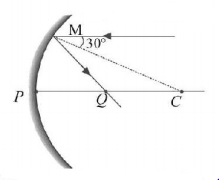
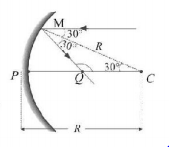
A ray parallel to principal axis is incident at $${30^ \circ }$$ from normal on concave mirror having radius of curvature $$R.$$ The point on principal axis where rays are focused is $$Q$$ such that $$PQ$$ is
A
$$\frac{R}{2}$$
B
$$\frac{R}{{\sqrt 3 }}$$
C
$$\frac{{2\sqrt R - R}}{{\sqrt 2 }}$$
D
$$R\left( {1 - \frac{1}{{\sqrt 3 }}} \right)$$
Answer :
$$R\left( {1 - \frac{1}{{\sqrt 3 }}} \right)$$
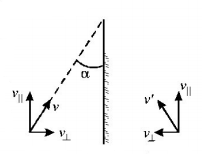
97. A person walks at a velocity $$v$$ in a straight line forming an angle $$\alpha $$ with the plane of a plane mirror. Determine the velocity $${v_{{\text{rel}}}}$$ at which he approaches his image, assuming that the object and its image are symmetric relative to the plane of the mirror.
A
$$2v\sin \,\alpha $$
B
$$2v\cos \,\alpha $$
C
$$v\sin \,\alpha $$
D
$$v\cos \,\alpha $$
Answer :
$$2v\sin \,\alpha $$
98.
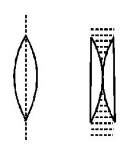
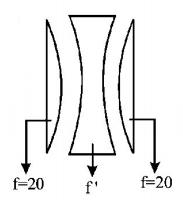
A thin convex lens of focal length $$10\,cm$$ and refractive index 1.5 is cut vertically into two equal pieces. They are placed as shown with a liquid of refractive index 3 between them. What is the focal length of the combination?
A
$$ - 10\,cm.$$
B
$$\frac{{ - 10}}{4}cm.$$
C
$$\frac{{ - 10}}{3}cm.$$
D
None of these
Answer :
$$\frac{{ - 10}}{3}cm.$$
99.
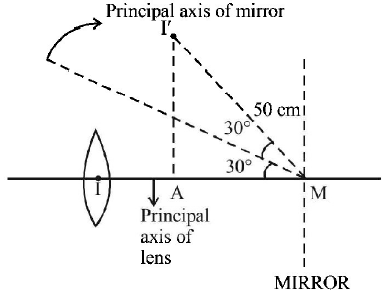
A small object is placed $$50\,cm$$ to the left of a thin convex lens of focal length $$30\,cm.$$ A convex spherical mirror of radius of curvature $$100\,cm$$ is placed to the right of the lens at a distance of $$50\,cm.$$ The mirror is tilted such that the axis of the mirror is at an angle $$\theta = {30^ \circ }$$ to the axis of the lens, as shown in the figure.
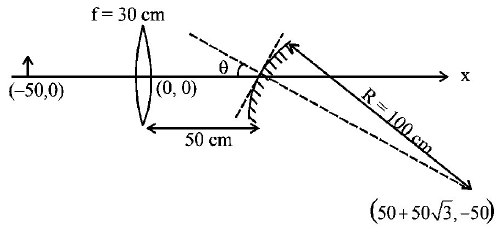
If the origin of the coordinate system is taken to be at the centre of the lens, the coordinates (in $$cm$$ ) of the point $$(x, y)$$ at which the image is formed are
A
$$\left( {0,0} \right)$$
B
$$\left( {50 - 25\sqrt 3 ,25} \right)$$
C
$$\left( {25, 25\sqrt 3} \right)$$
D
$$\left( {\frac{{125}}{3},25\sqrt 3 } \right)$$
Answer :
$$\left( {25, 25\sqrt 3} \right)$$
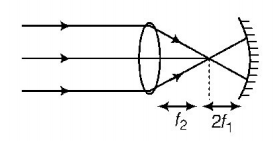
100. A concave mirror of focal length $${f_1}$$ is placed at a distance of $$d$$ from a convex lens of focal length $${f_2}.$$ A beam of light coming from infinity and falling on this convex lens- concave mirror combination returns to infinity. The distance $$d$$ must be equal
A
$${f_1} + {f_2}$$
B
$$ - {f_1} + {f_2}$$
C
$$2{f_1} + {f_2}$$
D
$$ - 2{f_1} + {f_2}$$
Answer :
$$2{f_1} + {f_2}$$