Ray Optics MCQ Questions & Answers in Optics and Wave | Physics
Learn Ray Optics MCQ questions & answers in Optics and Wave are available for students perparing for IIT-JEE, NEET, Engineering and Medical Enternace exam.
201.
Two point source $${S_1}$$ and $${S_2}$$ are $$24\,cm$$ apart. Where should a convex lens of focal length $$9\,cm$$ be placed in between them so that the images of both sources are formed at the same place?
A
$$6\,cm$$ from $${S_1}$$
B
$$15\,cm$$ from $${S_1}$$
C
$$10\,cm$$ from $${S_1}$$
D
$$12\,cm$$ from $${S_1}$$
Answer :
$$6\,cm$$ from $${S_1}$$
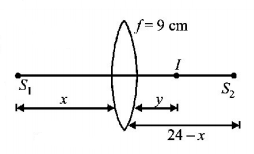
In this case, one of the image will be real and the other virtual. Let us assume that image of $${S_1}$$ is real and that of $${S_2}$$ is virtual.
Applying $$\frac{1}{v} - \frac{1}{u} = \frac{1}{f}$$
For $${S_1}:\frac{1}{y} + \frac{1}{x} = \frac{1}{9}\,......\left( {\text{i}} \right)$$
For $${S_2}:\frac{1}{y} + \frac{1}{{24 - x}} = \frac{1}{9}\,......\left( {{\text{ii}}} \right)$$
Solving eqs. (i) and (ii),
we get $$x = 6\,cm$$
202.
Transmission of light in optical fibre is due to
A
scattering
B
diffraction
C
polarisation
D
multiple total internal reflections
Answer :
multiple total internal reflections
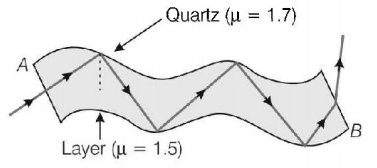
An optical fibre is a device based on total internal reflection by which a light signal can be transferred from one place to the other with a negligible loss of energy.
It consists of a very long and thin fibre of quartz glass.
When a light ray is incident at one end $$A$$ of fibre making a small angle of incidence. It suffers multiple total internal reflections and finally it reaches the point $$B.$$
203.
A ball is dropped from a height of $$20\,m$$ above the surface of water in a lake. The refractive index of water is $$4.3.$$ A fish inside the lake, in the line of fall of the ball, is looking at the ball. At an instant, when the ball is $$12.8\,m$$ above the water surface, the fish sees the speed of ball as [Take $$g = 10\,m/{s^2}.$$ ]
A
$$9\,m/s$$
B
$$12\,m/s$$
C
$$16\,m/s$$
D
$$21.33\,m/s$$
Answer :
$$16\,m/s$$
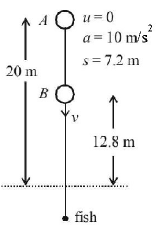
Consider the activity $$A$$ to $$B$$
Applying $${v^2} - {u^2} = 2\,as$$
$$\eqalign{
& {v^2} - {0^2} = 2 \times 10 \times 7.2 \cr
& \Rightarrow \,\,v = 12\,m/s \cr} $$
The velocity of ball as perceived by fish is
$$\eqalign{
& v' = {\,_w}\mu \times v \cr
& = \frac{4}{3} \times 12 \cr
& = 16\,m/s \cr} $$
204.
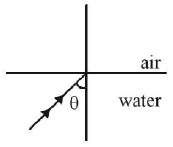
A green light is incident from the water to the air-water interface at the critical angle $$\left( \theta \right).$$ Select the correct statement.
A
The entire spectrum of visible light will come out of the water at an angle of 90° to the normal.
B
The spectrum of visible light whose frequency is less than that of green light will come out to the air medium.
C
The spectrum of visible light whose frequency is more than that of green light will come out to the air medium.
D
The entire spectrum of visible light will come out of the water at various angles to the normal.
Answer :
The spectrum of visible light whose frequency is less than that of green light will come out to the air medium.
For critical angle $${\theta _c},$$
$$\sin {\theta _c} = \frac{1}{\mu }$$
For greater wavelength or lesser frequency $$\mu $$ is less.
So, critical angle would be more. So, they will not suffer reflection and come out at angles less then 90°.
205.
Angle of deviation $$\left( \delta \right)$$ by a prism (refractive index $$ = \mu ,$$ and supposing the angle of prism $$A$$ to be small) can be given by
A
$$\delta = \left( {\mu - 1} \right)A$$
B
$$\delta = \left( {\mu + 1} \right)A$$
C
$$\delta = \frac{{\sin \frac{{A + \delta }}{2}}}{{\sin \frac{A}{2}}}$$
D
$$\delta = \frac{{\mu - 1}}{{\mu + 1}}A$$
Answer :
$$\delta = \left( {\mu - 1} \right)A$$
When refracting angle of a prism is small $$\left( {\angle {{10}^ \circ }} \right),$$ the deviation $$\delta $$ is calculated from the relation $$\delta = \left( {\mu - 1} \right)A.$$ For prisms with bigger refracting angles, we use the relation
$$\delta = \left( {{i_1} + {i_2}} \right) - A$$
206.
An air bubble in a glass slab with refractive index $$1.5$$ (near normal incidence) is $$5\,cm$$ deep when viewed from one surface and $$3\,cm$$ deep when viewed from the opposite face. The thickness (in $$cm$$ ) of the slab is
A
8
B
10
C
12
D
16
Answer :
12
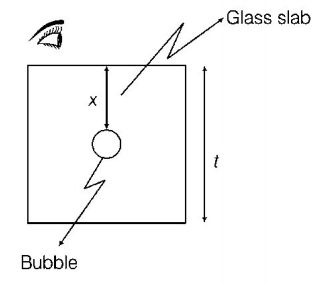
Let thickness of the given slab is $$t.$$ According to the question, when viewed from both the surfaces
$$\eqalign{
& \frac{x}{\mu } + \frac{{t - x}}{\mu } = 3 + 5 \cr
& \Rightarrow \frac{t}{\mu } = 8\,cm \cr
& \Rightarrow t = 8 \times \mu \cr
& \Rightarrow t = 8 \times \frac{3}{2} = 12\,cm \cr} $$
207.
A small coin is resting on the bottom of a beaker filled with a liquid. A ray of light from the coin travels upto the surface of the liquid and moves along its surface
(see figure).
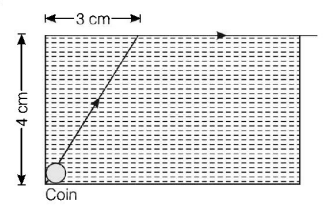
How fast is the light travelling in the liquid?
A
$$1.8 \times {10^8}m/s$$
B
$$2.4 \times {10^8}m/s$$
C
$$3.0 \times {10^8}m/s$$
D
$$1.2 \times {10^4}m/s$$
Answer :
$$1.8 \times {10^8}m/s$$
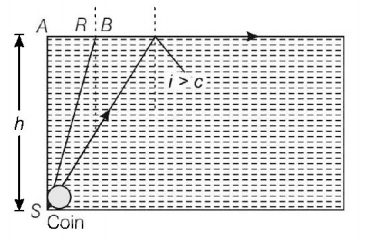
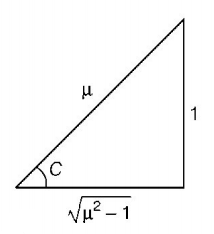
As shown in figure, a light ray from the coin will not emerge out of liquid, if $$i > C.$$
Therefore, minimum radius $$R$$ corresponds to $$i = C.$$
In $$\Delta SAB,$$
$$\eqalign{
& \frac{R}{h} = \tan C \cr
& {\text{or}}\,\,R = h\tan C \cr
& {\text{or}}\,\,R = \frac{h}{{\sqrt {{\mu ^2} - 1} }} \cr
& {\text{Given,}}\,\,R = 3\,cm,h = 4\,cm \cr
& {\text{Hence,}}\,\,\frac{3}{4} = \frac{1}{{\sqrt {{\mu ^2} - 1} }} \cr
& {\text{or}}\,\,{\mu ^2} = \frac{{25}}{9}\,\,{\text{or }}\mu = \frac{5}{3} \cr
& {\text{But}}\,\,\mu = \frac{c}{v}\,\,{\text{or}}\,\,v = \frac{c}{\mu } \cr
& = \frac{{3 \times {{10}^8}}}{{\frac{5}{3}}} \cr
& = 1.8 \times {10^8}\,m/s \cr} $$
208.
A point light source is moving with a constant velocity $$v$$ inside a transparent thin spherical shell of radius $$R,$$ which is filled with a transparent liquid. If at $$t = 0$$ light source is at the centre of the sphere, then at what time a thin dark ring will be visible for an observer outside the sphere. The refractive index of liquid with respect to that of shell is $$\sqrt 2 .$$
A
$$\frac{R}{{\sqrt 2 V}}$$
B
$$\frac{R}{{2V}}$$
C
$$\frac{R}{{3V}}$$
D
$$\frac{R}{{\sqrt 3 V}}$$
Answer :
$$\frac{R}{{\sqrt 2 V}}$$
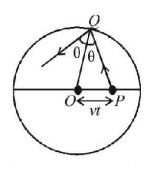
This dark ring will be visible if ray from source gets total internal reflection from the spherical shell.
Let the source at any instant be at point $$P$$ then at point $$Q$$ ray will be totally reflected if $$\theta $$ is equal to or greater than critical angle. If $$QP$$ is equal to $$x,$$ then
$$z = \cos \theta = \frac{{{R^2} + {x^2} - {v^2}{t^2}}}{{2Rx}}$$
For $$\theta $$ to be minimum
$$\eqalign{
& \frac{{dz}}{{dx}} = \frac{{2x\left( {2Rx} \right) - 2R\left( {{R^2} + {x^2} - {v^2}{t^2}} \right)}}{{4{R^2}{x^2}}} = 0 \cr
& \Rightarrow x = \sqrt {{R^2} - {v^2}{t^2}} \cr
& {\text{So,}}\,\cos \theta = \frac{{2\left( {{R^2} - {v^2}{t^2}} \right)}}{{2R\sqrt {{R^2} - {v^2}{t^2}} }} = \frac{{\sqrt {{R^2} - {v^2}{t^2}} }}{R} \cr} $$
For no light come out, $$\sin \theta \geqslant \frac{1}{{\sqrt 2 }}\,\,{\text{or}}\,\,\theta \geqslant {45^ \circ }$$
$$\eqalign{
& \frac{{\sqrt {{R^2} - {v^2}{t^2}} }}{R} = \frac{1}{{\sqrt 2 }}; \cr
& t = \frac{R}{{\sqrt 2 V}} \cr} $$
209.
A linear aperture whose width is $$0.02\,cm$$ is placed immediately in front of a lens of focal length $$60\,cm.$$ The aperture is illuminated normally by a parallel beam of wavelength $$5 \times {10^{ - 5}}cm.$$ The distance of the first dark band of the diffraction pattern from the centre of the screen is
A
$$0.10\,cm$$
B
$$0.25\,cm$$
C
$$0.20\,cm$$
D
$$0.15\,cm$$
Answer :
$$0.15\,cm$$
1st minima is formed at a distance $$Y = \frac{{\lambda D}}{a}$$
For the distance of the first dark band of the diffraction pattern from the centre of the screen is given by position of 1st minima.
i.e. $$Y = \frac{{\lambda D}}{a}$$
where, $$\lambda =$$ wavelength of parallel beams
$$D =$$ focal length
$$a =$$ width of linear aperture.
$$\eqalign{
& \Rightarrow Y = \frac{{\left( {5 \times {{10}^{ - 5}}} \right)\left( {0.6} \right)}}{{0.02 \times {{10}^{ - 2}}}}\,\,\left( {{\text{given}}} \right) \cr
& \Rightarrow Y = 0.15\,cm \cr} $$
210.
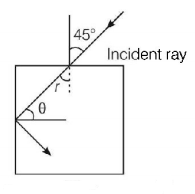
For the given incident ray as shown in figure, the condition of total internal reflection of the ray will be satisfied if the refractive index of block will be
A
$$\frac{{\sqrt 3 + 1}}{2}$$
B
$$\frac{{\sqrt 2 + 1}}{2}$$
C
$$\sqrt {\frac{3}{2}} $$
D
$$\sqrt {\frac{7}{6}} $$
Answer :
$$\sqrt {\frac{3}{2}} $$
For total internal reflection to take place,
angle of incidence > critical angle
i.e. $$\theta > C$$
or $$\sin \theta > \sin C$$
But for the case of total internal reflection,
$$\sin C = \frac{1}{\mu }$$
and according to question
$$\eqalign{
& \theta = {90^ \circ } - r \cr
& {\text{So,}}\,\,\sin \left( {{{90}^ \circ } - r} \right) > \frac{1}{\mu } \cr
& {\text{i}}{\text{.e}}{\text{.}}\,\mu > \frac{1}{{\cos r}}\,\,\left[ {\therefore \sin \left( {{{90}^ \circ } - r} \right) = \cos r} \right]\,......\left( {\text{i}} \right) \cr} $$
From Snell's law,
$$\eqalign{
& \frac{{\sin {{45}^ \circ }}}{{\sin r}} = \mu \cr
& \Rightarrow \sin r = \frac{1}{{\sqrt 2 \mu }} \cr
& \therefore \cos r = \sqrt {1 - {{\sin }^2}r} \cr
& = \sqrt {1 - \frac{1}{{2{\mu ^2}}}} \cr} $$
Thus, Eq. (i) becomes
$$\eqalign{
& \mu > \frac{1}{{\sqrt {1 - \frac{1}{{2{\mu ^2}}}} }} \cr
& \therefore {\mu ^2} = \frac{1}{{1 - \frac{1}{{2{\mu ^2}}}}} \cr
& {\text{or}}\,\,{\mu ^2} - \frac{1}{2} = 1\,\,{\text{or}}\,\,\mu = \sqrt {\frac{3}{2}} \cr} $$