Ray Optics MCQ Questions & Answers in Optics and Wave | Physics
Learn Ray Optics MCQ questions & answers in Optics and Wave are available for students perparing for IIT-JEE, NEET, Engineering and Medical Enternace exam.
41.
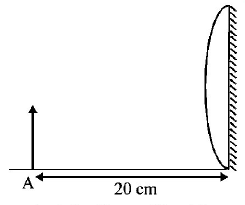
Focal length of the plano-convex lens is $$15\,cm.$$ A small object is placed at $$A$$ as shown in the figure. The plane surface is silvered. The image will form at
A
$$60\,cm$$ to the left of lens
B
$$12\,cm$$ to the left of lens
C
$$60\,cm$$ to the right of lens
D
$$30\,cm$$ to the left of lens
Answer :
$$12\,cm$$ to the left of lens
The focal length $$f$$ of the equivalent mirror is
$$\eqalign{
& \frac{1}{f} = \frac{2}{{{f_1}}} + \frac{1}{{{f_m}}} \cr
& = \frac{2}{{15}} + \frac{1}{\infty } \cr
& \Rightarrow \,\,f = \frac{{15}}{2}cm, \cr } $$
Since $$f$$ has a positive value, the combination behaves as a converging mirror.
Here $$u = - 20\,cm,f = - \frac{{15}}{2}cm,$$
$$v = ?$$
According to mirror formula $$\frac{1}{v} + \frac{1}{u} = \frac{1}{f}$$
$$\eqalign{
& \Rightarrow \,\,\frac{1}{v} - \frac{1}{{ - 20}} = \frac{1}{{ - \frac{{15}}{2}}} \cr
& \Rightarrow \,\,v = - 12\,cm \cr} $$
Negative sign indicates that the image is $$12\,cm$$ in front of mirror.
42.
A lens is placed between a source of light and a wall. It forms images of area $${A_1}$$ and $${A_2}$$ on the wall, for its two different positions, the area of the source of light is
A
$$\sqrt {{A_1}{A_2}} $$
B
$$\frac{{{A_1} + {A_2}}}{2}$$
C
$$\frac{{{A_1} - {A_2}}}{2}$$
D
$$\frac{1}{{{A_1}}} + \frac{1}{{{A_2}}}$$
Answer :
$$\sqrt {{A_1}{A_2}} $$
In displacement method, total magnification $$m = \sqrt {{m_1}{m_2}} .$$ Therefore, area of source is given by $$A = \sqrt {{A_1}{A_2}} .$$
43.
An achromatic combination of lenses is formed by joining
A
2 convex lenses
B
2 concave lenses
C
1 convex, 1 concave lens
D
1 convex and 1 plane mirror
Answer :
1 convex, 1 concave lens
When two or more lenses are combined together in such a way that the combination is free from chromatic aberration, then such a combination is called achromatic combination of lenses. For this purpose, one lens should be convex and other a concave lens.
44.
Which of the following is not due to total internal reflection?
A
Difference between apparent and real depth of a pond
B
Mirage on hot summer days
C
Brilliance of diamond
D
Working of optical fibre
Answer :
Difference between apparent and real depth of a pond
Real and apparent depth are explained on the basis of refraction only. The concept of TIR is not involved here.
45.
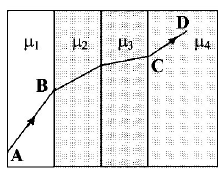
A ray of light passes through four transparent media with refractive indices $${\mu _1},{\mu _2},{\mu _3}$$ and $${\mu _4}$$ as shown in the figure. The surfaces of all media are parallel. If the emergent ray $$CD$$ is parallel to the incident ray $$AB,$$ we must have
A
$${\mu _1} = {\mu _2}$$
B
$${\mu _2} = {\mu _3}$$
C
$${\mu _3} = {\mu _4}$$
D
$${\mu _4} = {\mu _1}$$
Answer :
$${\mu _4} = {\mu _1}$$
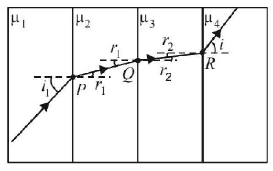
Applying Snell's law at $$P,$$
$$^1{\mu _2} = \frac{{\sin i}}{{\sin {r_1}}} = \frac{{{\mu _2}}}{{{\mu _1}}}\,\,\,.....\left( 1 \right)$$
Applying Snell's law at $$Q,$$
$$^2{\mu _3} = \frac{{\sin {r_1}}}{{\sin {r_2}}} = \frac{{{\mu _3}}}{{{\mu _2}}}\,\,\,\,.....\left( 2 \right)$$
Again applying Snell's law at $$R$$
$$^3{\mu _4} = \frac{{\sin {r_2}}}{{\sin i}} = \frac{{{\mu _4}}}{{{\mu _3}}}\,\,\,\,.....\left( 3 \right)$$
Multiplying (i), (ii) and (iii), we get
$${\mu _4} = {\mu _1}$$ NOTE : If the emergent ray is parallel to incident ray
after travelling a number of parallel interfaces then the
refractive index of the first and the last medium is always
same.
46.
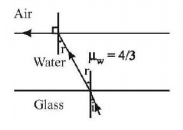
A ray of light is incident at the glass-water interface at an angle $$i,$$ it emerges finally parallel to the surface of water, then the value of $${\mu _g}$$ would be
47.
A short linear object of length $$\ell $$ lies along the axis of a concave mirror of focal length $$f$$ at a distance $$u$$ from the pole of the mirror. The size of the image is approximately equal to
A
$$\ell {\left( {\frac{{u - f}}{f}} \right)^{\frac{1}{2}}}$$
B
$$\ell {\left( {\frac{{u - f}}{f}} \right)^2}$$
C
$$\ell {\left( {\frac{f}{{u - f}}} \right)^{\frac{1}{2}}}$$
The axial magnification $$\delta v = - \frac{{{v^2}}}{{{u^2}}}\left( {\delta u} \right)$$
$$ = {\left( {\frac{f}{{u - f}}} \right)^2}\ell .$$
48.
The intensity at the maximum in a Young’s double slit experiment is $${I_0}.$$ Distance between two slits is $$d = 5\lambda ,$$ where $$\lambda $$ is the wavelength of light used in the experiment. What will be the intensity infront of one of the slits on the screen placed at a distance $$D = 10\,d$$ ?
A
$$\frac{{{I_0}}}{4}$$
B
$$\frac{3}{4}{I_0}$$
C
$$\frac{{{I_0}}}{2}$$
D
$${I_0}$$
Answer :
$$\frac{{{I_0}}}{2}$$
In the above figure, $${S_1}$$ and $${S_2}$$ are the two different slits.
Given, distance between slits $${S_1}$$ and $${S_2},$$ $$d = 5\,\lambda $$ distance between screen and slits, $$D = 10\,d = 50\,\lambda $$
Here, $$\lambda $$ is the wavelength of light used in the experiment.
According to question, the intensity at maximum in this Young's double slit experiment is $${I_0}.$$
$$ \Rightarrow {I_{\max }} = {I_0}$$
$$\because $$ Path difference $$ = \frac{{d{Y_n}}}{D} = \frac{{d \times \frac{d}{2}}}{{10\,d}} = \frac{d}{{20}} = \frac{\lambda }{4}\,\,\left\{ {\because d = 5\lambda } \right\}$$
A path difference of $$\lambda $$ corresponds to phase difference $$2\pi $$
So, for path difference $$\frac{\lambda }{4},$$ phase difference
$$\phi = \frac{{2\pi }}{\lambda } \times \frac{\lambda }{4} = \frac{\pi }{2} = {90^ \circ }$$
As we know, $$I = {I_0}{\cos ^2}\frac{\phi }{2}$$
$$\eqalign{
& \Rightarrow I = {I_0}{\cos ^2}\frac{{{{90}^ \circ }}}{2} \cr
& \Rightarrow I = {I_0} \times {\left( {\frac{1}{{\sqrt 2 }}} \right)^2} \Rightarrow I = \frac{{{I_0}}}{2} \cr} $$
49.
If two mirrors are kept at 60° to each other, then the number of images formed by them is
A
5
B
6
C
7
D
8
Answer :
5
KEY CONCEPT : When two plane mirrors are inclined at each other at an angle $$\theta $$ then the number of the images of a point object placed between the plane mirrors is $$\frac{{{{360}^ \circ }}}{\theta } - 1,{\text{if }}\frac{{{{360}^ \circ }}}{\theta }$$ is even
∴ Number of images formed $$ = \frac{{{{360}^ \circ }}}{{{{60}^ \circ }}} - 1 = 5$$
50.
The focal lengths of a converging lens measured for violet, green and red colours are $${f_V},{f_G},{f_R}$$ respectively. We will find
A
$${f_G} > {f_R}$$
B
$${f_V} < {f_R}$$
C
$${f_V} > {f_R}$$
D
$${f_V} = {f_R}$$
Answer :
$${f_V} < {f_R}$$
Lens maker's formula is
$$\eqalign{
& \frac{1}{f} = \left( {\mu - 1} \right)\left( {\frac{1}{{{R_1}}} = \frac{1}{{{R_2}}}} \right) \cr
& {\text{or}}\,\,\frac{1}{f} \propto \mu \,\,{\text{or}}\,\,f \propto \frac{1}{\mu }\,......\left( {\text{i}} \right) \cr} $$
According to Cauchy’s formula,
$$\mu \propto \frac{1}{\lambda }\,......\left( {{\text{ii}}} \right)$$
From Eqs. (i) and (ii), we get
$$f \propto \lambda $$
Hence, focal length of a converging lens is maximum for red colour (highest wavelength) and minimum for violet colour (lowest wavelength)
$${\text{i}}{\text{.e}}{\text{.}}\,{f_V} < {f_R}$$