Ray Optics MCQ Questions & Answers in Optics and Wave | Physics
Learn Ray Optics MCQ questions & answers in Optics and Wave are available for students perparing for IIT-JEE, NEET, Engineering and Medical Enternace exam.
61.
Time taken by sunlight to pass through a window of thickness $$4\,mm$$ whose refractive index is $$\frac{3}{2},$$ is
A
$$2 \times {10^{ - 4}}s$$
B
$$2 \times {10^8}s$$
C
$$2 \times {10^{ - 11}}s$$
D
$$2 \times {10^{11}}s$$
Answer :
$$2 \times {10^{ - 11}}s$$
Let $$x$$ be thickness of window, $$v$$ be velocity of light entering in window, so time taken by sunlight to pass through the window.
$$\eqalign{
& t = \frac{x}{v} = \frac{x}{{\frac{c}{\mu }}} = \frac{{\mu x}}{c}\,\,\left[ {v = \frac{c}{\mu }} \right] \cr
& \therefore t = \frac{{1.5 \times 4 \times {{10}^{ - 3}}}}{{3 \times {{10}^8}}} \cr
& = 2 \times {10^{ - 11}}s \cr} $$
62.
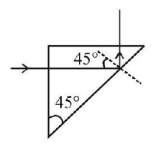
A triangular prism of glass is inside water. A ray, incident normally, on one of the faces, is totally reflected from face $$BC.$$ Then the minimum refractive index of glass is -
When white light is incident on a soap bubble it is partly reflected from upper surface and partly reflected from lower surface. These two reflected beams superpose to cause interference. The colours which satisfy the condition of maxima are visible in reflected light. So, colours of soap bubbles are caused due to interference.
64.
The magnifying power of a telescope is 9. When it is adjusted for parallel rays the distance between the objective and eyepiece is $$20\,cm.$$ The focal length of lenses are
65.
A body is located on a wall. Its image of equal size is to be obtained on a parallel wall with the help of a convex lens. The lens is placed at a distance $$d$$ ahead of second wall, then the required focal length will be
A
only $$\frac{d}{4}$$
B
only $$\frac{d}{2}$$
C
more than $$\frac{d}{4}$$ but less than $$\frac{d}{2}$$
D
less than $$\frac{d}{4}$$
Answer :
only $$\frac{d}{2}$$
For equal size of image and object, object must be placed of centre of curvature of lens i.e. $$u = v$$
The lens formula can be written as
$$\frac{1}{f} = \frac{1}{v} - \frac{1}{u}\,......\left( {\text{i}} \right)$$
Given, $$v = d$$
For equal sized image,
$$\left| v \right| = \left| u \right| = d$$
By sign convention,
$$\eqalign{
& u = - d \cr
& \therefore \frac{1}{f} = \frac{1}{d} + \frac{1}{d}\,\,{\text{or}}\,\,f = \frac{d}{2} \cr} $$
66.
The focal lengths of objective lens and eye lens of a Galilean telescope are respectively $$30\,cm$$ and $$3.0\,cm.$$ telescope produces virtual, erect image of an object situated far away from it at least distance of distinct vision from the eye lens. In this condition, the magnifying power of the Galilean telescope should be:
A
$$+ 11.2$$
B
$$- 11.2$$
C
$$- 8.8$$
D
$$+ 8.8$$
Answer :
$$+ 8.8$$
Given, Focal length of objective, $${f_0} = 30\,cm$$
focal length of eye lens, $${f_e} = 3.0\,cm$$
Magnifying power, $$M = ?$$
Magnifying power of the Galilean telescope,
$$\eqalign{
& {M_D} = \frac{{{f_0}}}{{{f_e}}}\left( {1 - \frac{{{f_e}}}{D}} \right) = \frac{{30}}{3}\left( {1 - \frac{3}{{25}}} \right)\,\,\left[ {\because D = 25\,cm} \right] \cr
& = 10 \times \frac{{22}}{{25}} = 8.8\,cm \cr} $$
67.
A man is $$6\,ft$$ tall. In order to see his entire image, he requires a plane mirror of minimum length equal to
A
$$6\,ft$$
B
$$12\,ft$$
C
$$2\,ft$$
D
$$3\,ft$$
Answer :
$$3\,ft$$
The minimum size of plane mirror required to see full length of a man $$ = \frac{{{\text{height of man}}}}{2}$$
Given, height of man $$= 6\,ft$$
Thus, minimum size of plane mirror $$ = \frac{6}{2} = 3\,ft$$
68.
A convex lens is put $$10\,cm$$ from a light source and it makes a sharp image on a screen, kept $$10\,cm$$ from the lens. Now a glass block (refractive index 1.5) of $$1.5\,cm$$ thickness is placed in contact with the light source. To get the sharp image again, the screem is shifted by a distance $$d.$$ Then $$d$$ is:
A
$$1.1\,cm$$ away from the lens
B
0
C
$$0.55\,cm$$ towards the lens
D
$$0.55\,cm$$ away from the lens
Answer :
$$0.55\,cm$$ away from the lens
As the object and image distance is same, object is placed at $$2\,f,$$ Therefore $$2\,f = 10$$
or $$f = 5\,cm.$$
Shift due to slab, $$d = t\left( {1 - \frac{1}{\mu }} \right)$$
in the direction of incident ray
$$ \Rightarrow \,\,d = 1.5\left( {1 - \frac{2}{3}} \right) = 0.5\,cm$$
Now, $$u = - 9.5\,cm$$
Again using lens formulas $$\frac{1}{v} - \frac{1}{{ - 9.5}} = \frac{1}{5}$$
⇒ $$v = 10.55\,cm$$
Thus, screen is shifted by a distance $$d = 10.55 - 10 = 0.55\,cm\,$$ away from the lens.
69.
A glass sphere, refractive index 1.5 and radius $$10\,cm,$$ has a spherical cavity of radius $$5\,cm$$ concentric with it. A narrow beam of parallel light is directed into the sphere. Find the final image and its nature.
A
$$25\,cm$$ left of $${S_4},$$ virtual
B
$$25\,cm$$ right of $${S_4},$$ real
C
$$15\,cm$$ left of $${S_4},$$ virtual
D
$$20\,cm$$ right of $${S_4},$$ virtual
Answer :
$$25\,cm$$ left of $${S_4},$$ virtual
We will have single surface refractions successively at the four surfaces $${S_1},{S_2},{S_3}$$ and $${S_4}.$$ Do not forget to shift origin to the vertex of respective surface.
Refractive at first surface $${S_1}$$ : Light travels from air to glass.
$$\eqalign{
& \frac{{1.5}}{{{v_1}}} - \frac{1}{\infty } = \frac{{1 - 1.5}}{{\left( { + 10} \right)}} \cr
& {v_1} = 30\,cm \cr} $$
First image is object for the refraction at second surface. For refraction at surface $${S_2}$$ : Light travels from glass to air
$$\eqalign{
& \frac{1}{{{v_2}}} - \frac{{1.5}}{{\left( { + 25} \right)}} = \frac{{1 - 1.5}}{{\left( + \right)5}} \cr
& {v_2} = - 25\,cm \cr} $$
For refraction at surface $${S_3}$$ : Light travels from air to glass.
$$\eqalign{
& \frac{{1.5}}{{{v_3}}} - \frac{1}{{\left( { - 35} \right)}} = \frac{{\left( {1.5 - 1} \right)}}{{\left( { - 5} \right)}} \cr
& {v_3} = \frac{{ - 35}}{3}cm \cr} $$
For refraction at surface $${S_4}$$ : Light travels from glass to air
similarly, $${v_4} = - 25\,cm$$
The final image is virtual, formal at $$25\,cm$$ to the left of the vertex of surface $${S_4}.$$
70.
In the Young’s double-slit experiment, the intensity of light at a point on the screen (where the path difference is $$\lambda $$) is $$K,$$ ($$\lambda $$ being the wavelength of light used). The intensity at a point where the path difference is $$\frac{\lambda }{4},$$ will be
A
$$K$$
B
$$\frac{K}{4}$$
C
$$\frac{K}{2}$$
D
zero
Answer :
$$\frac{K}{2}$$
For net intensity
$$I' = 4{I_0}{\cos ^2}\frac{\phi }{2}$$
For the first case, $$K = 4{I_0}{\cos ^2}\left[ \pi \right]\because \left( {\phi = \frac{{2\pi }}{\lambda } \times \lambda } \right)$$
$$K = 4{I_0}\,......\left( \operatorname{i} \right)$$
For the second case,
$$\eqalign{
& K' = 4{I_0}{\cos ^2}\left( {\frac{{\frac{\pi }{2}}}{2}} \right) \cr
& \because \left( {\phi = \frac{{2\pi }}{\lambda } \times \frac{\lambda }{4}} \right) \cr
& K' = 2{I_0}\,......\left( {{\text{ii}}} \right) \cr} $$
Comparing Eqs. (i) and (ii), we get
$$K' = \frac{K}{2}$$