Ray Optics MCQ Questions & Answers in Optics and Wave | Physics
Learn Ray Optics MCQ questions & answers in Optics and Wave are available for students perparing for IIT-JEE, NEET, Engineering and Medical Enternace exam.
71.
Spherical aberration in a thin lens can be reduced by
A
using a monochromatic light
B
using a doublet combination
C
using a circular annular mark over the lens
D
increasing the size of the lens.
Answer :
using a circular annular mark over the lens
Spherical aberration occurs due to the inability of a lens to converge marginal rays of the same wavelength to the focus as it converges the paraxial rays. This can
be done by using a circular annular mask over the lens.
72.
A concave mirror for face viewing has focal length of $$0.4\,m.$$ The distance at which you hold the mirror from your face in order to see your image upright with a magnification of 5 is:
73.
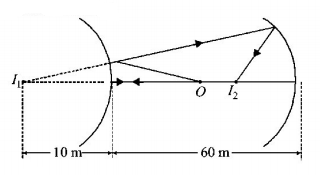
Two mirrors, one concave and the other convex, are placed $$60\,cm$$ apart with their reflecting surfaces facing each other. An object is placed $$30\,cm$$ from the pole of either of them on their axis. If the focal lengths of both the mirrors are $$15\,cm,$$ the position of the image formed by reflection, first at the convex and then at the concave mirror, is :
A
$$19.09\,cm$$ from the pole of the concave mirror
B
$$19.09\,cm$$ from the pole of the convex mirror
C
$$11.09\,cm$$ from the pole of the concave mirror
D
$$11.09\,cm$$ from the pole of the convex mirror
Answer :
$$19.09\,cm$$ from the pole of the concave mirror
Interference phenomenon is shown by both light and sound waves.
75.
The refractive index of the material of the prism is $$\sqrt 3 ,$$ then the angle of minimum deviation of the prism is
A
$${30^ \circ }$$
B
$${45^ \circ }$$
C
$${60^ \circ }$$
D
$${75^ \circ }$$
Answer :
$${60^ \circ }$$
The refractive index of material of prism (from Snell's law) is $$\mu = \frac{{\sin i}}{{\sin r}}$$
Here, $$i = \frac{{A + {\delta _m}}}{2}\,\,{\text{and}}\,\,r = \frac{A}{2}$$
where, $$A$$ is the angle of prism and $${{\delta _m}}$$ the angle of minimum deviation.
In case of minimum deviation, refractive index of prism is given by
$$\eqalign{
& \mu = \frac{{\sin \left( {\frac{{A + {\delta _m}}}{2}} \right)}}{{\sin \frac{A}{2}}} \cr
& {\text{Given,}}\,\mu = \sqrt 3 ,\,A = {60^ \circ }\,\,\left( {{\text{for}}\,{\text{prism}}} \right) \cr
& {\text{Thus,}}\,\,\sqrt 3 = \frac{{\sin \left( {\frac{{60 + {\delta _m}}}{2}} \right)}}{{\sin {{30}^ \circ }}} \cr
& {\text{or}}\,\,\sin \left( {\frac{{60 + {\delta _m}}}{2}} \right) = \frac{1}{2} \times \sqrt 3 \cr
& {\text{or}}\,\,\sin \left( {\frac{{60 + {\delta _m}}}{2}} \right) = \sin {60^ \circ } \cr
& {\text{or}}\,\,\frac{{60 + {\delta _m}}}{2} = 60 \cr
& {\text{or}}\,\,{\delta _m} = 2 \times 60 - 60 = {60^ \circ } \cr} $$
76.
A planoconvex lens is made of material of refractive index 1.6. The radius of curvature of the curved surface is $$60\,cm.$$ The focal length of the lens is
A
$$50\,cm$$
B
$$100\,cm$$
C
$$200\,cm$$
D
$$400\,cm$$
Answer :
$$100\,cm$$
According to Lens maker's formula, focal length of lens is given by
$$\frac{1}{f} = \left( {\mu - 1} \right)\left( {\frac{1}{{{R_1}}} - \frac{1}{{{R_2}}}} \right)\,......\left( {{\text{ii}}} \right)$$
We know that for planoconvex lens, the radius of curvature of plane surface is infinite,
$$\eqalign{
& {\text{i}}{\text{.e}}{\text{.}}\,\,{R_2} = \infty . \cr
& {\text{Given,}}\,\,{R_1} = 60\,cm,\mu = 1.6 \cr} $$
Substituting the given values in Eq. (i), we get
$$\frac{1}{f} = \left( {1.6 - 1} \right)\left( {\frac{1}{{60}} - \frac{1}{\infty }} \right) = 0.6 \times \frac{1}{{60}}$$
∴ Focal length of plane convex lens
$$f = \frac{{60}}{{0.6}} = 100\,cm$$
77.
There is a prism with refractive index equal to $$\sqrt 2 $$ and the refracting angle equal to $${30^ \circ }.$$ One of the refracting surface of the prism is polished. A beam of monochromatic will retrace its path if its angle of incidence over the refracting surface of the prism is
A
$${0^ \circ }$$
B
$${30^ \circ }$$
C
$${45^ \circ }$$
D
$${60^ \circ }$$
Answer :
$${45^ \circ }$$
The ray $$OR$$ will retrace its path, when
$$\eqalign{
& \angle ARQ = {90^ \circ },\angle r = {30^ \circ } \cr
& \therefore \angle AQR = {90^ \circ } - {30^ \circ } = {60^ \circ } \cr} $$
As from Snell's law,
$$\eqalign{
& \sin i \times 1 = \sin r \times \mu \cr
& \sin i = \mu \sin r = \sqrt 2 \sin {30^ \circ }\,\left[ {{\text{Refractive index of air}} = 1} \right] \cr
& = \sqrt 2 \times \frac{1}{2} = \frac{1}{{\sqrt 2 }} \cr
& \therefore \angle i = {45^ \circ } \cr} $$
78.
Electromagnetic radiation of frequency $$v,$$ velocity $$v$$ and wavelength $$\lambda ,$$ in air, enters a glass slab of refractive index $$\mu .$$ The frequency, wavelength and velocity of light in the glass slab will be, respectively
A
$$\frac{v}{\mu },\frac{\lambda }{\mu },v$$
B
$$v,\lambda ,\frac{v}{\mu }$$
C
$$v,\frac{\lambda }{\mu },\frac{v}{\mu }$$
D
$$\frac{v}{\mu },\frac{\lambda }{\mu },\frac{v}{\mu }$$
When electromagnetic wave enters in other medium, frequency remains unchanged while wavelength and velocity become $$\frac{1}{\mu }$$ times.
So, after entering from air to glass slab of refractive index $$\left( \mu \right),$$ frequency remains $$\nu ,$$ wavelength $$\lambda ' = \frac{\lambda }{\mu }$$ and velocity of light $$v' = \frac{v}{\mu }.$$
79.
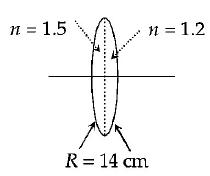
A bi - convex lens is formed with two thin plano - convex lenses as shown in the figure. Refractive index $$n$$ of the first lens is 1.5 and that of the second lens is 1.2. Both the curved surface are of the same radius of curvature $$R = 14\,cm.$$ For this biconvex lens, for an object distance of $$40\,cm,$$ the image distance will be
A
$$- 280.0\,cm$$
B
$$40.0\,cm$$
C
$$21.5\,cm$$
D
$$13.3\,cm$$
Answer :
$$40.0\,cm$$
The focal length $$\left( {{f_1}} \right)$$ of the lens with $$n = 1.5$$ is given by
$$\eqalign{
& \frac{1}{{{f_1}}} = \left( {{n_1} - 1} \right)\left[ {\frac{1}{{{R_1}}} - \frac{1}{{{R_2}}}} \right] \cr
& = \left( {1.5 - 1} \right)\left[ {\frac{1}{{14}} - \frac{1}{\infty }} \right] \cr
& = \frac{1}{{28}} \cr} $$
The focal length $$\left( {{f_2}} \right)$$ of the lens with $$n = 1.2$$ is given by
$$\eqalign{
& \frac{1}{{{f_2}}} = \left( {{n_2} - 1} \right)\left[ {\frac{1}{{{R_1}}} - \frac{1}{{{R_2}}}} \right] \cr
& = \left( {1.2 - 1} \right)\left[ {\frac{1}{\infty } - \frac{1}{{ - 14}}} \right] \cr
& = \frac{1}{{70}} \cr} $$
The focal length $$F$$ of the combination is
$$\frac{1}{F} = \frac{1}{{{f_1}}} + \frac{1}{{{f_2}}} = \frac{1}{{20}}$$
Applying lens formula for the combination of lens
$$\eqalign{
& \frac{1}{V} - \frac{1}{U} = \frac{1}{F} \cr
& \Rightarrow \,\,\frac{1}{V} - \frac{1}{{ - 40}} = \frac{1}{{20}} \cr
& \Rightarrow \,\,V = 40\,cm \cr} $$
80.
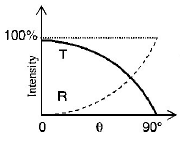
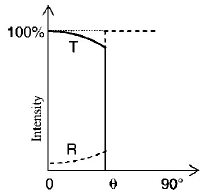
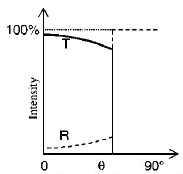
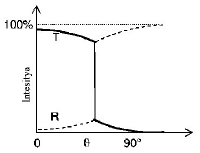
A light ray travelling in glass medium is incident on glass air interface at an angle of incidence $$\theta .$$ The reflected $$(R)$$ and transmitted $$(T)$$ intensities, both as function of $$\theta ,$$ are plotted. The correct sketch is
A
B
C
D
Answer :
When the light is incident on glass - an interface at an angle less than critical angle a small part of light will be reflected and most part will be transmitted.
When the light is incident greater than the critical angle, it gets completed reflected (total internal reflection) These characteristics are depicted in option (C).