201.
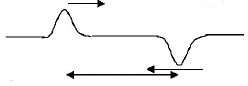
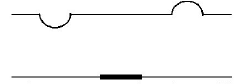
Two pulses in a stretched string whose centers are initially $$8\,cm$$ apart are moving towards each other as shown in the figure. The speed of each pulse is $$2\,cm/s.$$ After 2 seconds, the total energy of the pulses will be
A
zero
B
purely kinetic
C
purely potential
D
partly kinetic and partly potential
Answer :
purely kinetic
202. Two waves are represented by the equations $${y_1} = a\sin \left( {\omega t + kx + 0.57} \right)m$$ and $${y_2} = a\cos \left( {\omega t + kx} \right)m,$$ where $$x$$ is in metre and $$t$$ in second. The phase difference between them is
A
$$1.25\,rad$$
B
$$1.57\,rad$$
C
$$0.57\,rad$$
D
$$1\,rad$$
Answer :
$$1\,rad$$
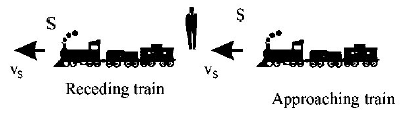
203. A man is watching two trains, one leaving and the other coming in with equal speeds of $$4\,m/\sec.$$ If they sound their whistles, each of frequency $$240\,Hz,$$ the number of beats heard by the man (velocity of sound in air $$= 320\,m/\sec$$ ) will be equal to
A
6
B
3
C
0
D
12
Answer :
6
204. Two waves of same frequency and intensity superimpose on each other in opposite phases. After the superposition, the intensity and frequency of waves will
A
increase
B
decrease
C
remain constant
D
become zero
Answer :
become zero
205. When a sound wave goes from one medium to another, the quantity that remains unchanged is
A
frequency
B
amplitude
C
wavelength
D
speed
Answer :
frequency
206. Two waves are said to be coherent, if they have
A
same phase but different amplitude
B
same frequency but different amplitude
C
same frequency, phase and amplitude
D
different frequency, phase and amplitude
Answer :
same frequency, phase and amplitude
207. A string is stretched between fixed points separated by $$75.0\,cm.$$ It is observed to have resonant frequencies of $$420\,Hz$$ and $$315\,Hz.$$ There are no other resonant frequencies between these two. Then, the lowest resonant frequency for this string is
A
$$105\,Hz$$
B
$$1.05\,Hz$$
C
$$1050\,Hz$$
D
$$10.5\,Hz$$
Answer :
$$105\,Hz$$